Hai Collection, Middle Volume
Radical: Bird (niǎo)
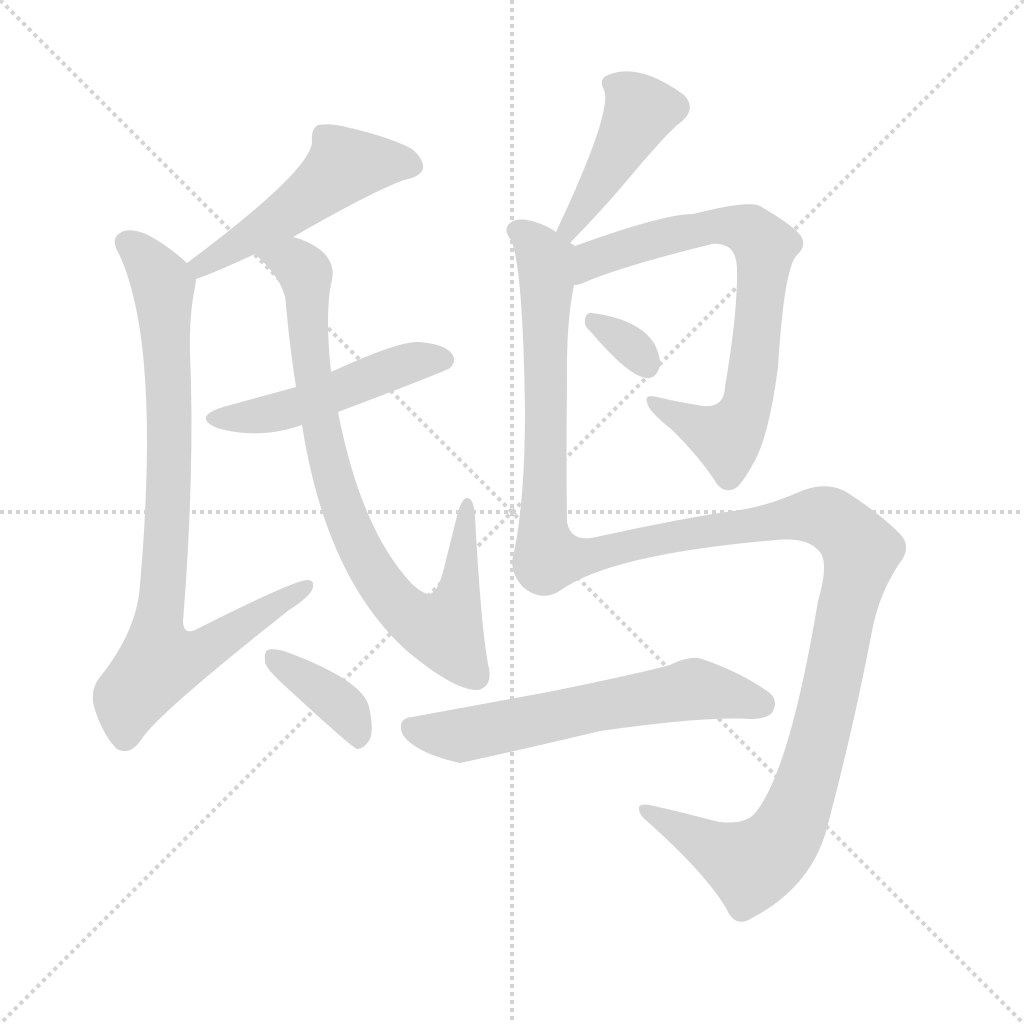
Chi
Kangxi stroke count: 16
Page 1486, Entry 01
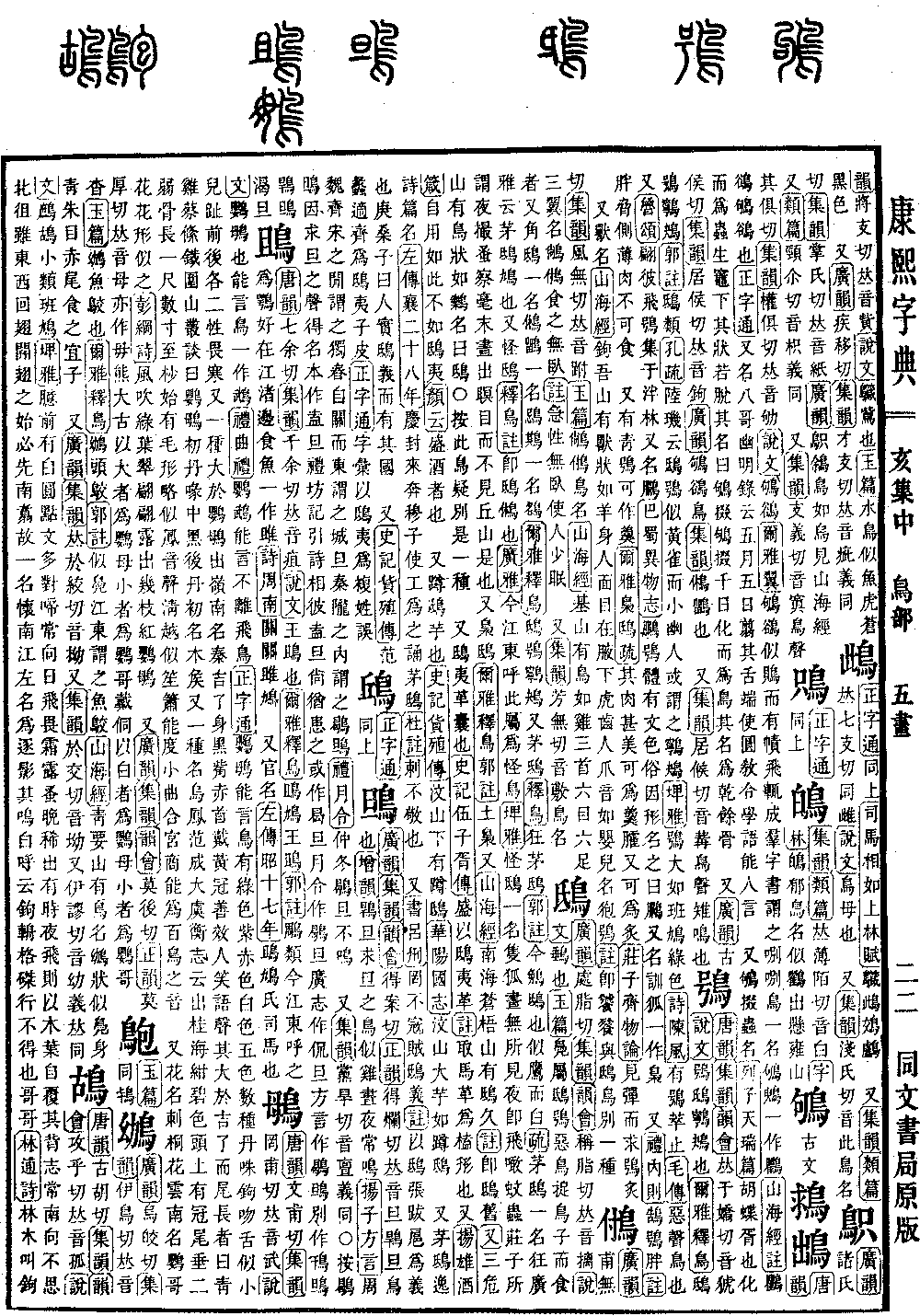
Guangyun: Pronounced chi. Jiyun and Yunhui: Pronounced chi.
Shuowen Jiezi: A bird of prey.
Yupian: A type of wild duck. The chi-xiao is an ominous bird that catches and eats the young of other birds.
Also known as the jiao-chi, also called the xiu-liu, the ji, or the ge.
Erya, Explanation of Birds: The chi-xiao is the ning-jue.
Also known as the mao-chi. Erya states: The kuang is the mao-chi. Guo Pu commentary: It is the current tu-chi. It resembles a hawk but is white. The commentary notes: The mao-chi is also called the kuang. Guangya states: The mao-chi is a dove.
Also known as the guai-chi. Erya commentary: This is the chi-xiu. Guangya states: In the Jiangdong region, this type is called a strange bird. Piya states: The guai-chi, also called the zhi-hu, is not seen during the day but flies at night to eat mosquitoes and insects. This is what Zhuangzi refers to as capturing a flea at night and inspecting the tip of a hair, yet emerging during the day and closing its eyes so as not to see a mountain.
Also known as xiao-chi. Erya, Explanation of Birds, Guo Pu commentary: The tu-xiao.
Classic of Mountains and Seas: In the Cangwu Mountains of the South Sea, there is a bird called the chi-jiu. Commentary: This is the chi-jiu. Also, in the Sanwei Mountains, there is a bird shaped like a chi, named the chi. Note: This bird is suspected to be a distinct species.
Also chi-yi, a leather wine sack. Records of the Grand Historian (Shiji), Biography of Wu Zixu: Filled with a chi-yi leather sack. Commentary: It is a vessel made from horse hide.
Yang Xiong, Wine Admonition: Acting on one's own like this is inferior to a chi-yi. Yan Shigu note: A vessel for containing wine.
Also cun-chi, a type of taro. Records of the Grand Historian (Shiji), Biographies of Money-makers: Under Mount Wen, there is the cun-chi. Huayang Guo Zhi: In Mount Wen, there are large taros resembling a squatting owl (cun-chi).
Also Mao-chi, the title of a lost poem. Zuo Zhuan, 28th Year of Duke Xiang: When Qing Feng came to seek refuge, Muzi ordered the musicians to chant the Mao-chi for him. Du Yu note: A satire on the lack of respect.
Book of Documents (Shujing), Counsels of Lu: To act with the arrogance of an owl. Note: To act with the arrogance of an owl means to act with the predatory spread of wings and unrestrained insolence. Gengsangzi says: A person who is truly predatory and insolent possesses the state.
Records of the Grand Historian (Shiji), Biographies of Money-makers: Fan Li went to Qi and became known as the Master of the Leather Sack (Chiyi Zhipi). Zhengzitong: The Zihui dictionary incorrectly treats the term chiyi as a double-character surname.
Textual verification:
Book of Documents (Shujing), Counsels of Lu: There is no one who is not a traitorous owl. Note: To act with the arrogance of an owl means to act with the predatory spread of wings and unrestrained insolence. Per the original text, corrected to: Predatory and insolent. Note: Predatory and insolent means to act with the predatory spread of wings and unrestrained insolence.