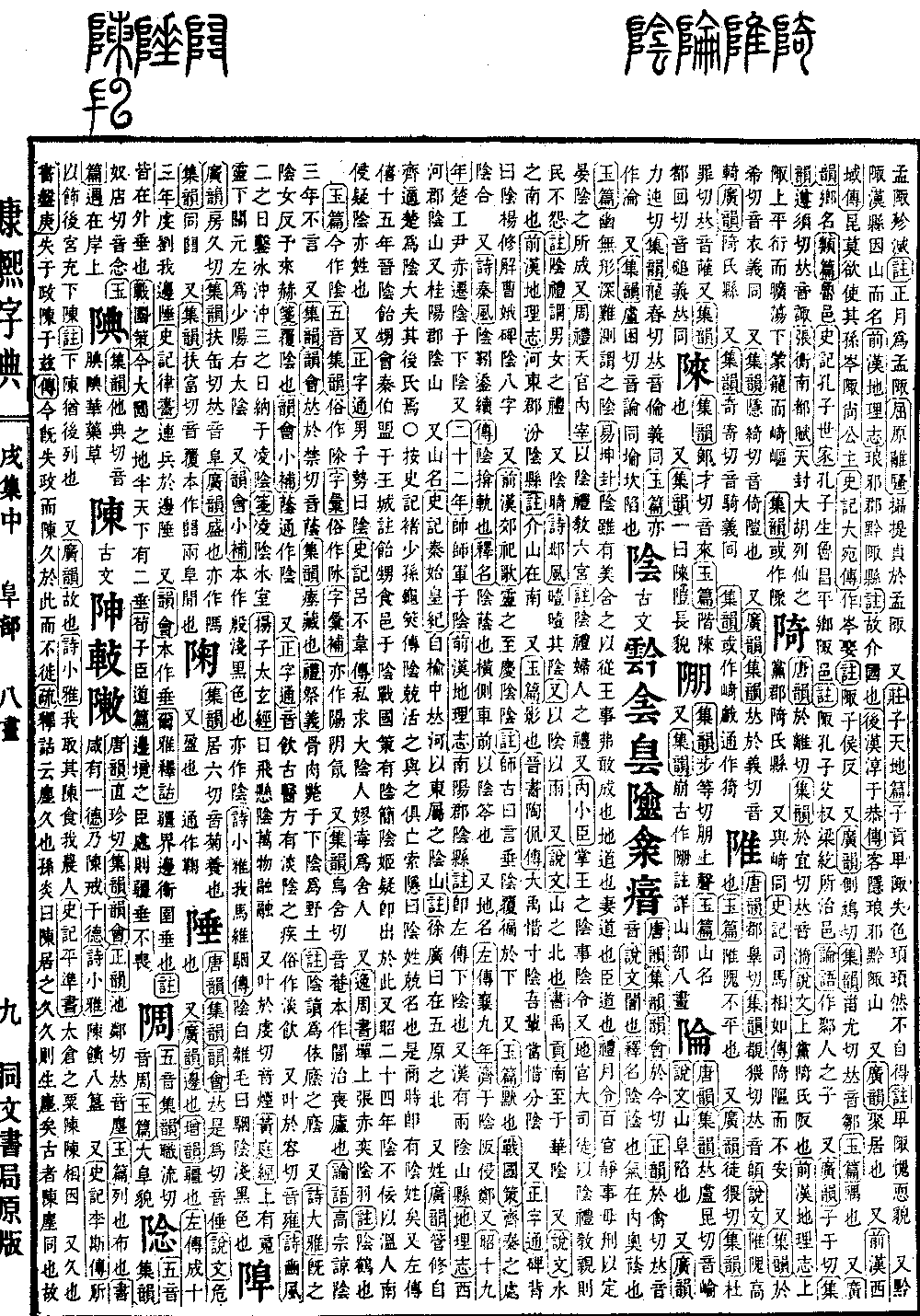
Xu Collection, Middle Volume
Radical: Mound (fù)
Kangxi Stroke Count: 16
Page Number: Page 1353, Entry 19
Anciently written as variant characters chèn and chěn.
From Tang Rhyme (Tangyun): the fanqie pronunciation is zhízhēn qiē. From Jiyun (Jiyun), Yunhui (Yunhui), and Zheng Yun (Zheng Yun): the fanqie pronunciation is chílín qiē, pronounced like chén.
From Yupian (Yupian): "to arrange, to set forth."
From Book of Documents (Shangshu), "Xian You Yi De" chapter: "Thereupon, he set forth admonitions on virtue."
From Book of Odes (Shijing), "Xiao Ya" section: "They presented eight gui, a type of ritual food vessel."
Also, from Records of the Grand Historian (Shiji), "Biography of Li Si": "used to adorn the imperial harem and fill the xiàchén." [Note] Xiàchén is like a back row or lower rank.
Also, from Guangyun (Guangyun): "old."
From Book of Odes (Shijing), "Xiao Ya" section: "I take those old ones and provide for my farmers."
From Records of the Grand Historian (Shiji), "Treatise on the Equalization of Standards": "The grain in the imperial granaries, old grain accumulated with new, layer upon layer."
Also interpreted as: "long-lasting, for a long time."
From Book of Documents (Shangshu), "Pan Geng" chapter: "Policies have gone astray, and this has been so for a long time in this place." [Commentary] "Now that policies have gone astray and you reside here for a long time without moving." [Sub-commentary] "According to Explanation of Words (Shigu): chén means 'long-lasting'. Sun Yan said: 'When one resides for a long time, dust accumulates over time.' Anciently, the character chén (meaning 'dust') was interchangeable with chèn (the main character being defined). Hence, it carries the meaning of 'long-lasting'."
Also, from Guangyun (Guangyun): "to display, to make public."
From Book of Rites (Liji), "Biaoji" chapter: "When serving the ruler, one wishes to admonish, but not to display (it publicly)." [Note] "This refers to publicizing his faults to the outside."
Also, from Guangyun (Guangyun): "numerous."
Also, from Erya (Erya), "Explanation of Palaces": "The path in front of the main hall is called chèn." [Note] "Refers to the path from below the hall to inside the gate." From Explanation of Names (Shimíng): "This refers to the place where guests and host meet and line up."
From Book of Odes (Shijing), "Xiao Ya" section: "Who is that person, why does he pass along my hall's path?" [Note] "Facing the steps to the north, its south side connects to the eaves' drip-line inside the gate."
Also, a state name. From Guangyun (Guangyun): "King Wu of Zhou enfeoffed Hu Gongman, a descendant of Shun, in the State of Chen. After Chu destroyed it, it was established as a county. During the Han Dynasty, it became Huaiyang Commandery, and during the Sui Dynasty, it was established as Chen Prefecture."
Also, a surname. Descendants of Hu Gongman took the state name as their surname.
Also, from Yupian (Yupian): "sometimes written as chén."
Also, from Guangyun (Guangyun) and Jiyun (Jiyun): the fanqie pronunciation is zhírèn qiē. It is equivalent to zhèn (meaning 'military formation'). Refers to military formations. For details, see the previous entry for zhèn.
Also, a rhyming sound: dūnián qiē, pronounced like diān.
From Forest of Changes (Yilín): "Autumn grain not yet ripe, cannot be brought before me. Water too deep to cross, preventing my advance."
From Yellow Court Classic (Huangtingjing): "Fire soldiers' talismans prepared at the Spirit Pass (língguān), high in front and undulating behind. Guān is pronounced like juān."