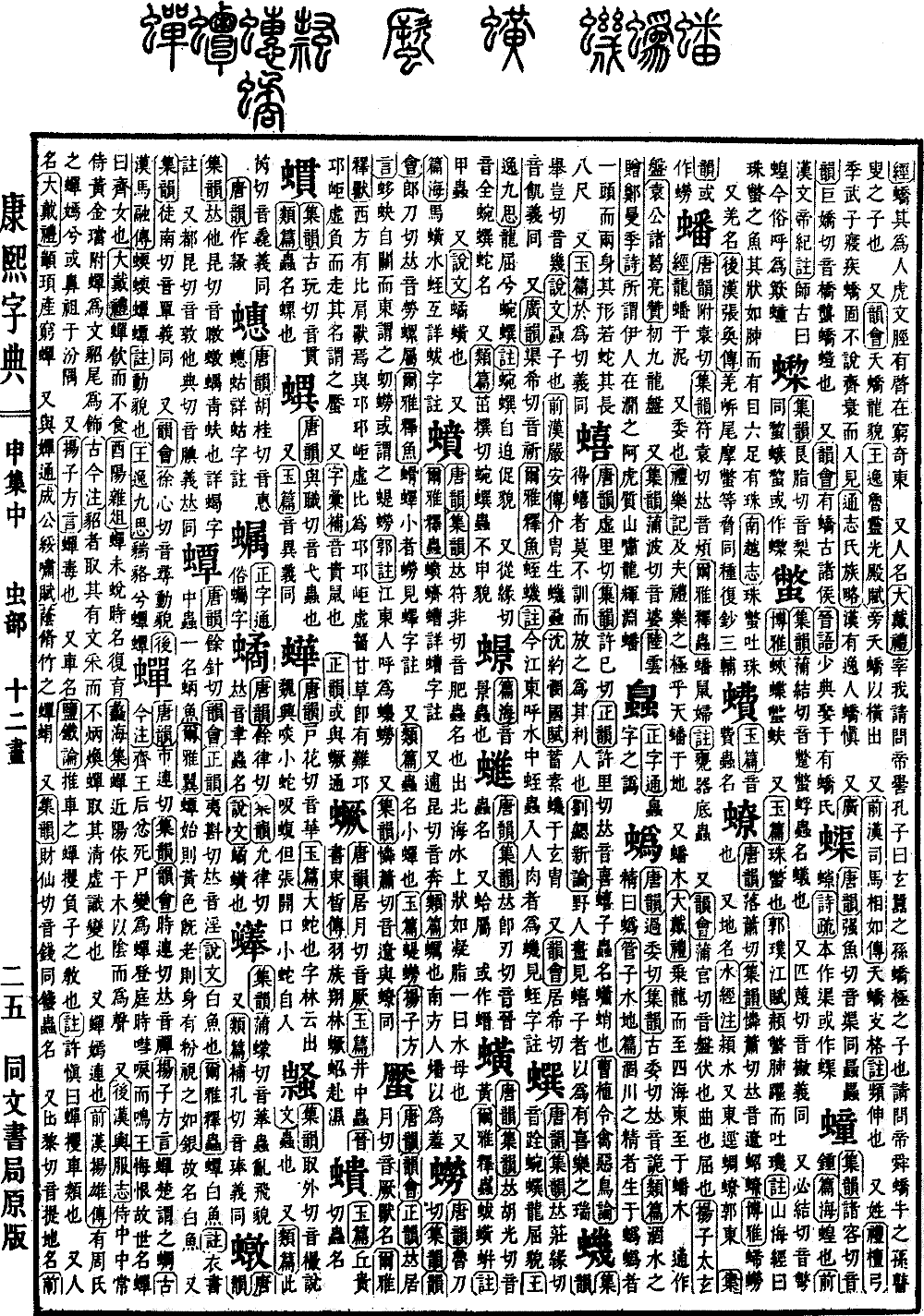
Shen Collection, Middle Volume
Radical: Insect (chóng)
Entry: Cicada
Kangxi Strokes: 18
Page 1097, Entry 01
Pronounced chan (rising tone).
In the Book of Local Languages (Fangyan), the cicada is called tiao in the Chu region.
In the Records of Ancient and Modern Matters (Gujin Zhu), it is noted that after the Queen of Qi died with a grievance, her body transformed into a cicada. It flew into the courtyard and chirped shrilly, causing the King of Qi to feel remorse; therefore, people of that age called the cicada the Lady of Qi.
In the Book of Elder Dai (Da Dai Liji), it is written that the cicada drinks only dew and consumes no food.
In the Miscellaneous Morsels from Youyang (Youyang Zazu), it is noted that before the cicada molts, it is called a fuyu.
In the Collection of Sea Shells (Lihai Ji), it is written that the cicada is close to the yang energy and clings to trees, relying on yin energy to produce its sound.
Furthermore, in the Book of the Later Han (Hou Hanshu), it is recorded that palace attendants and regular palace attendants wore gold ear ornaments decorated with cicada motifs and adorned with sable tails.
The Records of Ancient and Modern Matters (Gujin Zhu) states that the sable was chosen because it possesses patterned beauty without being ostentatious. The cicada was chosen because it is noble, detached, and understands the changing of the seasons.
Also chanyan, meaning continuous and unbroken.
In the Book of the Former Han (Qian Hanshu), it is written that the Zhou family lineage is passed down through generations, perhaps with their earliest ancestor by the Fen River.
In the Book of Local Languages (Fangyan), it is also a term for harmful things.
Also refers to a type of carriage. In the Discourses on Salt and Iron (Yantie Lun), it mentions the chan jue carriage, which taught people how to carry children on their backs. The commentary by Xu Shen states that the chan jue is a type of carriage.
Also refers to a personal name. The Book of Elder Dai (Da Dai Liji) states that Zhuanxu gave birth to Qiongchan.
It is also used interchangeably with chan (graceful). In the Rhapsody on Whistling (Xiao Fu) by Cheng Gongshui, it describes the graceful and beautiful appearance of someone obscured by tall bamboo.
Pronounced qian. Variant form of an insect name.
Pronounced ti. A place name. In the Book of the Former Han (Qian Hanshu), it is noted that there is a Nianchan County in Lelang Commandery.
Pronounced shan. Wanchan describes a winding or convoluted appearance. In the Nine Laments (Jiusi) by Wang Yi, it mentions riding six dragons that wind and meander. The commentary describes this as the appearance of a group of dragons. Sometimes written with the character for worm and the character for eel (shan).