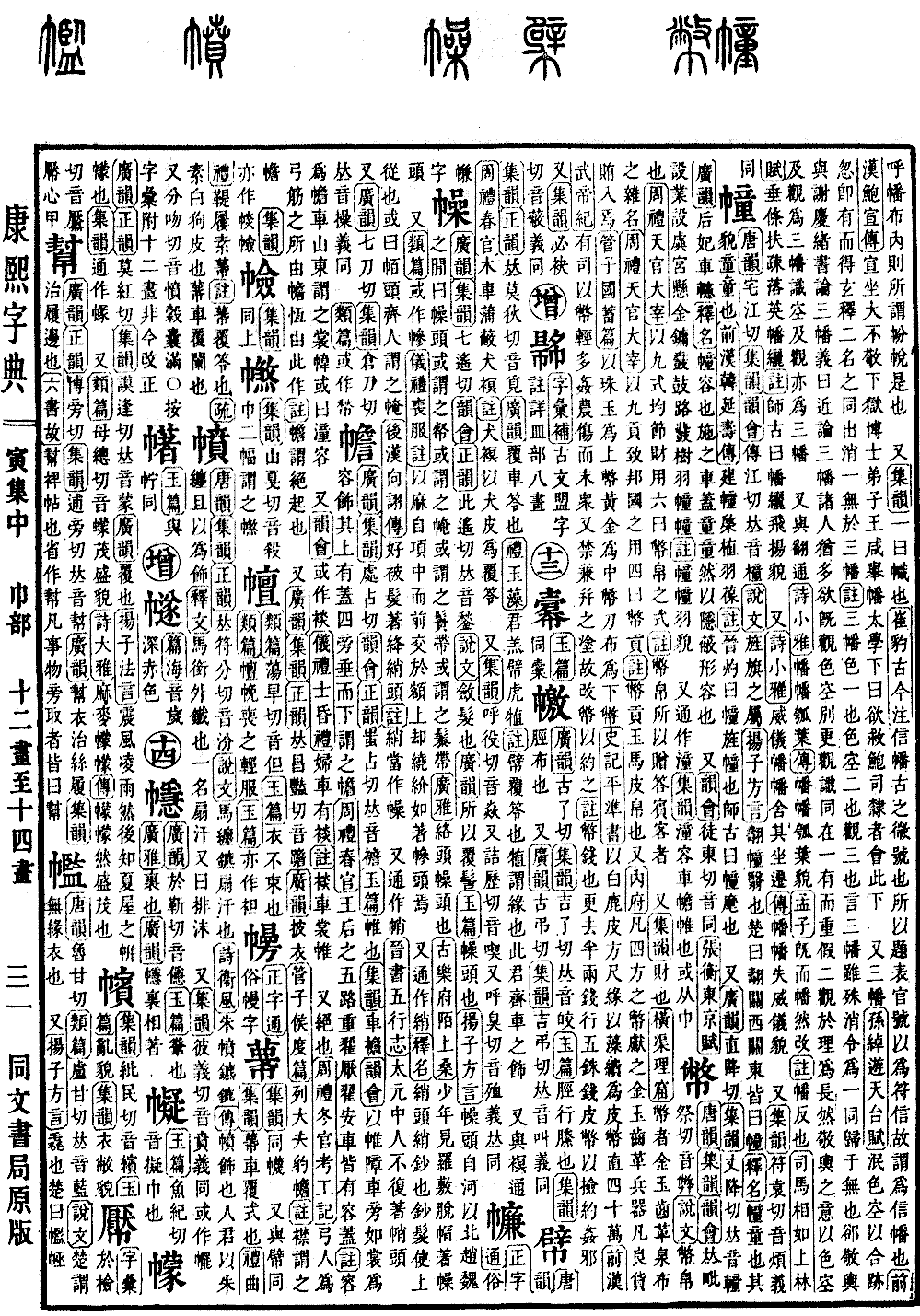
Yin Collection, Middle Volume. Radical: Cloth (bù). Kangxi stroke count: 15. Page 337, Entry 01.
Tang Rhymes (Tangyun): Pronounced chuang. Collected Rhymes (Jiyun) and Rhyme Collection (Yunhui): Pronounced chuang, sound of tong.
From Explaining Graphs (Shuowen): A type of banner or flag.
From Yangzi Dialects (Fangyan): A fan or banner, also known as an overshadowing device. In the state of Chu it is called a dao, while in the regions east and west of the pass it is known as a chuang.
From Names Defined (Shiming): The term chuang implies a childlike appearance (tong), as its shape is bushy and dense.
From History of the Former Han (Qianhan), Biography of Han Yanshou: To erect banners and halberds, and plant feather canopies. The commentary by Jin Zhuo states: A chuang is a flag or banner. The commentary by Yan Shigu states: A chuang is a military standard.
Also, from Extended Rhymes (Guangyun): Pronounced zhuang. Collected Rhymes (Jiyun): Pronounced zhuang.
From Extended Rhymes (Guangyun): The wheel guards of an empress’s carriage.
From Names Defined (Shiming): A chuang refers to containment; it is applied to a carriage cover to appear bushy, serving to screen and conceal the carriage occupants.
Also, from Rhyme Collection (Yunhui): Pronounced tong.
From Zhang Heng, Eastern Capital Rhapsody (Dongjing Fu): Arranging the racks and stands, palace bells, and golden chimes. Large drums and road rattles, set up with feathers waving (chuang chuang). The commentary notes: Chuang chuang describes the appearance of feathers.
Also written interchangeably as tong. From Collected Rhymes (Jiyun): Tong rong refers to the side curtains of a carriage. Sometimes written with the cloth radical.