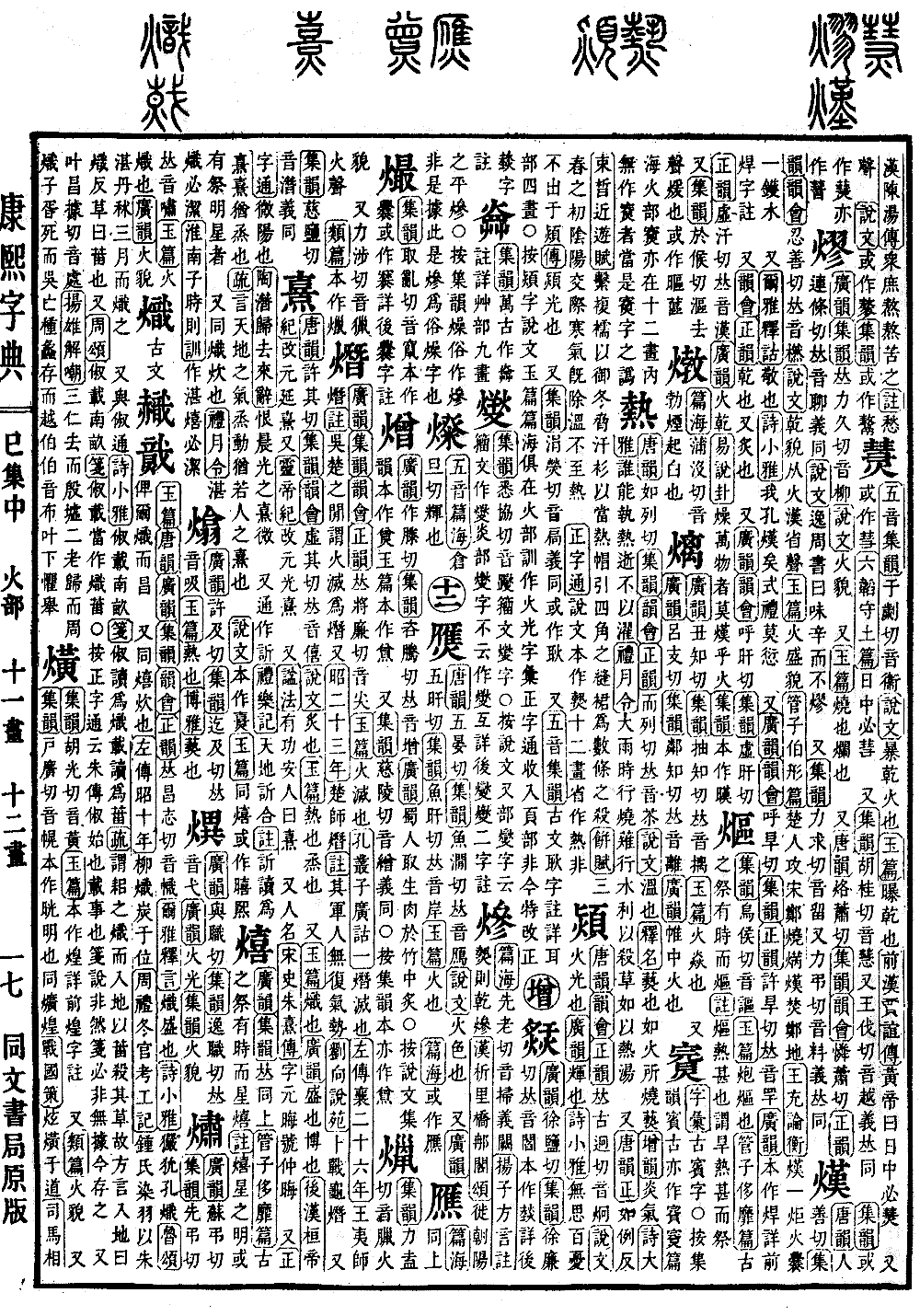
Si Collection, Middle Volume
Radical: Fire (huǒ)
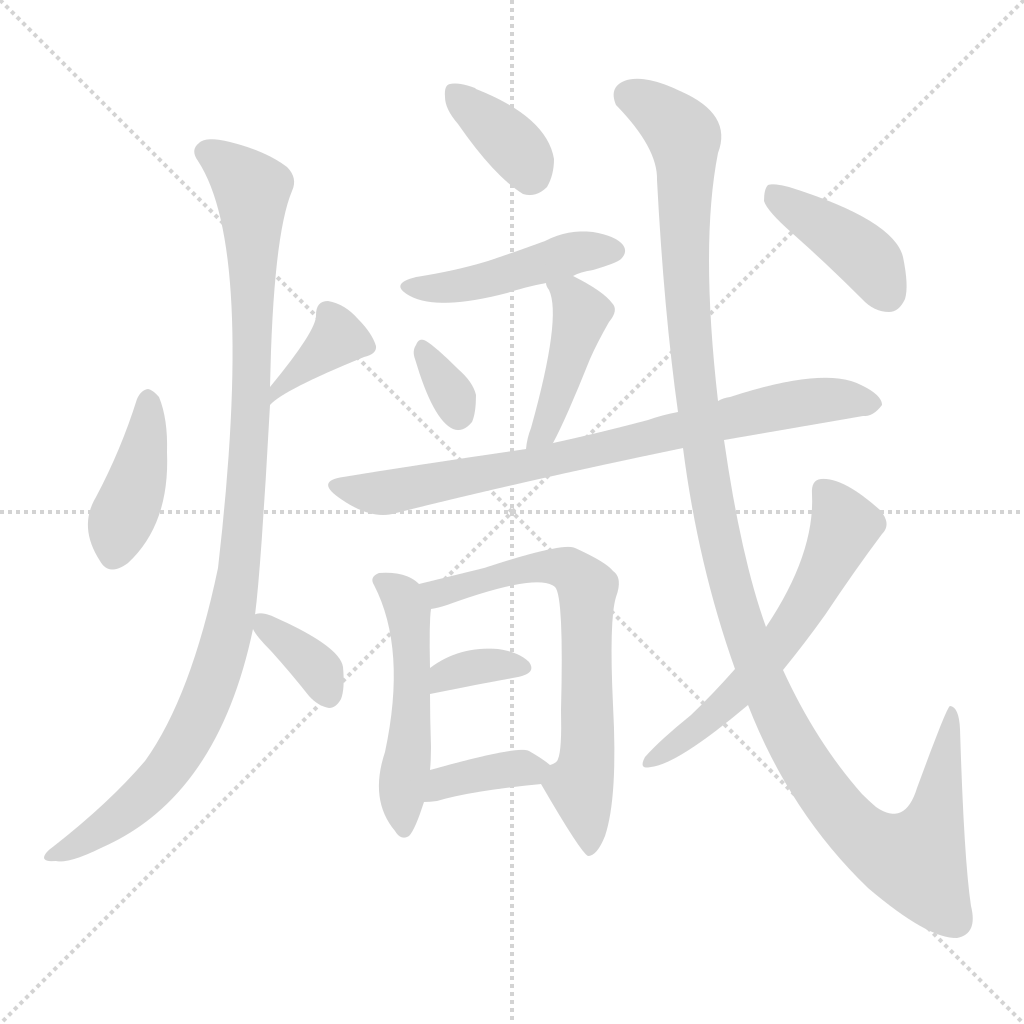
Character: chi
Kangxi Strokes: 16
Page 681, Entry 26
Ancient script forms.
Found in Jade Chapters (Yupian), Tang Rhymes (Tangyun), Broad Rhymes (Guangyun), Collected Rhymes (Jiyun), Rhyme Meetings (Yunhui), and Correct Rhymes (Zhengyun).
Pronounced chi (falling tone).
Erya, Explanation of Words: Chi means flourishing.
Book of Odes (Shijing), Lesser Odes: The Xianyun are very flourishing.
Book of Odes (Shijing), Eulogies of Lu: Let you be flourishing and prosperous.
Also identical to xi. Means to cook.
Zuo Tradition (Zuozhuan), Tenth Year of Zhao: Liu burned charcoal at the seat.
Rites of Zhou (Zhouli), Winter Officers, Artificer's Record: The Zhong family dyes feathers, soaking them in red cinnabar and glutinous millet, and after three months, they heat them.
Also interchangeable with chu.
Book of Odes (Shijing), Lesser Odes: Begin the work in the southern fields.
Commentary (Jian): Chu should be read as chi. Zai should be read as zi.
Sub-commentary (Shu): This refers to the plowshare penetrating the earth, by which the grass is killed; thus, the local dialect refers to penetrating the earth as chi, and the overturning of grass as zi.
Also, Book of Odes (Shijing), Eulogies of Zhou: Begin the work in the southern fields.
Commentary (Jian): Chu zai should be written as chi zi.
Note: The Correct Character Dictionary (Zhengzitong) states that the Zhu commentary says: Chu means to begin, and zai means matters. The commentary's explanation is incorrect. However, since the commentary must not be without foundation, it is preserved here.
Also rhymes with chu (falling tone).
Yang Xiong, Dissuasion from Ridicule: The three benevolent men departed and the Yin dynasty became ruins, the two elders returned and the Zhou dynasty flourished, the son died and the state of Wu perished, Zhong and Li remained and the state of Yue became hegemon. Hegemon is pronounced bu, rhyming with the following ju (falling tone).