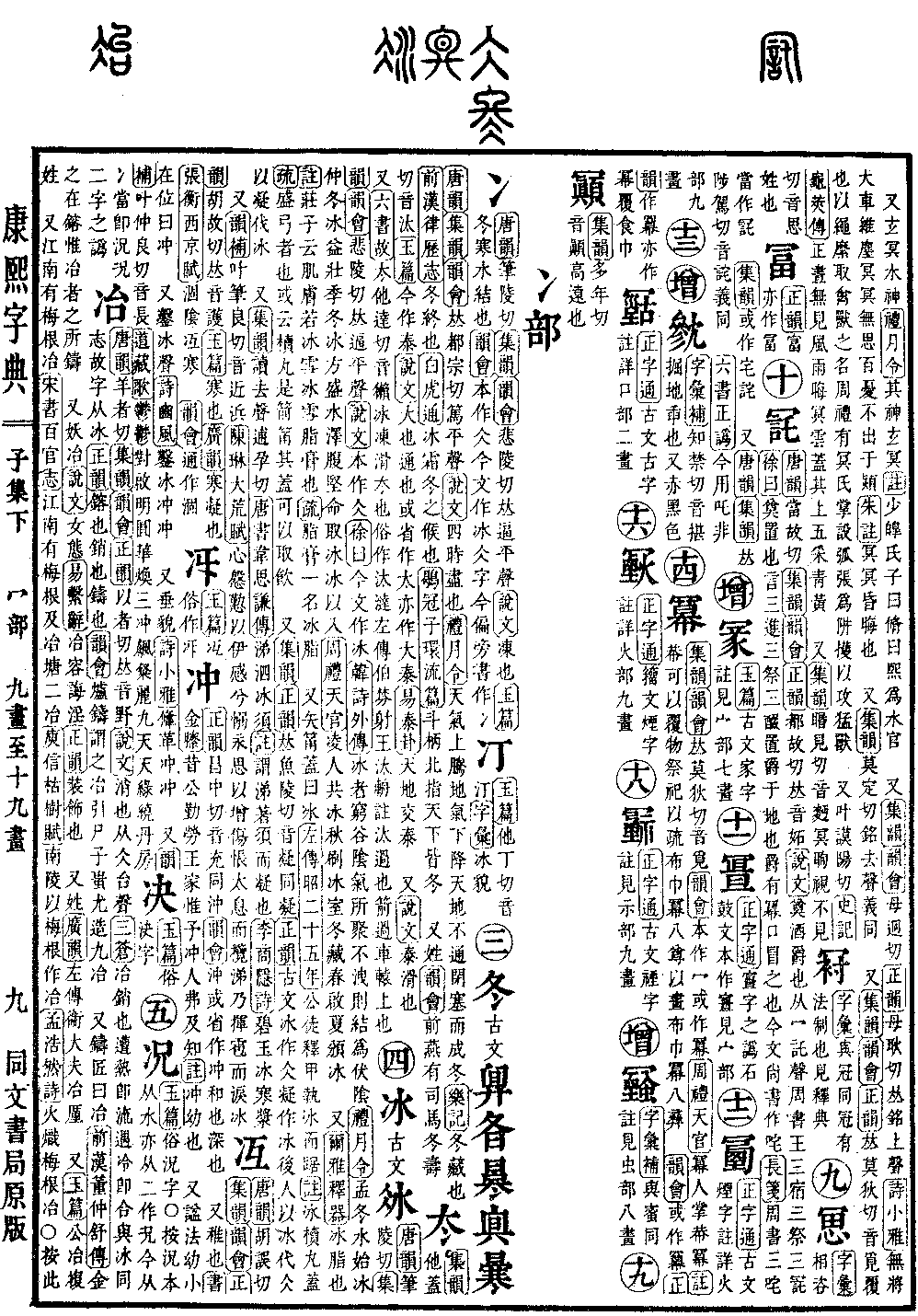
Zi Collection, Page Position: Lower, Radical: Ice (bīng)
Ice; Kangxi Dictionary Stroke Count: 6; Page: 131, Column: 24
Ancient texts record:
"Tang Yun" annotates the pronunciation as "bǐ líng qiè," and "Jiyun" and "Yunhui" annotate it as "bēi líng qiè," with a pronunciation similar to the level tone of "bī."
"Shuowen Jiezi" originally wrote it as "仌."
Xu Xuan commented that the current common usage is "冰."
"Han Shi" explains that ice is formed when the cold qi of deep mountains and secluded valleys accumulates and cannot dissipate, thus condensing into latent cold qi.
"Record of Rites - Monthly Ordinances (Liji - Yuè Lìng)" records: In early winter, water begins to freeze; in midwinter, the ice layer becomes thicker; in deep winter, the ice is at its peak. When rivers and lakes freeze solid, orders are given to collect ice and store it in ice cellars.
"Rites of Zhou - Official of the Heavens (Zhou Li - Tiān Guān)" records: The Lingren are in charge of matters related to supplying ice. In autumn, they clean the ice cellars; in winter, they store ice; in spring, they open the cellars to retrieve ice; in summer, they distribute ice.
Furthermore, "Erya - Explaining Vessels (Erya - Shì Qì)" states: Ice refers to fat and grease.
Annotation: "Zhuangzi" says: The skin is as white as ice and snow. Ice and snow refer to fat and grease.
Explanation: Fat and grease are also called ice grease.
Additionally, the lid of an arrow quiver is called "bīng."
"Zuo Zhuan - Duke Zhao, Year 25 (Zuo Zhuan - Zhāogōng Twenty-fifth Year)" records: Duke Zhao's soldiers took off their armor and squatted with their arrow quiver lids.
Annotation: Bīng refers to the lid of an arrow quiver.
Explanation: It is a container for bows. Some also say: The lid of an arrow quiver can be used to scoop and drink water.
Furthermore, "Jiyun" and "Zhengyun" annotate the pronunciation as "yú líng qiè," with the same pronunciation as "níng." It is the same as the character "níng."
"Zhengyun" explains: In ancient texts, "bīng" was written as "仌," and "níng" was written as "冰." Later people used "冰" to replace "仌," and "凝" to replace "冰."
Also, "Jiyun" reads it with a departing tone, pronounced "bū yùn qiè."
"History of Tang - Biography of Wei Sixian (Tang Shu - Wéi Sīqiān Zhuàn)" contains the phrase "tì sì bīng xū."
Annotation: This means tears flowed onto the beard and froze.
Li Shangyin's poem contains the line "bì yù bīng hán jiāng."
Also, "Yun Bu" rhymes with "bǐ liáng qiè," pronounced close to "bāng."
Chen Lin's "Ode to the Great Wilderness (Da Huang Fu)" writes: The heart is filled with earnest emotion, sorrow is long and adds to the sadness. Sighing and wiping away tears, the falling teardrops freeze into ice.
Verification:
"Han Shi Wai Zhuan" says: Ice is formed when the yin qi of deep mountains and secluded valleys accumulates and does not dissipate, thus condensing into latent cold qi. Careful note: "Han Shi Wai Zhuan" does not contain this sentence. It is cited in "Chu Xue Ji" as "Han Shi." Therefore, following the original text of "Chu Xue Ji," the characters "Wai Zhuan" are deleted. The character "Shuo" is added before "Bing zhe," and the character "er" is added after "jie."
"Zhengyun" says: In ancient texts, "bīng" was written as "仌," and "níng" was written as "冰." Later people used "冰" to replace "仌," and "凝" to replace "冰." Careful note: Based on the meaning, "fá bīng" is changed to "dài bīng."