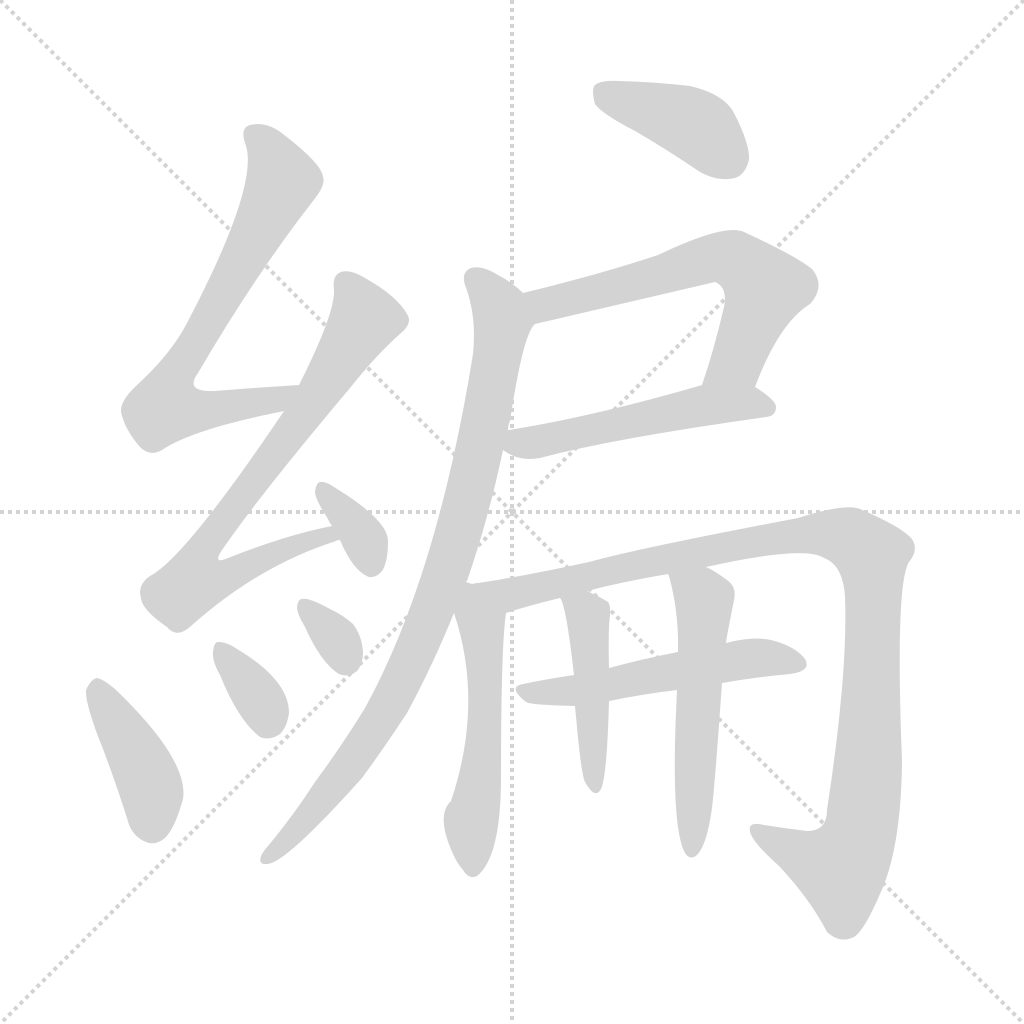
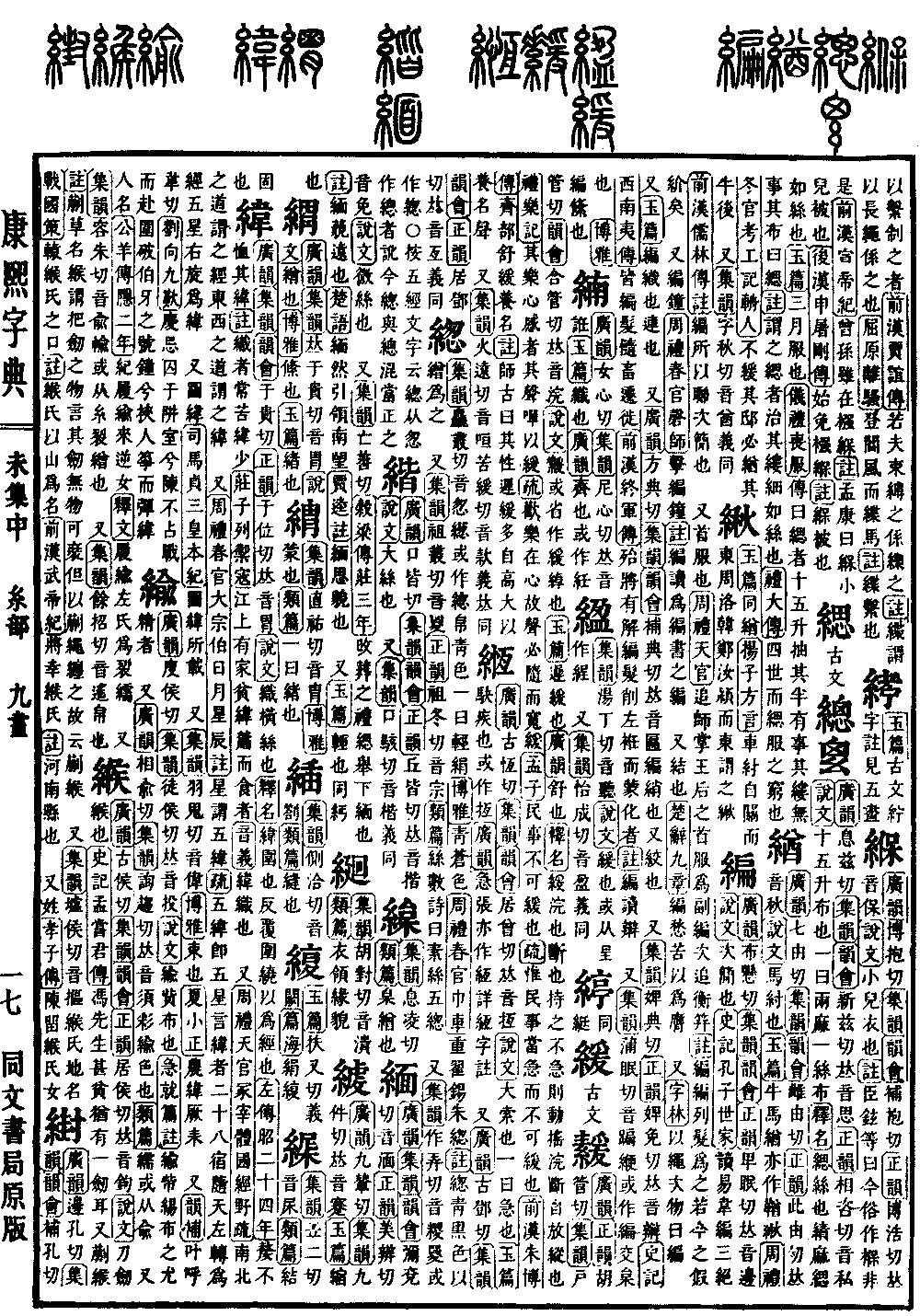
Wei Collection, Middle Volume
Radical: Silk (mì)
Kangxi Strokes: 15
Page 931, Entry 08
Pronounced bian.
Shuowen Jiezi says: to order in sequence.
Records of the Grand Historian (Shiji), Biography of Confucius: Reading the Book of Changes (Yijing), the leather binding cords broke three times.
Commentary on the History of the Former Han (Hanshu), Biographies of Confucian Scholars: To bind means to connect and sequence.
Also, a type of headwear.
Rites of Zhou (Zhouli), Offices of Heaven: The master of ritual ornaments manages the queen's headwear, arranging secondary and primary ornaments, as well as pendants and hairpins.
Commentary: To bind hair together to make it, similar to modern hairpieces.
Also, a set of bells.
Rites of Zhou, Offices of Spring: Striking a set of bells.
Commentary: The term used for binding books.
Also, to knot or tie.
Songs of Chu (Chuci), Nine Chapters: Knotting up sorrow and bitterness to form a chest.
Also, Zilin dictionary: Using rope to order items is called bian.
Also, Yupian dictionary: To weave or connect.
Also, pronounced bian.
Fine silk.
Also, to twist.
Also, pronounced bian.
Records of the Grand Historian, Biographies of the Southwest Barbarians: All have braided hair and move with their livestock.
History of the Former Han (Hanshu), Biography of Zhong Jun: There will likely be those who undo their braided hair, remove their left-lapping robes, and embrace civilization.
Commentary: To be read as bian (braid).
Also, pronounced pian.
The character bian (to weave hemp) is sometimes written as this character.
Also, Guangya dictionary: To weave into a silk cord.