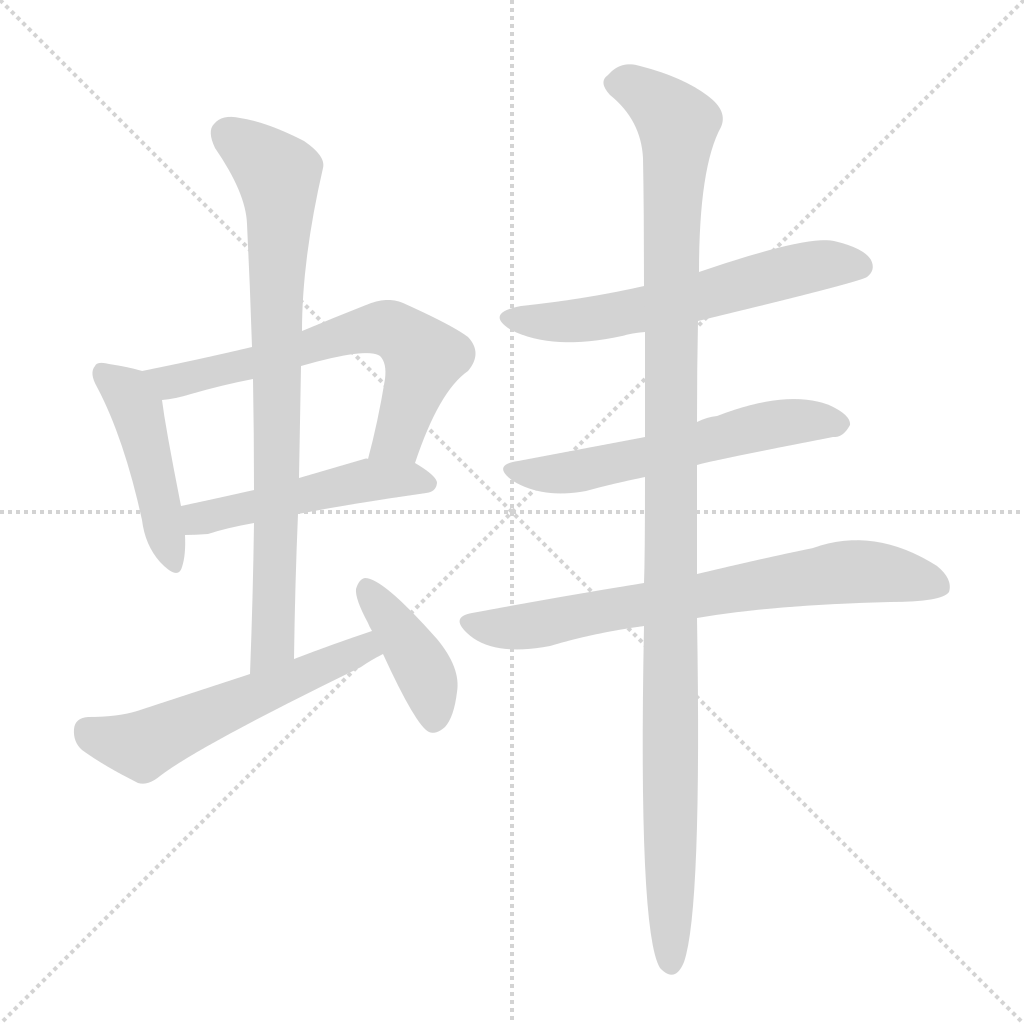
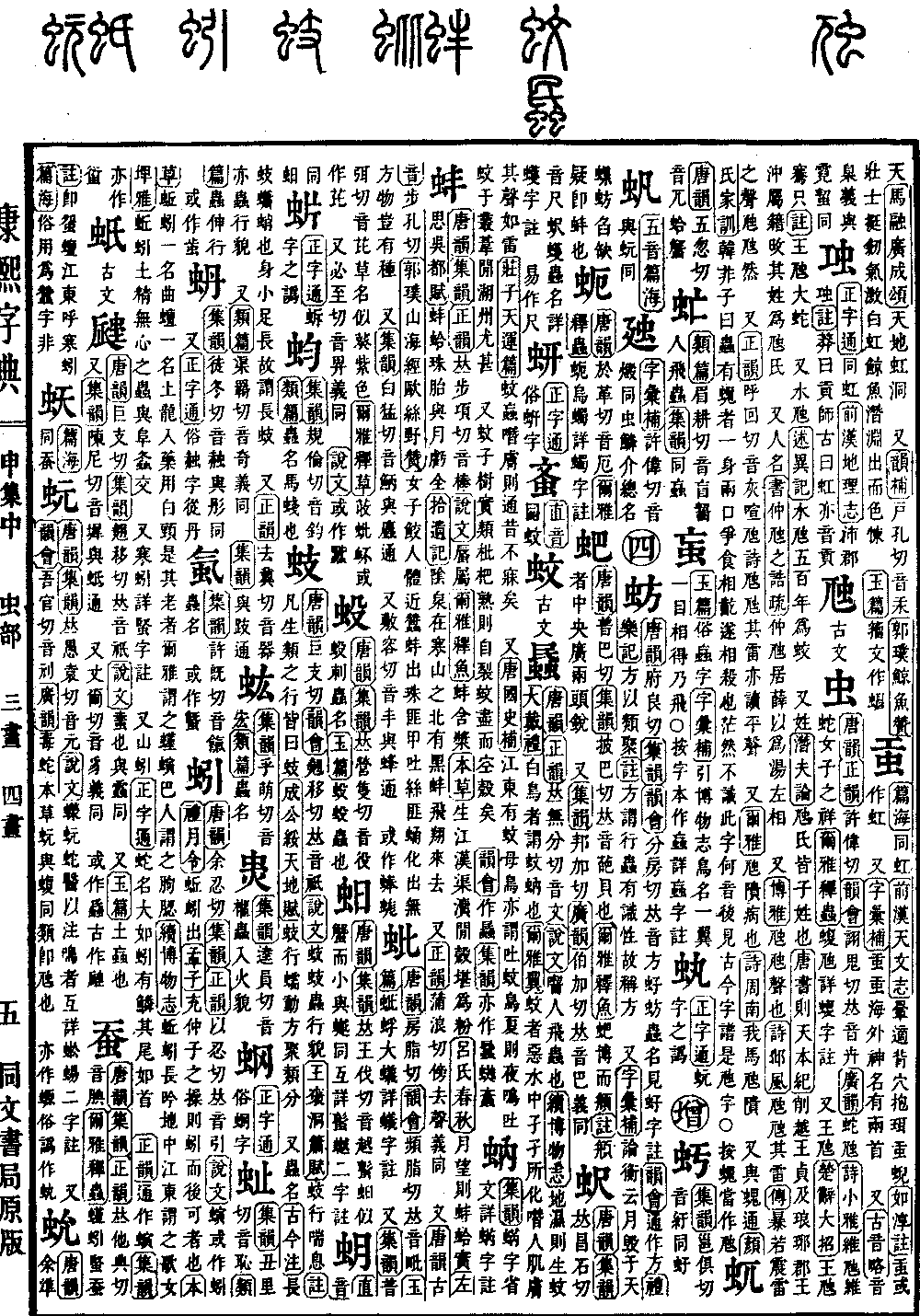
Shen Collection, Middle Volume. Radical: Insect (chóng). Kangxi strokes: 10. Page 1077, Entry 21.
Tang Rhyme (Tangyun), Collection Rhyme (Jiyun), and Orthodox Rhyme (Zhengyun) state it is pronounced bang (falling-rising tone). According to the Analytical Dictionary of Characters (Shuowen), it belongs to the clam family. Erya: Interpretation of Fish states that inside the clam, there is fluid. Materia Medica (Bencao) notes it grows in the Yangtze River, Han River, and drainage ditches; its shell can be ground into powder. Annals of Lu (Lüshi Chunqiu) states that when the moon is full, the meat of clams is plump. Zuo Si, Rhapsody on the Capital of Wu (Wu Du Fu) states that clams gestate pearls, which change according to the fullness or waning of the moon. Records of Forgotten Matters (Shiyiji) states that the Yin Spring is located north of Cold Mountain, where black clams fly to and fro.
Additionally, according to Orthodox Rhyme (Zhengyun), it is pronounced bang (falling tone). The meaning is the same.
Also, according to the archaic pronunciation in Tang Rhyme (Tangyun Guyin), as cited in Guo Pu, Praise for the Ousi Wilderness in the Classic of Mountains and Seas (Shanhaijing): Women and merfolk have bodies similar to silkworms and clams. They do not produce pearls by relying on shells, nor do they spit silk by relying on silkworm cocoons. Transformations have no fixed method; how could the ten thousand things have unchanging forms?
Additionally, according to Collection Rhyme (Jiyun), it is pronounced meng (rising tone). It is synonymous with the character pi.
Additionally, it is pronounced feng (level tone). It is synonymous with the character feng (bee). Sometimes also written in variant forms (beng) or (beng).