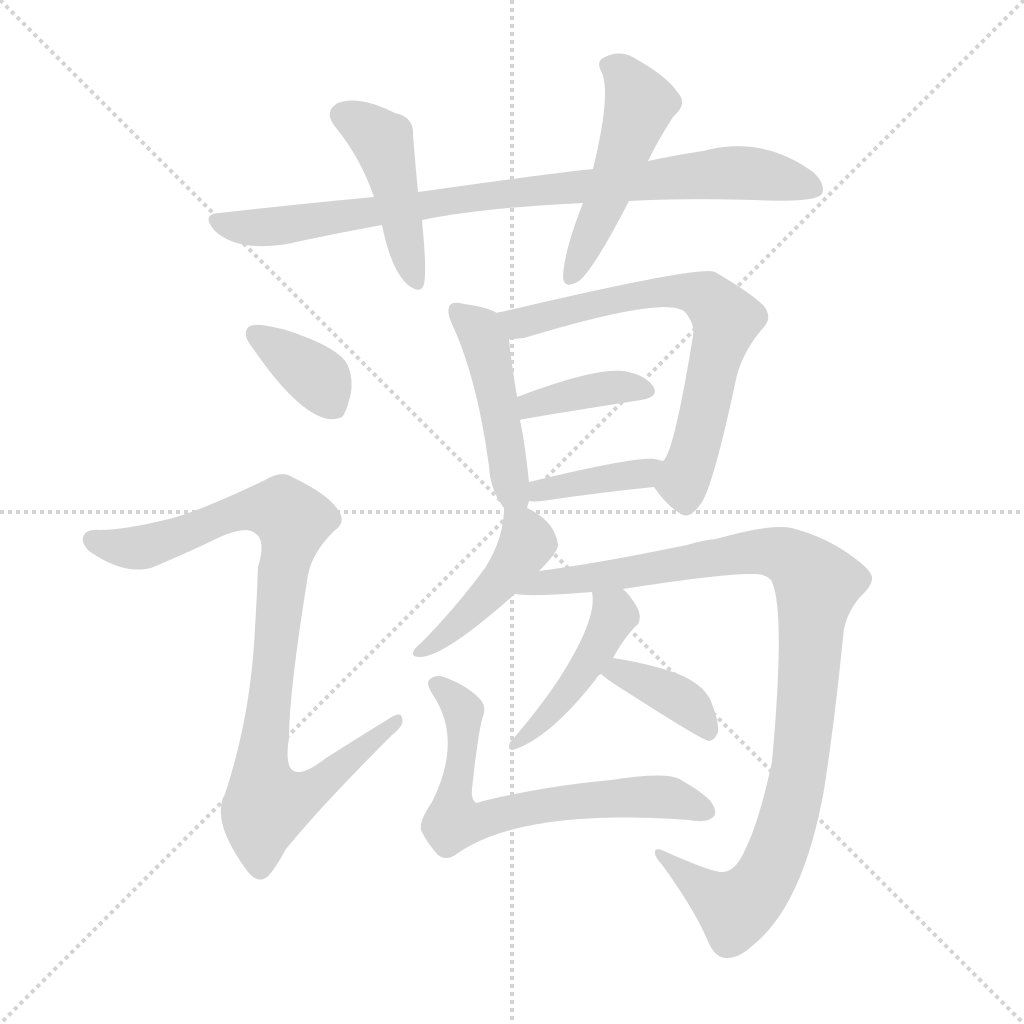
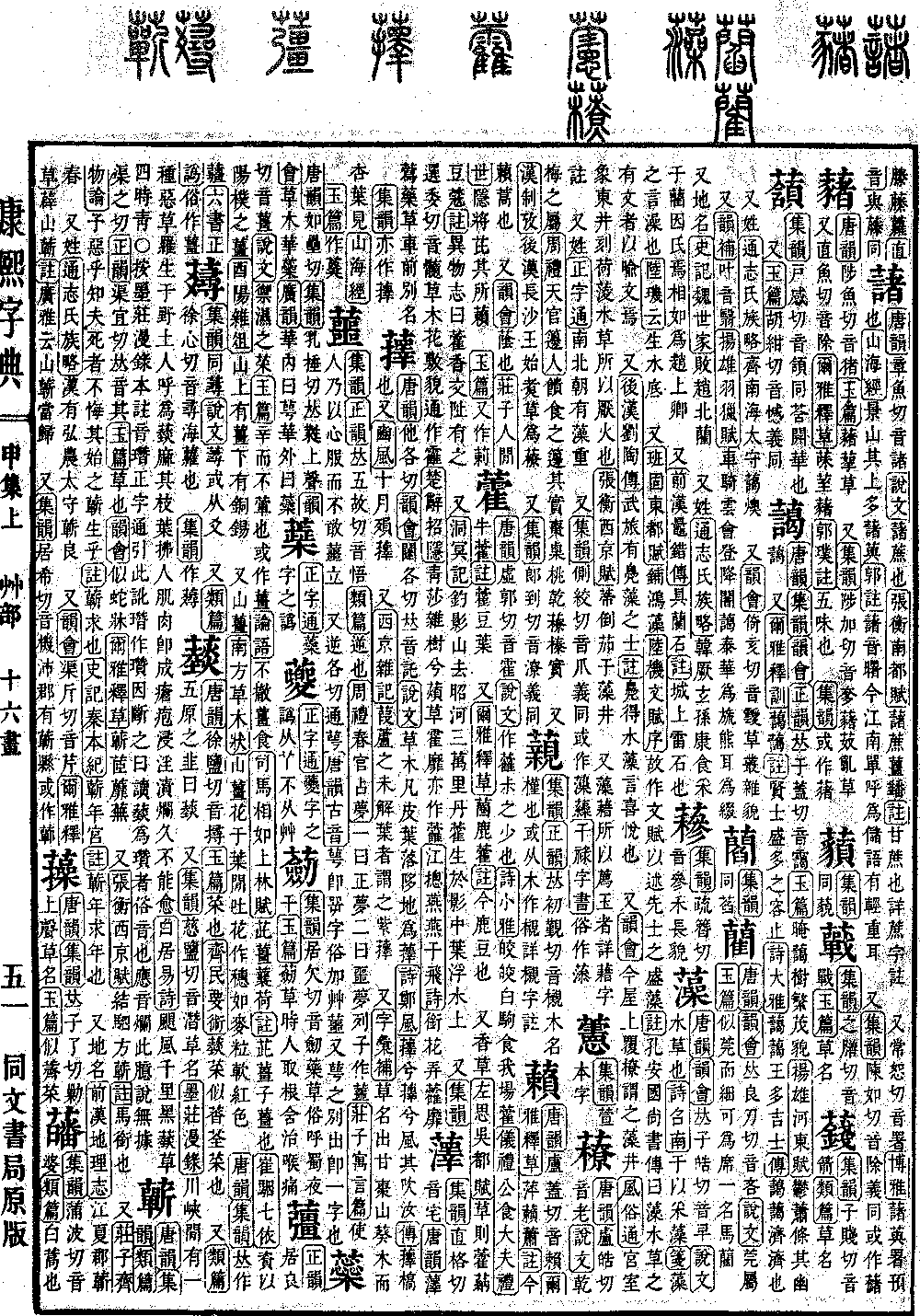
Shen Collection, Upper Volume
Radical: Grass (cǎo)
Kangxi stroke count: 22
Page 1067, Entry 01
Pronounced ai (falling tone).
In Jade Chapter (Yupian), it refers to the appearance of trees growing lush and thick.
In Yang Xiong’s Rhapsody on Hedong (Hedong Fu), it describes a scene as lush, verdant, deep, and flourishing.
Also, in Er Ya: Interpretations of Exemplary Instructions (Er Ya Shixun), it says ai-ai. The commentary explains this as the appearance and deportment of many virtuous and capable people.
In Book of Odes (Shijing), Great Odes (Daya), it refers to a king who has many virtuous and capable subordinates who are harmonious and kind. The commentary states that ai-ai describes a state of being numerous and orderly.
Also, a surname. In Comprehensive Records: Treatise on Clans and Lineages (Tongzhi Shizulue), it mentions Ai Yu, a governor of Nanhai during the Qi dynasty.
Pronounced ai (falling tone).
It refers to the appearance of grass growing in a dense and tangled manner.
Also, in Rhyme Supplement (Yunbu), it rhymes with the sound yi. In Yang Xiong’s Rhapsody on the Feather Hunt (Yulie Fu), it describes carriages and horses gathering like clouds, with banners and flags obscuring the sun as they move up and down. It uses Mount Tai and Mount Hua as the trailing ribbons of the banners, and Mount Xiong'er as the decorative tassels of the flags.