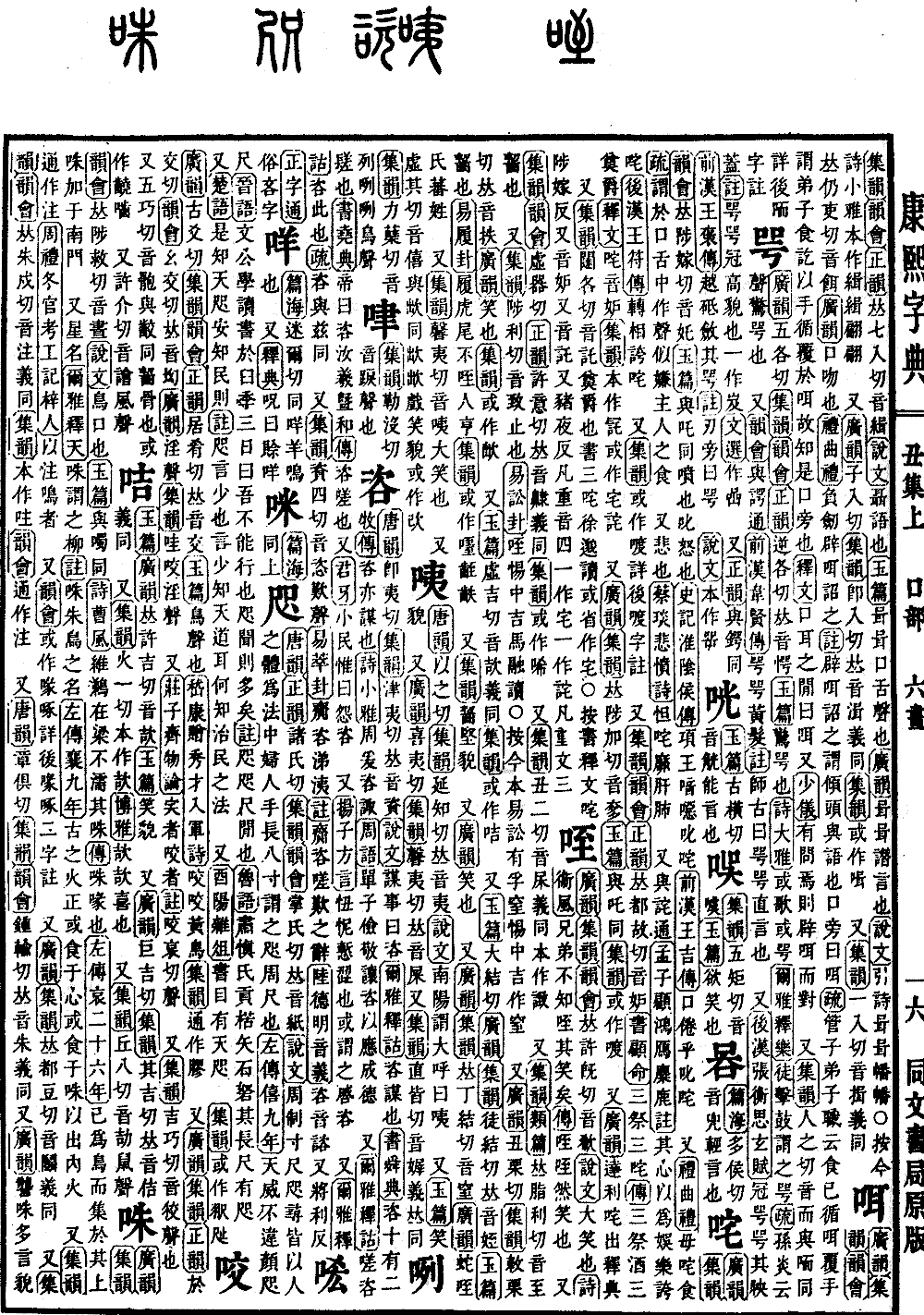
Chou Collection, Upper Volume
Radical: Mouth (kǒu)
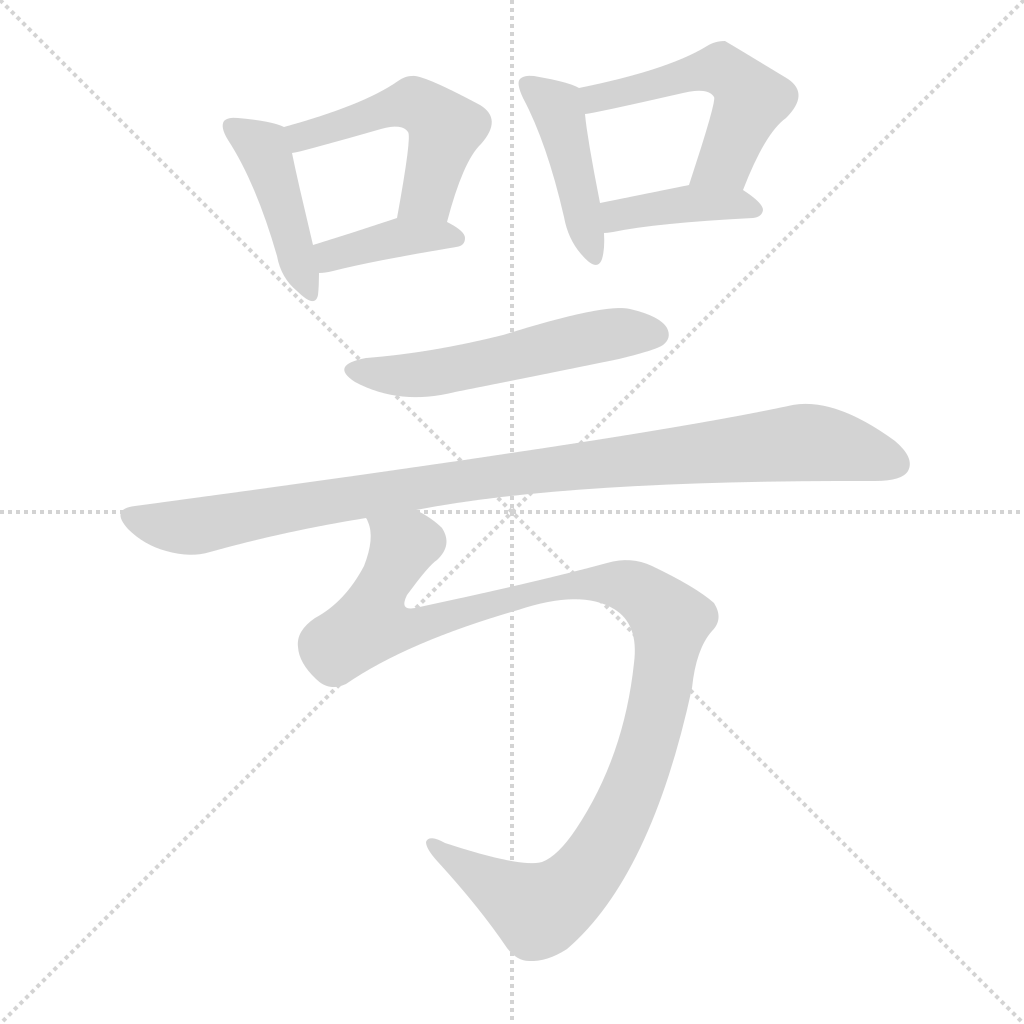
Character: È
Kangxi stroke count: 12
Page 186, Entry 02
Broad Rhymes (Guangyun): Pronounced è. Collected Rhymes (Jiyun), Rhyme Meetings (Yunhui), and Orthodox Rhymes (Zhengyun): Pronounced è, the reading is the same as the character for startled.
Jade Chapters (Yupian): Refers to an appearance of being startled.
Book of Odes (Shijing), Greater Odes (Daya): There are people singing and people beating drums.
Approaching Elegance (Erya), Explanation of Music (Shiyue): Simply beating a drum is called è.
Commentary (Shu): Sun Yan explains it as: a sound that causes one to be startled.
Also, according to Rhyme Meetings (Yunhui), it is interchangeable with the character meaning straightforward speech (è).
History of the Former Han (Qianhan), Biography of Wei Xian: The white-haired elder who speaks straightforwardly without reservation.
Annotation (Zhu): Shigu says: è è is the appearance of speaking straightforwardly.
Also, from History of the Later Han (Houhan), Zhang Heng's Rhapsody on Thinking (Sifu): A tall hat reflecting the carriage canopy.
Annotation (Zhu): È è describes the appearance of a hat rising high. Another variant form is (jí).
Literary Selections (Wenxuan): Written as (yán).
Also, according to Orthodox Rhymes (Zhengyun), it is the same as the character for sword edge (è).
History of the Former Han (Qianhan), Biography of Wang Bao: The whetstone of the Yue region sharpens its edge.
Annotation (Zhu): The side of a blade is called è.
Explanation of Graphs and Analysis of Characters (Shuowen): Originally written as.