Mao Collection, Middle Volume
Radical: Hand (shǒu)
攢; Kangxi stroke count: 23; Page 464, Entry 16
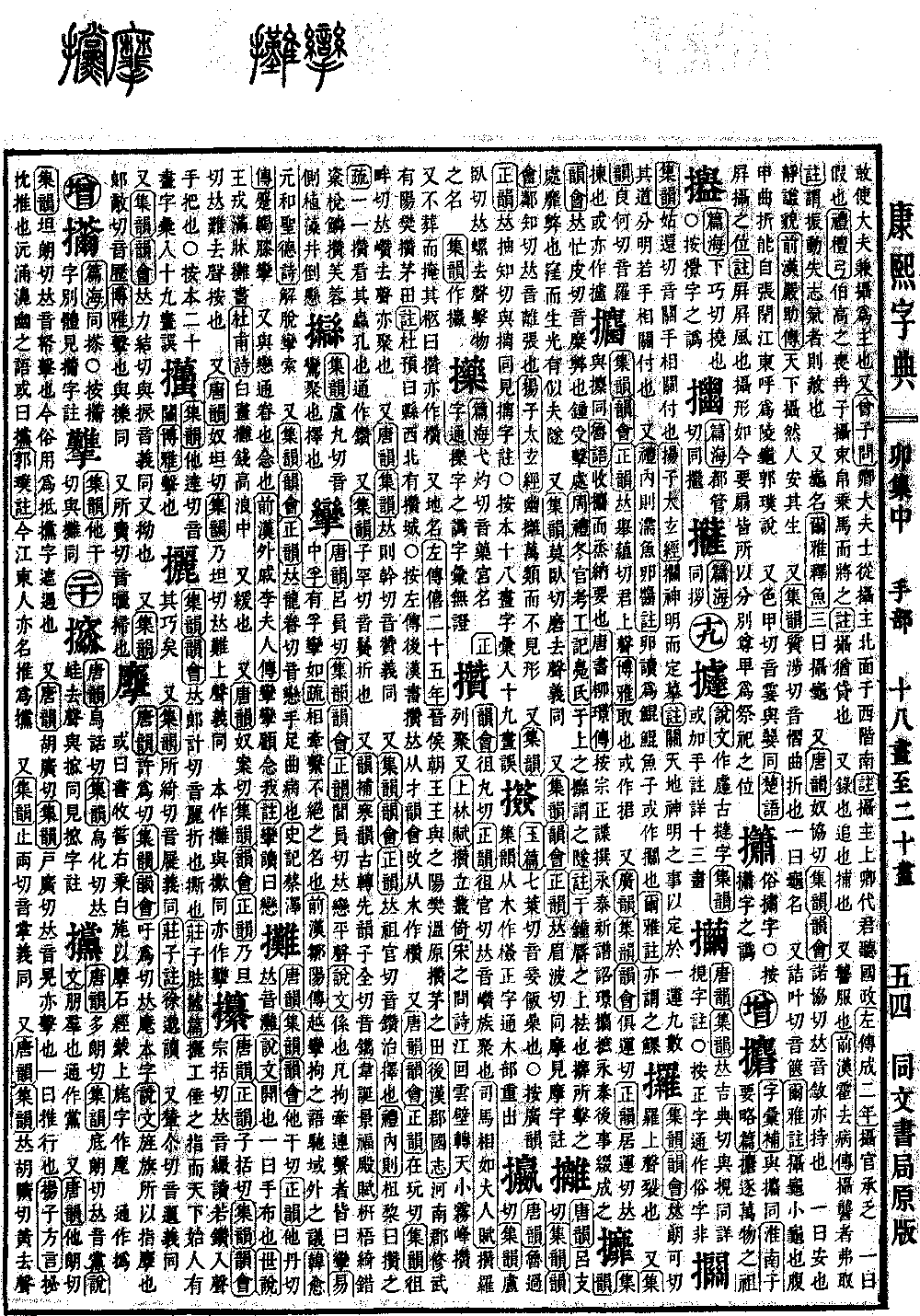
Yunhui states the pronunciation is cuán. Zhengyun states the pronunciation is cuán; it is pronounced the same as the character cuán. It means to gather or assemble. In the Adults Rhapsody (Daren Fu) by Sima Xiangru, it is used in the phrase gathered and arrayed. In the Park Rhapsody (Shanglin Fu), it appears in the phrase standing together in a cluster. A poem by Song Zhiwen writes: The river turns and the cloudy cliffs revolve, the sky narrows where the misty peaks gather. Additionally, the temporary interment of a coffin without formal burial is called cuán. This meaning is also written as the variant form (cuán).
It is also a place name. The Commentary on the Spring and Autumn Annals (Zuo Zhuan), twenty-fifth year of Duke Xi, records: The Marquis of Jin had an audience with the King of Zhou, who bestowed upon him fields in Yangfan, Wen, Yuan, and Cuanmao. The Records of Commanderies and States in the Later Han (Houhan Junguozhi) records: In Xiuwu County of Henan Commandery, there are fields in Yangfan and Cuanmao. Note: Du Yu states: There is Cuan City northwest of the county. According to the Commentary on the Spring and Autumn Annals and the Book of the Later Han (Houhanshu), the radical for this character is hand. The Yunhui changes this to the wood radical variant.
Also, Tangyun, Yunhui, and Zhengyun state the pronunciation is zuàn. Jiyun states the pronunciation is cuàn; it is the falling tone of cuán. The meaning is also to gather.
Also, Tangyun and Jiyun state the pronunciation is zàn. The meaning is the same.
Also, Jiyun, Yunhui, and Zhengyun state the pronunciation is zuàn. It is pronounced the same as the character zuàn. It means to examine or check carefully. The Book of Rites (Liji), Inner Teachings (Neize), records: For crabapples and pears, one must zuàn them. The Commentary (Shu) explains: To carefully check for wormholes in the pears one by one. This meaning is interchangeable with the character zuàn.
Also, Jiyun states the pronunciation is zǎn. The meaning is to break.
Also, in the rhyme supplement (Yunbu), in the han rhyme category, the ancient pronunciation can shift to the xian rhyme category; it is pronounced juān. In the Rhapsody on the Jingfu Hall (Jingfu Dian Fu) by Wei Dan, it is written: The bracket sets and paulownia timbers are intricately layered, the short rafters and ridge poles are scaled and clustered. The lotus flowers are planted on the sides, and the ornate ceiling is suspended inverted.