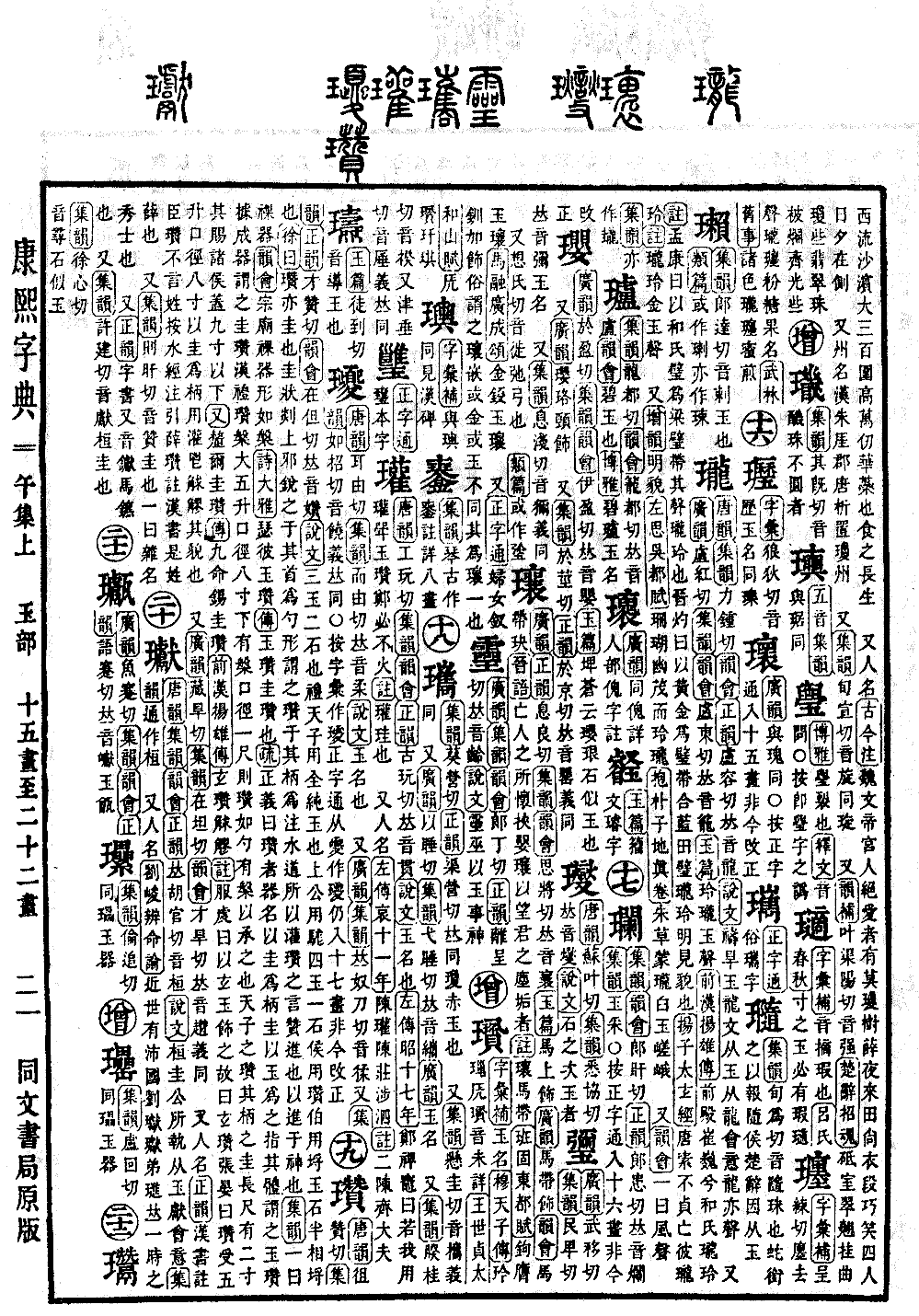
Wu Collection, Upper Volume
Radical: Jade (yù)
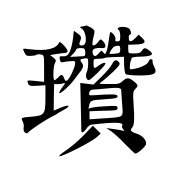
Zan
Kangxi strokes: 24
Page 745, Entry 29
Pronounced zan.
According to the Explanation of Scripts and Signs (Shuowen Jiezi), it refers to a mixture of three parts jade and two parts stone. According to ritual regulations, the Son of Heaven used the quan, which was pure jade. The Duke used the mang, which was four parts jade and one part stone. The Marquis used the zan, and the Earl used the lie, both consisting of equal parts jade and stone.
Xu states that the zan is a type of gui (a pointed ritual jade). The gui is shaped with a sharp, beveled top. When a scoop is fashioned at the top, it is called a zan. A channel is formed in the handle to pour water or sacrificial wine during libation rites. The character zan takes its meaning from the term zan, meaning to present or offer, indicating its use in offering sacrifices to the spirits.
According to the Collected Rhymes (Jiyun), it is also described as a vessel used for libation rituals.
According to the Collection of Rhymes (Yunhui), it is a vessel used for libation in the ancestral temple, shaped like a tray.
Book of Odes (Shijing), Great Odes (Daya): That gleaming jade zan.
The Commentary says: The jade zan is the gui zan.
The Subcommentary states: The orthodox meaning is that zan is the name of a vessel. It uses the gui as a handle; since the gui is made of jade, it is referred to as a jade zan based on its material, and as a gui zan based on the vessel itself. In the ritual system of the Han dynasty, the capacity of the zan basin was five sheng, with an opening of eight cun, and a supporting tray below with a diameter of one chi. Thus, the zan is like a scoop with a basin to catch it. The gui serving as the handle for the Son of Heaven's zan was one chi and two cun long; those bestowed upon feudal lords were generally nine cun or less.
Also: Bestowing upon you the gui zan.
The Commentary says: (Refers to receiving) the bestowal of the gui zan associated with the nine ranks of nobility.
Former Han (Qianhan), Biography of Yang Xiong: The zan is curved (qiu).
The Note says: Fu Qian states: It is decorated with jade, hence it is called zan. Zhang Yan states: The capacity of the zan is five sheng, the opening is eight cun, it uses a gui as a handle, and it is used to pour aromatic sacrificial wine. Qiu is a word describing its appearance.
Also pronounced zan. The meaning is the same.
Also used as a personal name.
The Orthodox Rhymes (Zhengyun) states: The commentary to the Book of Han (Hanshu) mentions: Minister Zan, whose surname is not provided. According to the Commentary on the Water Classic (Shuijing Zhu), which cites Xue Zan's commentary on the Book of Han, it is known that his surname was Xue.
Also pronounced zan. Refers to a gui. Another theory suggests it refers to a type of mixture.