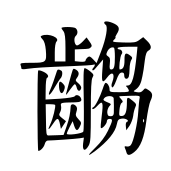
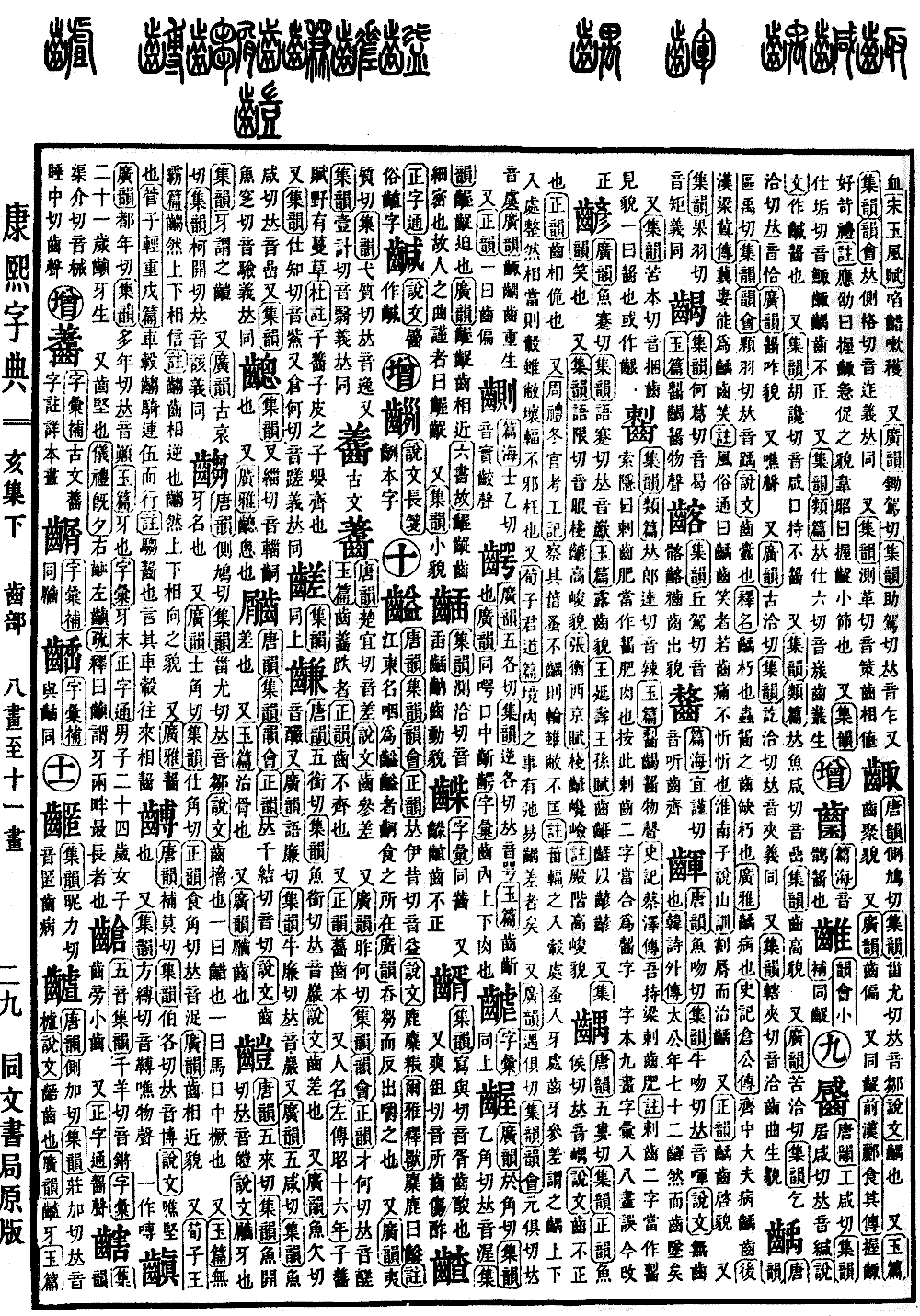
Hai Collection, Lower Volume
Radical: Tooth (chǐ)
Kangxi strokes: 25
Page 1535, Entry 31
Pronounced zou
According to the Tang Dynasty Rhymes (Tangyun) and the Collected Rhymes (Jiyun), it is pronounced like the character zou.
According to the Explaining Graphs and Analyzing Characters (Shuowen), it refers to the occlusion of teeth. One theory suggests it refers to gnawing. Another theory suggests it refers to the bit in a horse's mouth.
According to the Jade Chapters (Yupian), it refers to the name for having no teeth.
Pronounced zhuo
According to the Broad Rhymes (Guangyun), the Collected Rhymes (Jiyun), and the Correct Rhymes (Zhengyun), it is pronounced like the character zhuo.
According to the Broad Rhymes (Guangyun), it describes the appearance of teeth being tightly gathered together.
According to the Xunzi, King and Hegemon Chapter (Wangba pian), it says, they were zhuo-like in their mutual trust between superiors and subordinates. The commentary states that zhuo refers to teeth interlocking, and zhuo-like describes the appearance of those above and below corresponding to one another.
According to the Broadly Refined (Guangya), it refers to gnawing.
According to the Guanzi, Light and Heavy Part Five (Qingzhong wu pian), it says, the wheel hubs zhuo, with cavalry traveling in connected ranks. The commentary states that zhuo refers to gnawing, meaning that the wheel hubs were rubbing and gnawing against one another as they passed.
Verification: In the Guanzi, Light and Heavy Part Five, the commentary originally read zhou, meaning to gnaw. Following the original text, zhou has been corrected to zhuo.