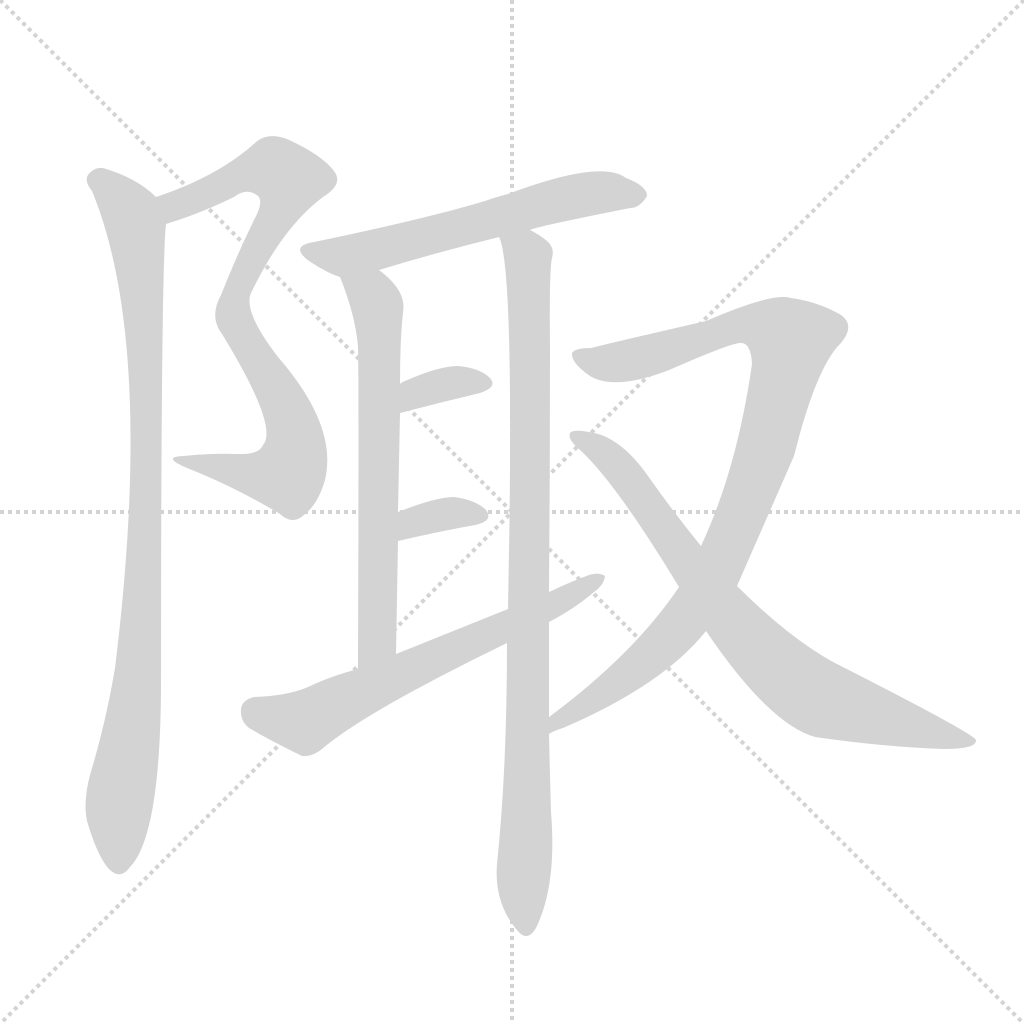
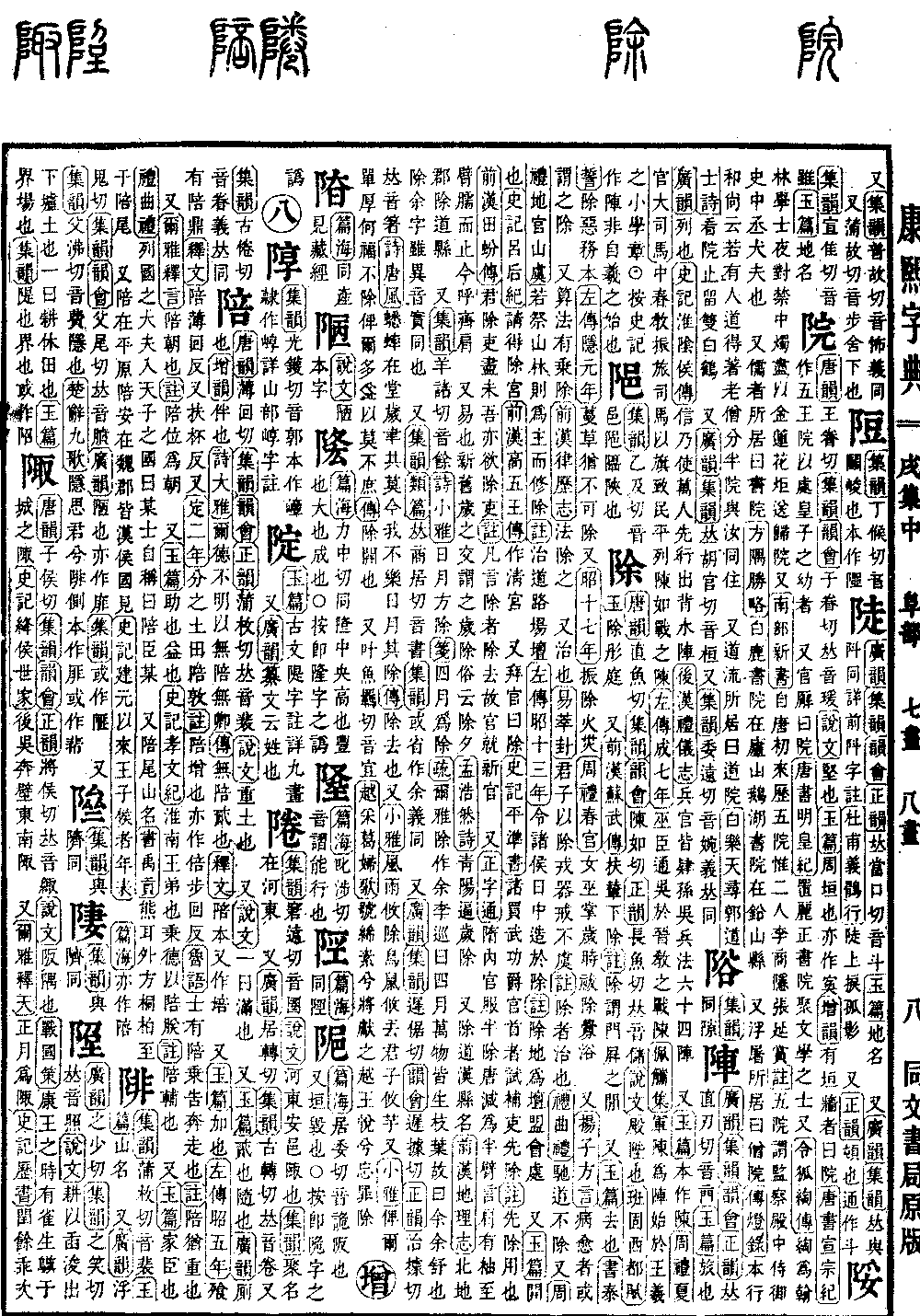
Xu Collection, Middle Volume
Radical: Mound (fù)
陬; Kangxi stroke count: 16; Page 1352, Entry 23
According to Tang Rhymes (Tangyun), zǐhóu qie; according to Jiyun (Jiyun), Yunhui (Yunhui), and Zhengxun (Zhengxun), jiānghóu qie; pronounced zōu.
According to Shuowen (Shuowen), a corner of a bank or cliff.
"During King Kang's reign, a sparrow was born in a corner of the city." — Stratagems of the Warring States (Zhanguoce)
"Later, Wu fled to the southeast corner of the rampart." — Records of the Grand Historian (Shiji), House of Marquis Jiang
Also, according to Erya (Erya), Explaining Heaven, the first month is called zōu.
"The intercalary remainder was out of sequence, and the first month (Mèngzōu) was annihilated." — Records of the Grand Historian (Shiji), Treatise on the Calendar
Note: The first month is Mèngzōu.
"Sheti was aligned with the first month (Mèngzōu)." — Qu Yuan, Lisao (Lisao)
Also, according to Zhuangzi (Zhuangzi), Heaven and Earth, "Zigong lost his color, looking uneasy and discomfited."
Note: zōu here describes a shamed and embarrassed appearance.
Also, Qianzhou, a Han dynasty county, named after a mountain.
"Qianzhou County in Langya Commandery." — Book of Han (Qian Han Shu), Treatise on Geography
Note: It was formerly the state of Jie.
"A guest sought refuge in Qianzhou Mountain in Langya." — Book of Later Han (Hou Han Shu), Biography of Chunyu Gong
Also, according to Guangyun (Guangyun), to gather and reside.
Also, according to Book of Han (Qian Han Shu), Account of the Western Regions, "Kunmo wished to have his grandson Cen Zōu marry the princess."
In Records of the Grand Historian (Shiji), Account of Dayuan, it is written as Cen Qǔ.
Note: zōu, pronounced zǐhóu fǎn (using the initial of zi and the final of hou).
Also, according to Guangyun (Guangyun), cèjiū qie; according to Jiyun (Jiyun), zāiyóu qie; pronounced zōu.
According to Yupian (Yupian), a corner.
Also, according to Guangyun (Guangyun), a place name.
According to Leipian (Leipian), a city in Lu.
"Confucius was born in Zōu settlement, Changping township, Lu state." — Records of the Grand Historian (Shiji), House of Confucius
Note: Zōu was the settlement governed by Confucius's father, Shuliang He.
In The Analects (Lunyu), it is written as "son of the man from zōu."
Also, according to Guangyun (Guangyun), zǐyú qie; according to Jiyun (Jiyun), zūnxū qie; pronounced zōu.
"Heaven seals the vast land, a corner for the arrayed immortals; above, it is flat, open, and expansive; below, it is dense, overgrown, and rugged." — Zhang Heng, Ode to the Southern Capital (Nandu Fu)
According to Jiyun (Jiyun), sometimes also written as a variant character pronounced zuì.