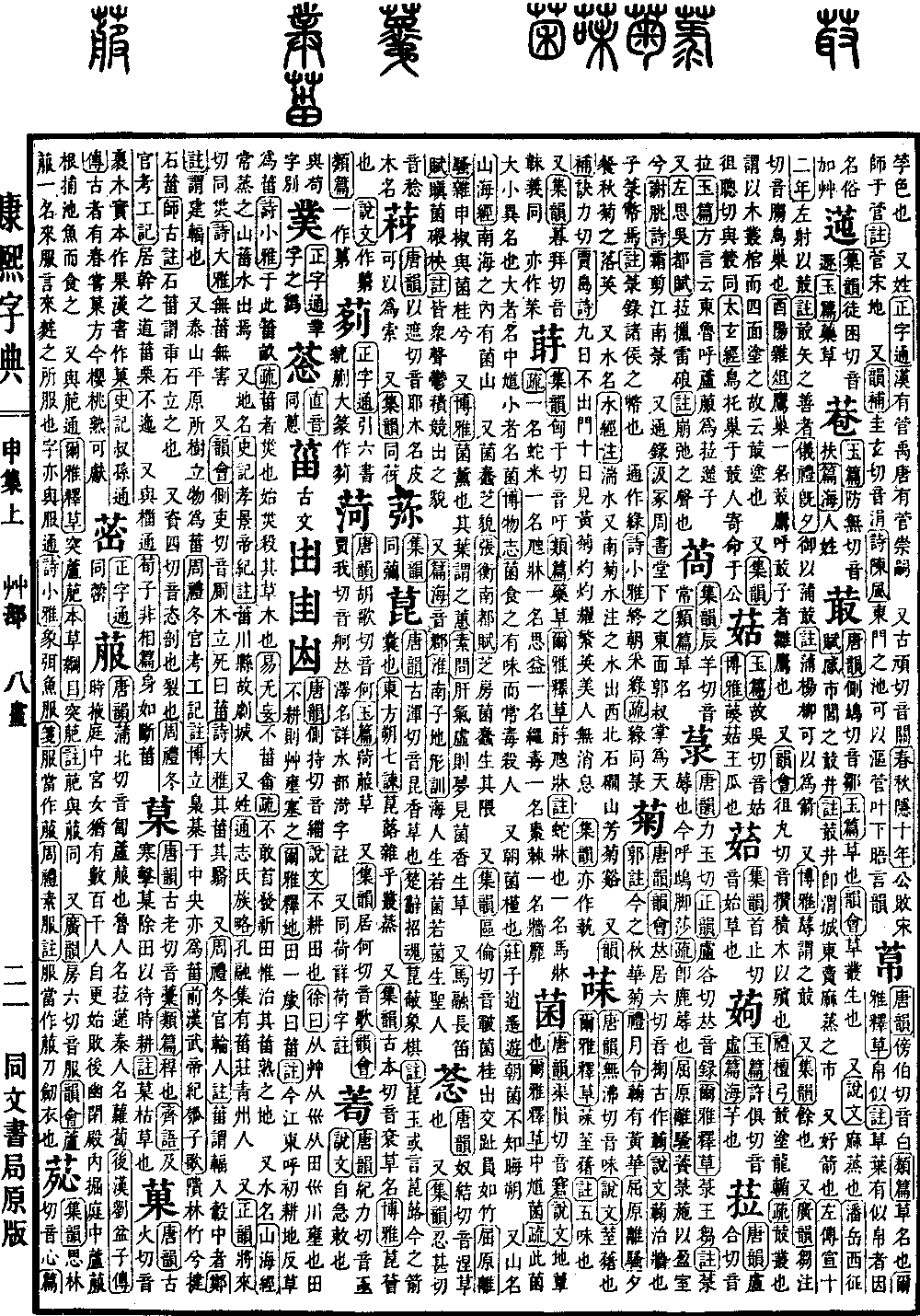
Shen Collection, Upper Volume
Radical: Grass (cǎo)
Kangxi Strokes: 14
Page 1037, Entry 04
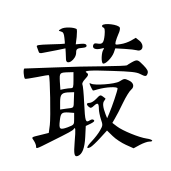
Pronounced zou.
In the Jade Chapters (Yupian), grass.
In the Collection of Rhymes (Yunhui), grass growing in clusters.
Also, in the Explaining Graphs and Analyzing Characters (Shuowen), hemp stalks.
In Pan Yue's Western Expedition Rhapsody (Xizheng Fu), moved by the hemp-stalk wells of the market lanes. The commentary notes that hemp-stalk wells refers to the market east of Weicheng where hemp stalks were sold.
Also refers to good arrows.
In the Zuo Commentary on the Spring and Autumn Annals (Zuo Zhuan), the left archer shot using clustered-head arrows. The commentary notes that this refers to good arrows.
In the Book of Etiquette and Ceremonial (Yili), controlled with reed arrows. The commentary notes that these are willow-reed arrows, which can be made into arrows.
Also, in the Extensive Refinements (Boya), a grass mat is called a zou.
Also, pronounced yu.
Also, pronounced chu. Bird nests.
In the Miscellaneous Morsels from Youyang (Youyang Zazu), an eagle's nest is also called a zou. Eagles called zou-zi refer to young eagles.
Also, pronounced cuan. Piling up timber.
In the Book of Rites (Liji), clustering and plastering the dragon-patterned funeral carriage. The commentary explains that this means to cluster or gather together, referring to using timber to surround a coffin and plastering the four sides, hence the term clustered plastering.
Also, pronounced cong. Same as the word for a thicket.
In the Great Classic (Taijing), birds entrust their nests to the thicket, and humans entrust their lives to the public.