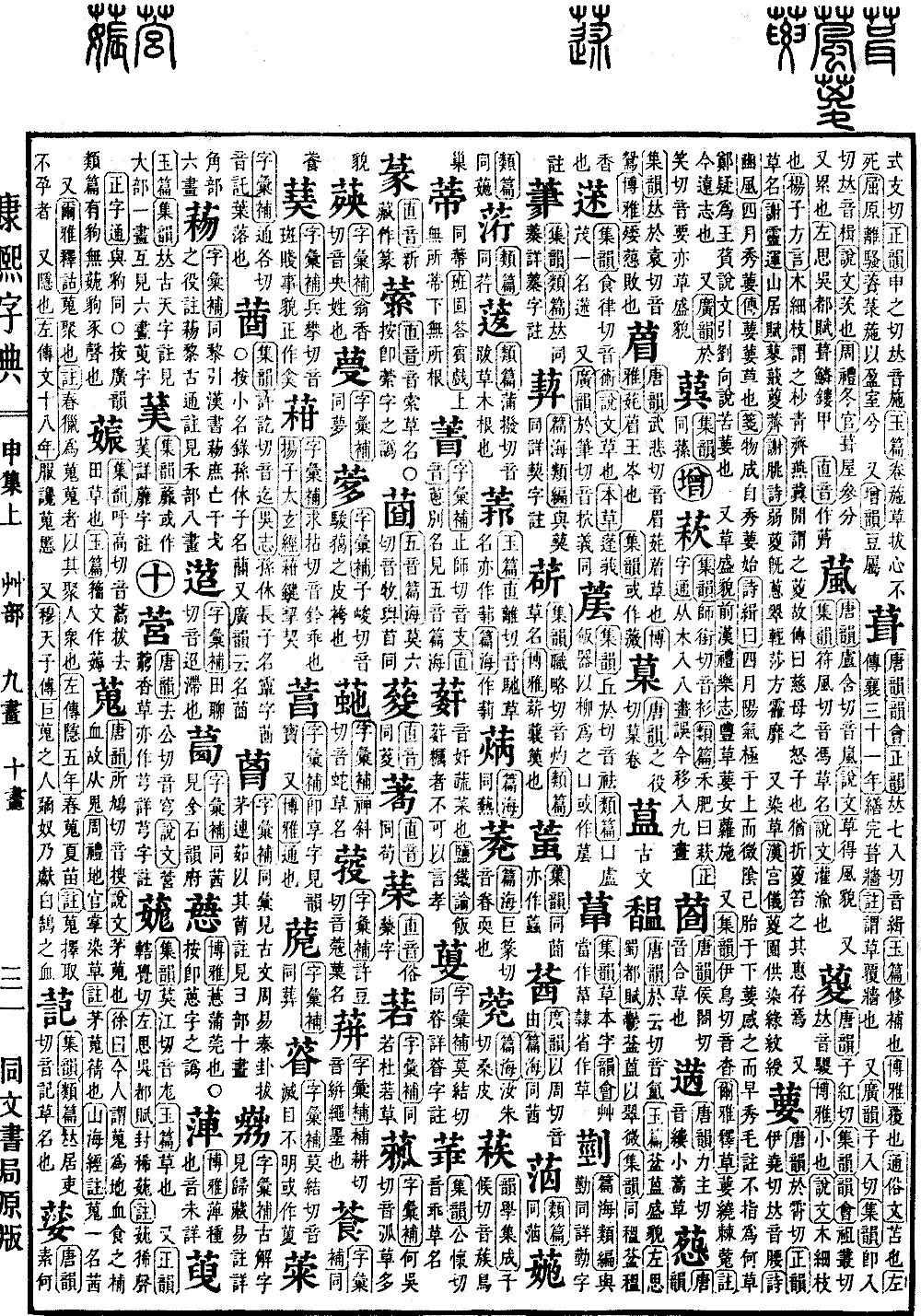
Shen Collection, Upper Volume
Radical: Grass (cǎo)
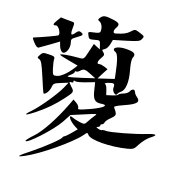
葼
Kangxi Dictionary Strokes: 15
Page 1047, Entry 03
Pronounced zong.
Guangya (Broad Refinements): Refers to something small.
Shuowen (Explaining Graphs and Analyzing Characters): Thin branches of trees.
Yangzi Fangyan (Regional Speech): Thin branches of trees are called miao; in the regions of Qingzhou, Qi, Yanzhou, and Jizhou, they are called zong. Thus, the ancient commentary says: When a kind mother is angry at her child, even if she breaks a thin branch to whip him, her love still remains.
Also refers to a type of grass.
Xie Lingyun, Shanju Fu (Rhapsody on Mountain Dwelling): Smartweed, houttuynia, zong, and shepherd's purse.
Xie Tiao, Poetry: The tender zong grass is already verdant, and the soft sedge grass is gently swaying.
Also refers to a dyeing grass.
Han Gongyi (Rites of the Han Palace): The Zong Garden provides the grass used for dyeing green decorative ribbons.
Textual Research Note: In Yangzi Fangyan, it is stated that thin branches are called miao, and in the regions of Qi, Yan, and Ji they are called zong, thus the commentary says: When a kind mother is angry at her child, she may whip him with a zong branch, yet her affection remains. Regarding the text: Yan has been corrected to Yanzhou, and the word for still/even (you) has been corrected to though (sui) according to the original source.