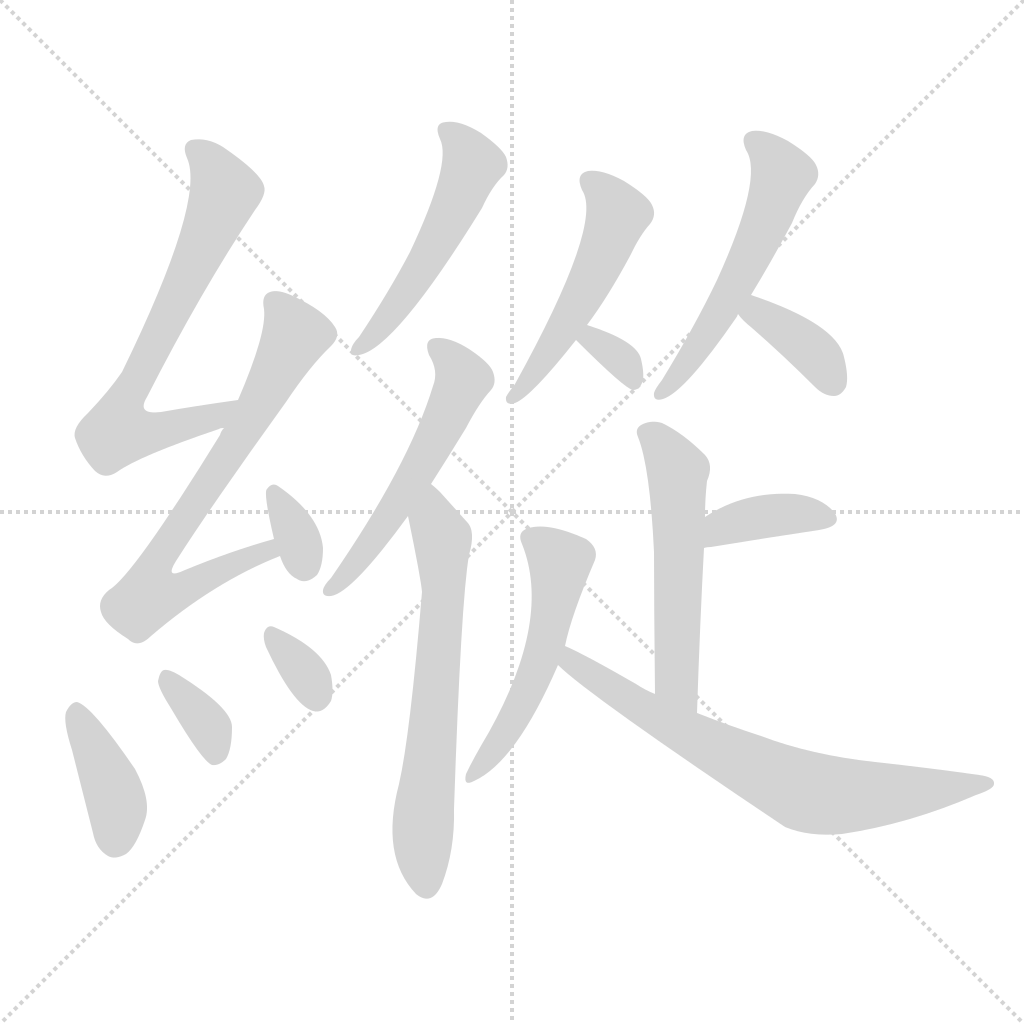
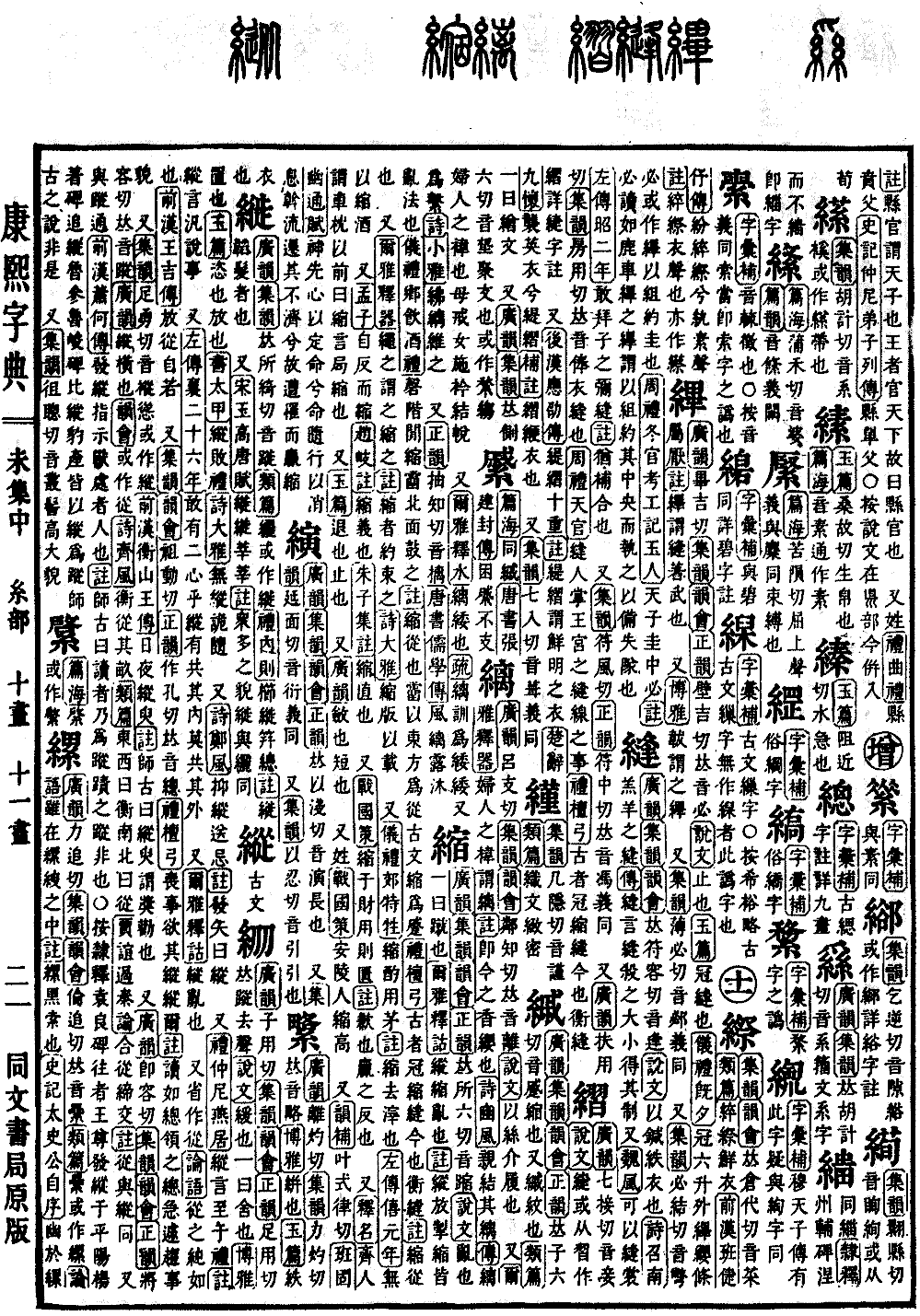
Wei Collection, Middle Volume
Radical: Silk (mì)
Kangxi Strokes: 17
Page 935, Entry 31
Ancient form. Pronounced yong (falling tone). Pronounced zong (falling tone).
Shuowen Jiezi (Explanation of Simple and Compound Characters): To slacken. Another meaning is to release.
Guangya (Expanded Glossaries): To place.
Yupian (Jade Chapters): To be unrestrained; to release.
Book of Documents (Shangshu): To yield to ruined propriety.
Book of Odes (Shijing): Do not indulge treacherous sycophants.
Also, Book of Odes (Shijing): To release and send off. Commentary: To discharge an arrow is called zong.
Also, Book of Rites (Liji): To speak unrestrainedly while adhering to propriety. Commentary: Unrestrained speech refers to talking about matters broadly.
Also, Zuo Tradition (Zuozhuan): Dare one have divided loyalties? Even if one does, they contribute to the internal affairs and not to the external ones.
Also, Erya (Approaching Elegance): Zong means chaotic.
Also, written in the abbreviated form (cóng).
Analects (Lunyu): Follow it in a pure manner.
History of the Former Han (Hanshu): To be unrestrained and at ease.
Also, pronounced zong (rising tone). Book of Rites (Liji): In funeral matters, one wishes for them to be hurried. Commentary: Read as the zong in zongling (to oversee). It describes the appearance of rushing to attend to matters.
Also, pronounced song (rising tone). Song (to encourage) is sometimes written as zong. History of the Former Han (Hanshu): To encourage and advise day and night. Commentary: According to Shigudao, zongyu means to encourage and advise.
Also, pronounced zong (level tone).
Guangya (Expanded Glossaries): Vertical and horizontal.
Rhyme Compendium (Yunhui): Sometimes written as cong.
Book of Odes (Shijing): The fields are laid out horizontally and vertically.
Leipian (Category Chapters): East-west is called heng, north-south is called zong.
Jia Yi, Faults of Qin (Guo Qin Lun): To form vertical and horizontal alliances. Commentary: Zong is the same as zong.
Also, interchangeable with zong (track/footprint).
History of the Former Han (Hanshu): He who points out the tracks and directs where the animal is, is the person. Commentary: Shigudao says that readers use the zong of footprint for this, but that is incorrect. According to the Lishi (Interpretations of Clerical Script) by Yuan Liang: In the past, Wang Zun pointed out the tracks at Pingyang. Yang Zhu: Tracing the footsteps of Lu Can. Lu Jun: Comparing the footsteps of Bao Chan. All of these use zong to mean tracks. The view of Shigudao is incorrect.
Also, pronounced cong (level tone). The appearance of a hair bun that is high and large.