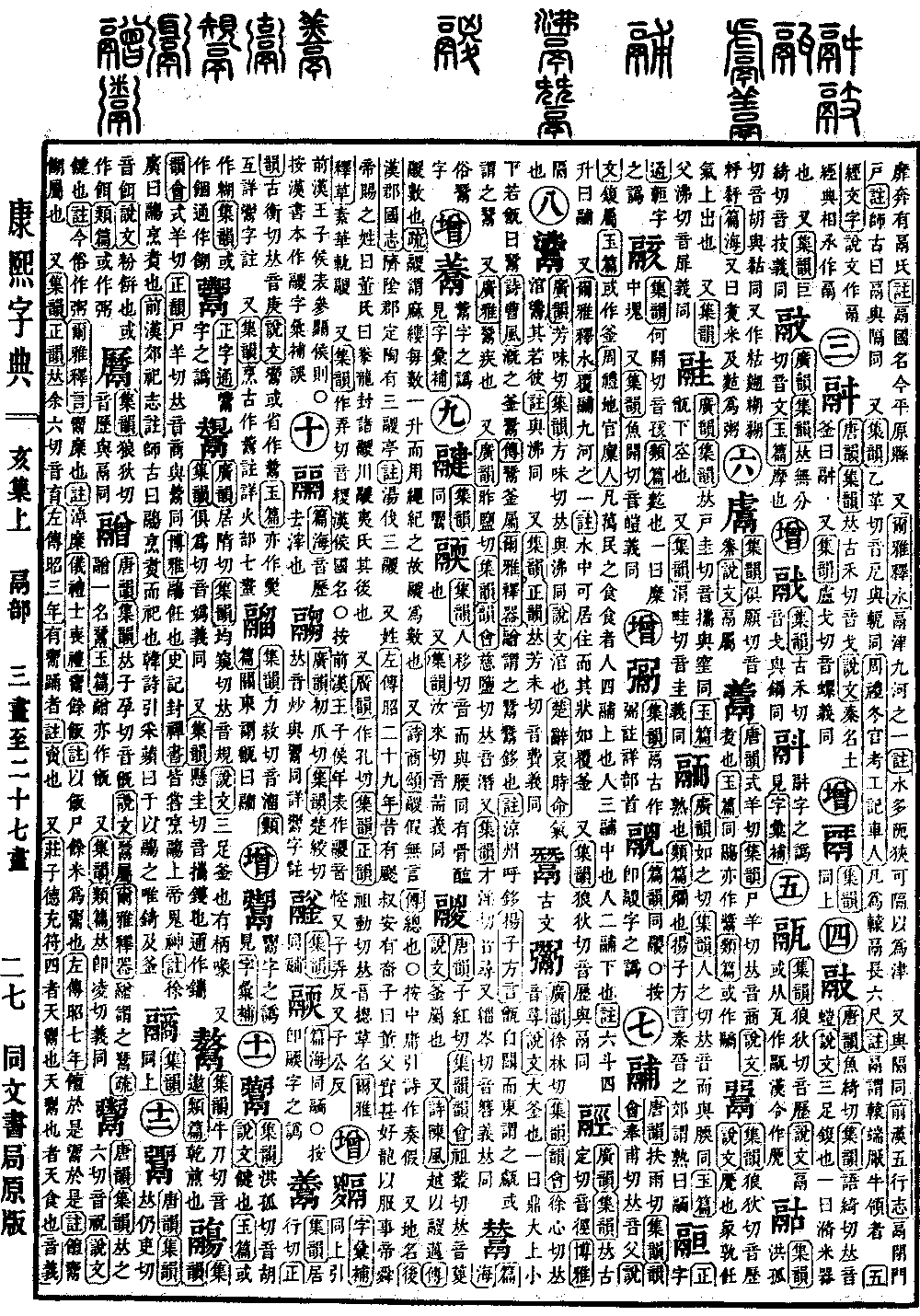
Hai Collection, Upper Volume
Radical: Cauldron (lì)
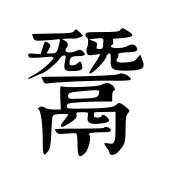
鬵
Kangxi strokes: 18
Page 1459, Entry 21
Ancient literature records: The Broad Rhymes (Guangyun) states it is pronounced xún. The Collection of Rhymes (Jiyun) and the Rhyme Gathering (Yunhui) state it is pronounced xún. The Explaining Graphs and Analyzing Characters (Shuowen Jiezi) explains it as a large pot. Another source states it refers to a type of tripod, large at the top and small at the bottom, shaped like a steaming pot, called a zan. The Book of Odes (Shijing), in the Odes of Cao, contains the sentence: Cleaning the pots and the zan. The Commentary (Zhuan) explains: A zan belongs to the category of pots. The Literary Expositor (Erya), in the section on utensils, calls it a zan. A zan is a chi. The Annotation (Zhu) says: In the Liangzhou region, it is called a chi. Master Yangs Dialects (Fangyan) records: A steaming pot is called a yan in the regions east of the pass, or is called a zan. Additionally, the Broad Rhymes (Guangyun) mentions: Zan also carries the meaning of rapid. Furthermore, the Broad Rhymes (Guangyun) states it is pronounced qián. The Collection of Rhymes (Jiyun) and the Rhyme Gathering (Yunhui) state it is pronounced qián. Also, the Collection of Rhymes (Jiyun) states it is pronounced xún. Another pronunciation is zān. The above pronunciations all carry the same meaning.