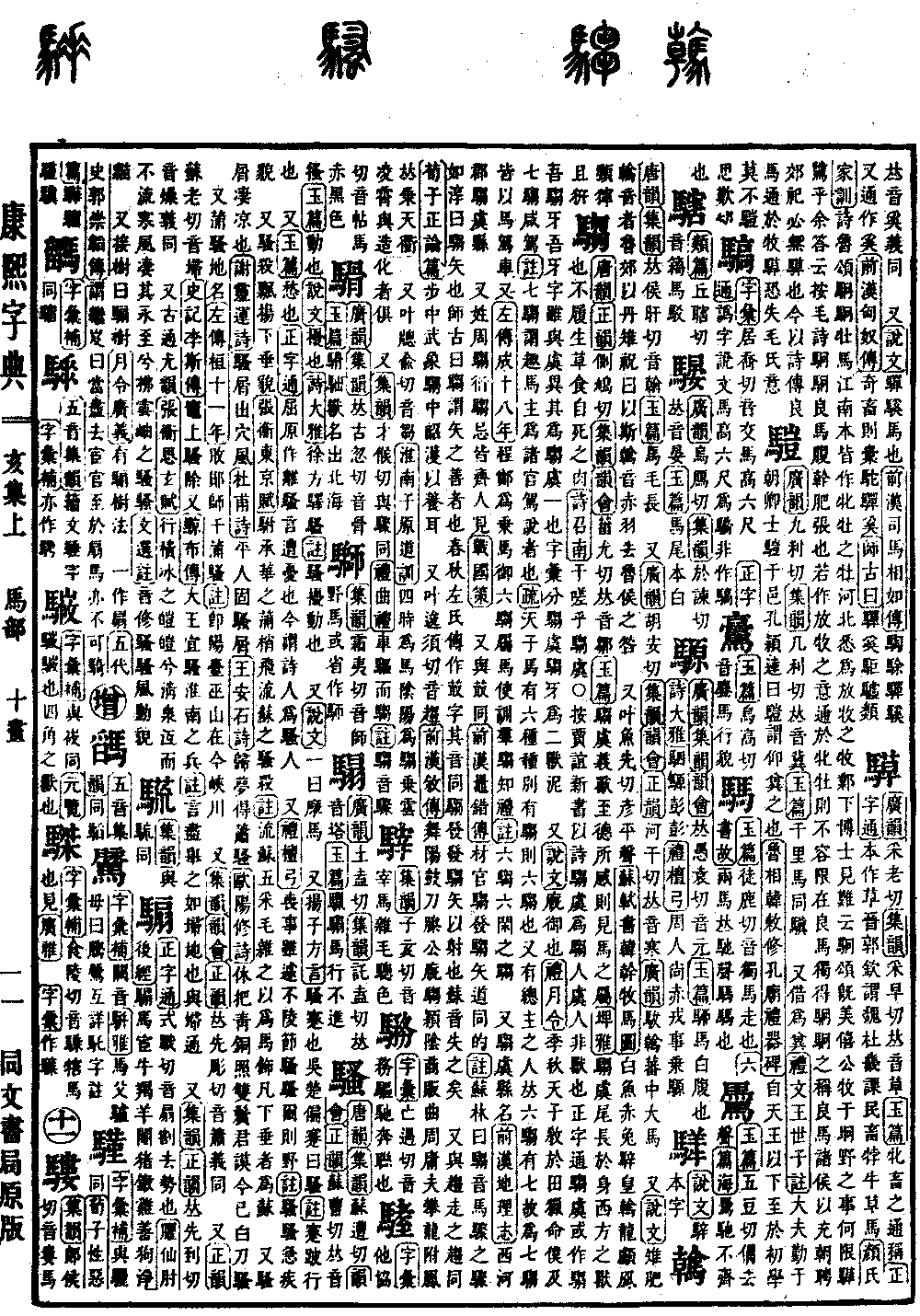
Hai Collection, Upper Volume
Radical: Horse (mǎ)
Entry: zou
Kangxi stroke count: 20
Page 1443, Entry 12
Pronounced zou.
According to the Tang Dynasty Rhymes (Tangyun) and Correct Rhymes (Zhengyun), the pronunciation is as cited. According to the Collected Rhymes (Jiyun) and Rhyme Assembly (Yunhui), the pronunciation is as cited.
In the Jade Chapters (Yupian), Zouyu is a righteous beast that appears when a ruler possesses supreme virtue. It belongs to the horse family.
In the Expanded Encyclopedia (Piya), it is stated that the Zouyu has a tail longer than its body and is a beast of the west. It does not tread on living grass and eats only animals that have died naturally.
In the Book of Odes (Shijing), section Shao Nan, it says: Alas, the Zouyu.
Jia Yi’s New Book (Xinshu) suggests that the Zouyu mentioned in the Odes refers to the groom and the forest warden, not a beast.
The Zhengzitong states that Zouyu is sometimes written as Zouwu or Zouya. Although the characters for wu and ya differ from yu, they all refer to the same beast.
The Compendium of Characters (Zihui) divides the Zouyu and the Zouya into two different beasts, which is a pedantic interpretation.
Also, in the Explaining Graphs (Shuowen), it refers to stable management and driving.
In the Book of Rites (Liji), chapter Monthly Ordinances (Yueling), it states that in the last month of autumn, the Son of Heaven trains for hunting, ordering the charioteers and the seven zou to ready the carriages. The commentary states that the seven zou refers to the grooms, officials in charge of harnessing and unharnessing the horses for various dignitaries. The sub-commentary explains that the Son of Heaven has six types of horses, each managed by a groom, totaling six grooms. Including the supervisor, they are known as the seven zou, who all drive carriages.
In the Zuo Commentary (Zuo Zhuan), 18th year of Duke Cheng, it states that Cheng Zheng served as the imperial charioteer, and the six grooms were under his jurisdiction, tasked with teaching the various grooms the proper rituals. The commentary notes that the six grooms refer to the grooms of the six stables.
Zouyu is also a county name. According to the History of the Former Han (Qian Hanshu), Geographical Records, there was a Zouyu County in Xihe Commandery.
It is also used as a surname. Zou Yan and Zou Ji of the Zhou Dynasty were both from the State of Qi, as recorded in the Strategies of the Warring States (Zhanguo Ce).
It is synonymous with the character zou (meaning a type of arrow). In the Biography of Chao Cuo in the History of the Former Han (Qian Hanshu), it states: The skilled troops shot with zou, and the arrow paths all hit the target. Su Lin says: The pronunciation is the same as the zou in galloping horse. Ru Chun says: Zou refers to an arrow. Yan Shigu says: Zou refers to a high-quality arrow. In the Zuo Commentary (Zuo Zhuan) of the Spring and Autumn period, it is written with the character for zou, with the same pronunciation. Zou fa means to shoot with high-quality arrows. Su Lin’s annotation on the pronunciation is incorrect.
It is also synonymous with the character for walking rapidly (qu). In the Xunzi, chapter Correct Argument (Zheng Lun), it says: The pace matches the music of the Wu and Xiang, and the rapid gait matches the music of the Shao and Hu, which is used to cultivate the ear.
Pronounced qu (with level tone). In the History of the Former Han (Qian Hanshu), Narrative Biography (Xuzhuan), it refers to the butcher Yang and the groom of the Teng Duke’s stables. The merchants of Yingyin and the commoners of Quzhou, climbing the dragon and following the phoenix to ride upon the heavenly road.
Pronounced chu (with level tone). In the Huainanzi, chapter Original Dao (Yuan Dao Xun), it says: The four seasons serve as horses, and the yin and yang serve as the groom, riding the clouds to soar above, moving in unison with the creator.
According to the Collected Rhymes (Jiyun), the pronunciation is as cited. It is synonymous with the character for galloping (zhou). In the Book of Rites (Liji), chapter Qu Li, it states: When the carriage drives and accelerates (zou). The commentary notes: The pronunciation is zhou.
Editorial Notes:
In the Zuo Commentary (Zuo Zhuan), 18th year of Duke Cheng, the text originally read that the six grooms were subordinate to the horses; it has been corrected to read that they were subordinate to him (Cheng Zheng).
In the Biography of Chao Cuo in the History of the Former Han (Qian Hanshu), the text originally read "zou arrow paths"; the extra character for zou has been removed.
In the Xunzi, chapter Correct Argument (Zheng Lun), the text originally read "pace matches Wu Xiang, zou matches Shao Hu"; the character for "cultivate" has been added above the word "ear" according to the original text.