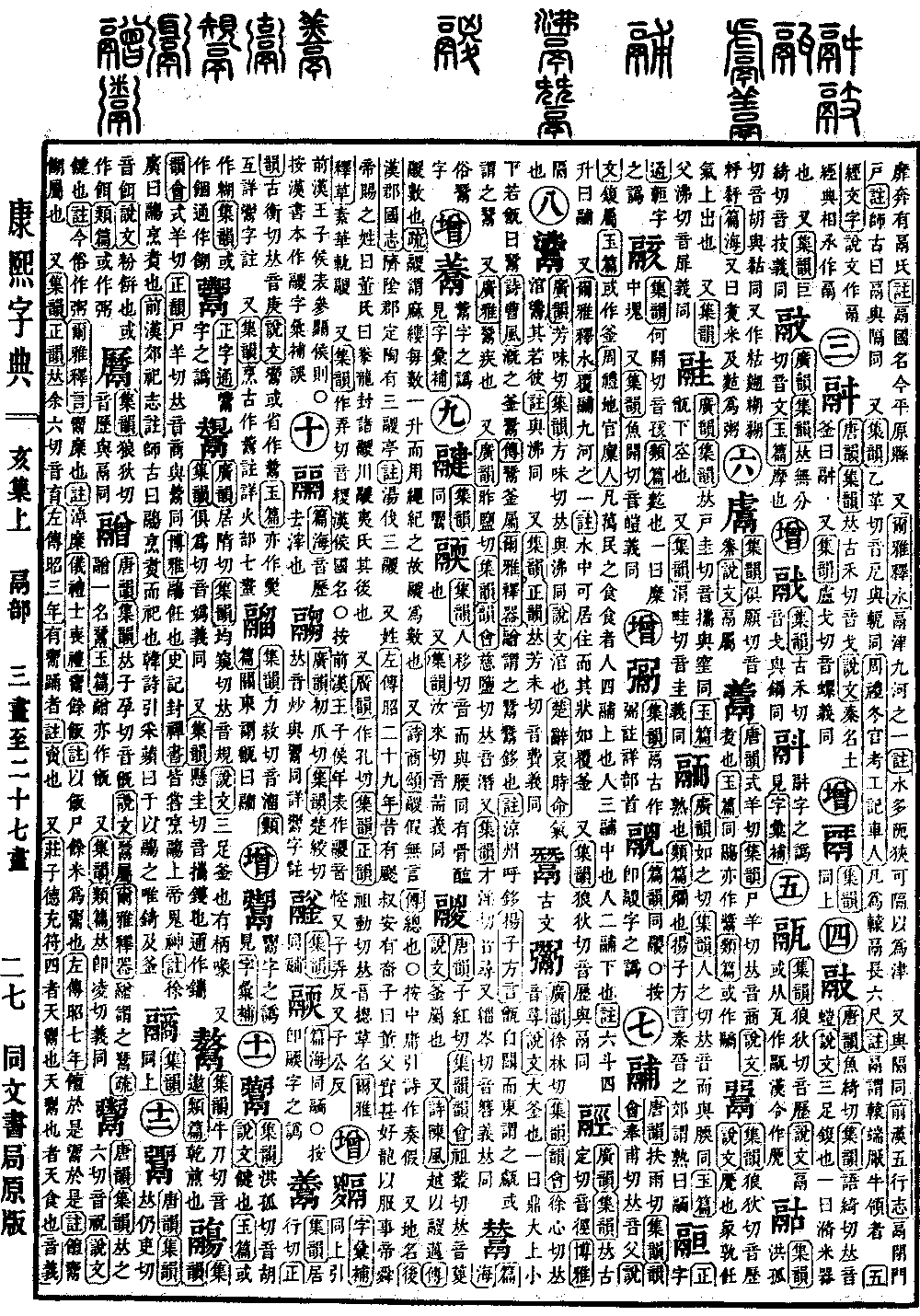
Hai Collection, Upper Volume
Radical: Cauldron (lì)
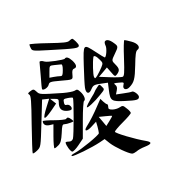
Zong
Kangxi stroke count: 19
Page 1459, Entry 27
Pronounced zong.
According to the Explaining Graphs and Analyzing Characters (Shuowen), this is a type of cauldron-like vessel.
In the Book of Odes (Shijing), in the section Odes of the States: "Crossing over with zong and proceeding." The commentary states that zong means frequently or repeatedly. The sub-commentary explains that zong refers to hemp threads; for every sheng measure counted out, a knot was tied in the string as a marker, thus zong extended to mean the act of counting.
In the Book of Odes (Shijing), in the section Odes of Shang: "Zong reaches without words." The commentary states that this means to gather or assemble. Note: The Doctrine of the Mean (Zhongyong), when quoting the Book of Odes, writes this as zou.
Also a place name. In the History of the Later Han (Hou Hanshu), in the Treatise on Commanderies and Kingdoms: There is a Three Zong Pavilion in Dingtao County, Jiyin Commandery. The annotation notes that Shang Tang launched a campaign against the Three Zong.
Also a surname. In the Zuo Tradition (Zuo Zhuan), in the twenty-ninth year of Duke Zhao: In the past there was Liu Shu'an, who had a descendant named Dong Fu. He loved dragons and served Emperor Shun with this skill. Emperor Shun bestowed upon him the surname Dong, calling him the Dragon-Rearing Clan, and enfeoffed him in Zongchuan; the Zongyi clan are his descendants.
Pronounced zong.
The name of a type of grass. In the Erya (Approaching Elegance), in the section Explaining Plants: "White flowers, zong-like stems."
Pronounced zong.
The name of a marquisate during the Han dynasty. Note: The History of the Former Han (Qian Hanshu), in the Table of Princely Marquises, writes this as zong. It also has pronunciations equivalent to zong and zong.