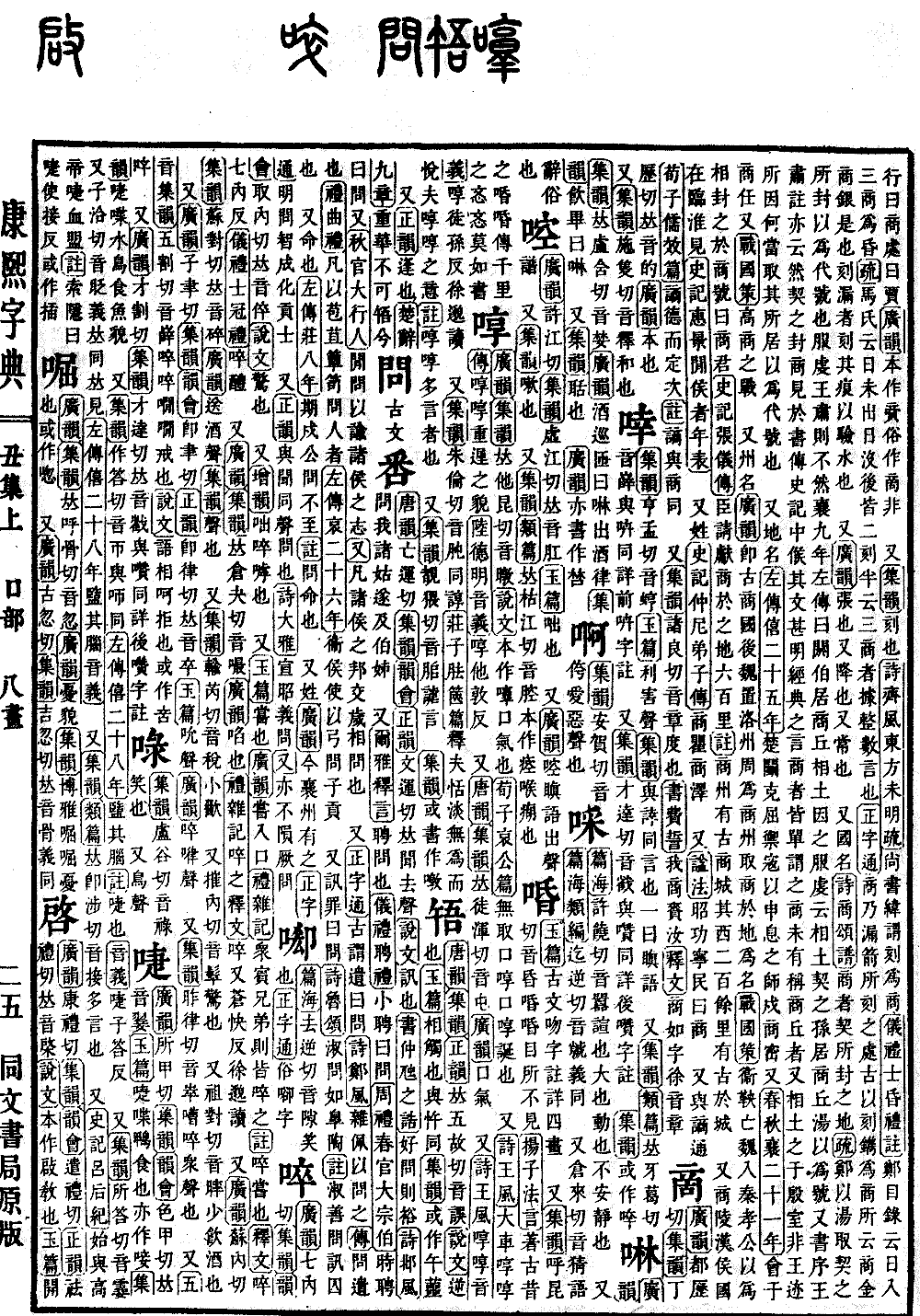
Chou Collection, Upper Volume
Radical: Mouth (kǒu)
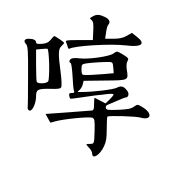
Character: Tun
Kangxi Stroke Count: 11
Page 195, Entry 08
Broad Rhymes (Guangyun), Collected Rhymes (Jiyun): Pronounced tun.
Explaining Graphs and Analyzing Characters (Shuowen): Originally written as a variant form, referring to the breath of the mouth.
Xunzi (Xunzi), Chapter on Duke Ai (Aigong pian): Do not adopt oral boasting. Oral boasting means arrogant speech.
Also, Book of Odes (Shijing), Odes of Wang (Wangfeng): The great carriage moves slowly (tun-tun).
Commentary: Tun-tun describes the appearance of being heavy and slow.
Lu Deming, Sound and Meaning (Yinyi): Tun is pronounced tun.
Also, Tang Rhymes (Tangyun), Collected Rhymes (Jiyun): Pronounced tun.
Broad Rhymes (Guangyun): The breath of the mouth.
Also, Book of Odes (Shijing), Odes of Wang (Wangfeng), Sound and Meaning (Yinyi) for Tun-tun: Tun is pronounced tun, according to the reading by Xu Miao.
Also, Collected Rhymes (Jiyun): Pronounced zhun. Same as zhun.
Zhuangzi (Zhuangzi), Chapter on Rummaging Through Chests (Quxie pian): Release that which is calm and inactive, and delight in that which is verbose (tun-tun).
Annotation: Tun-tun refers to one who talks a great deal.
Also, Collected Rhymes (Jiyun): Pronounced dui. Jesting speech.
Collected Rhymes (Jiyun): Sometimes also written in a variant form.