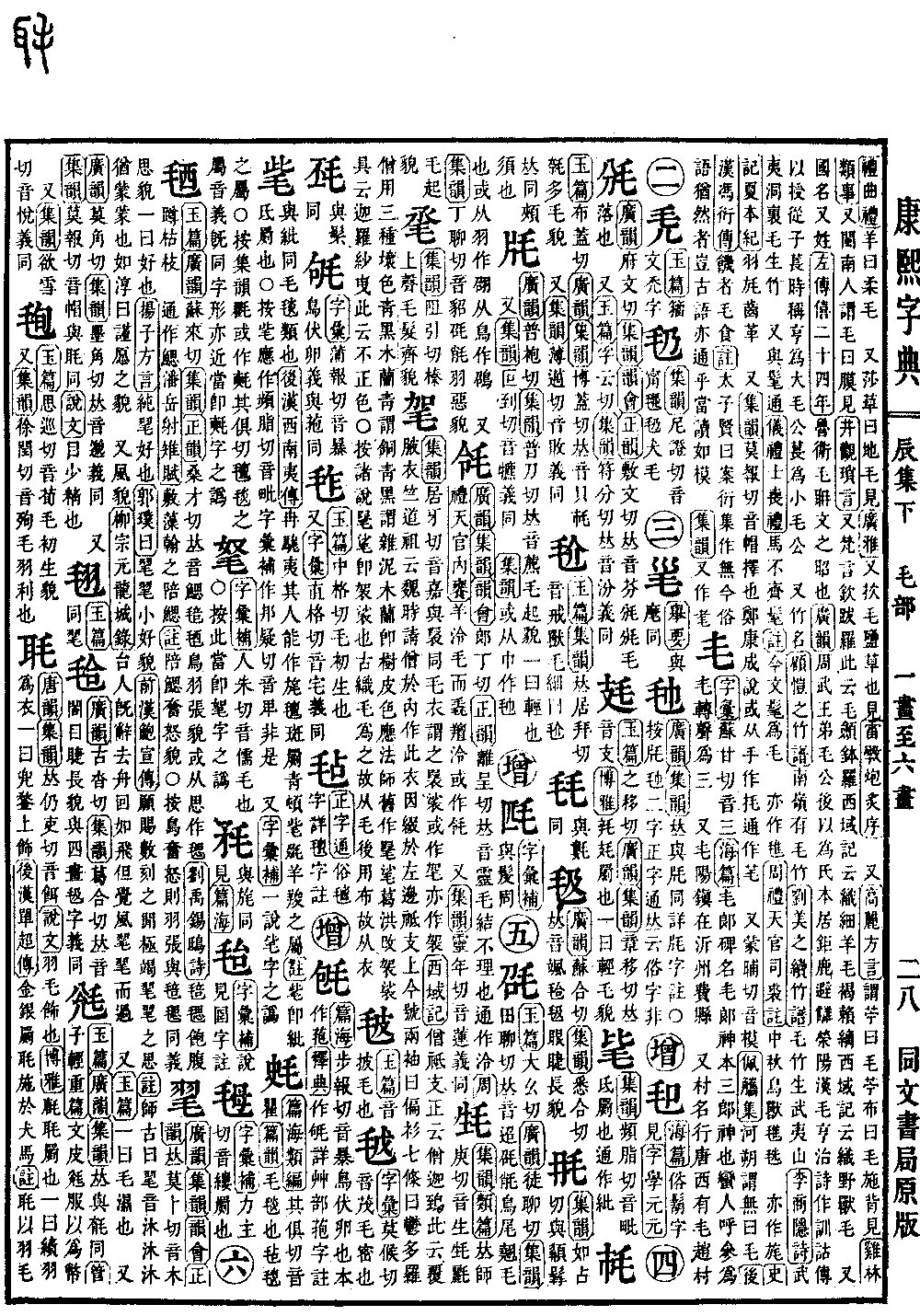
Chen Collection, Lower Volume
Radical: Fur (máo)
Kangxi Strokes: 17
Page 592, Entry 01
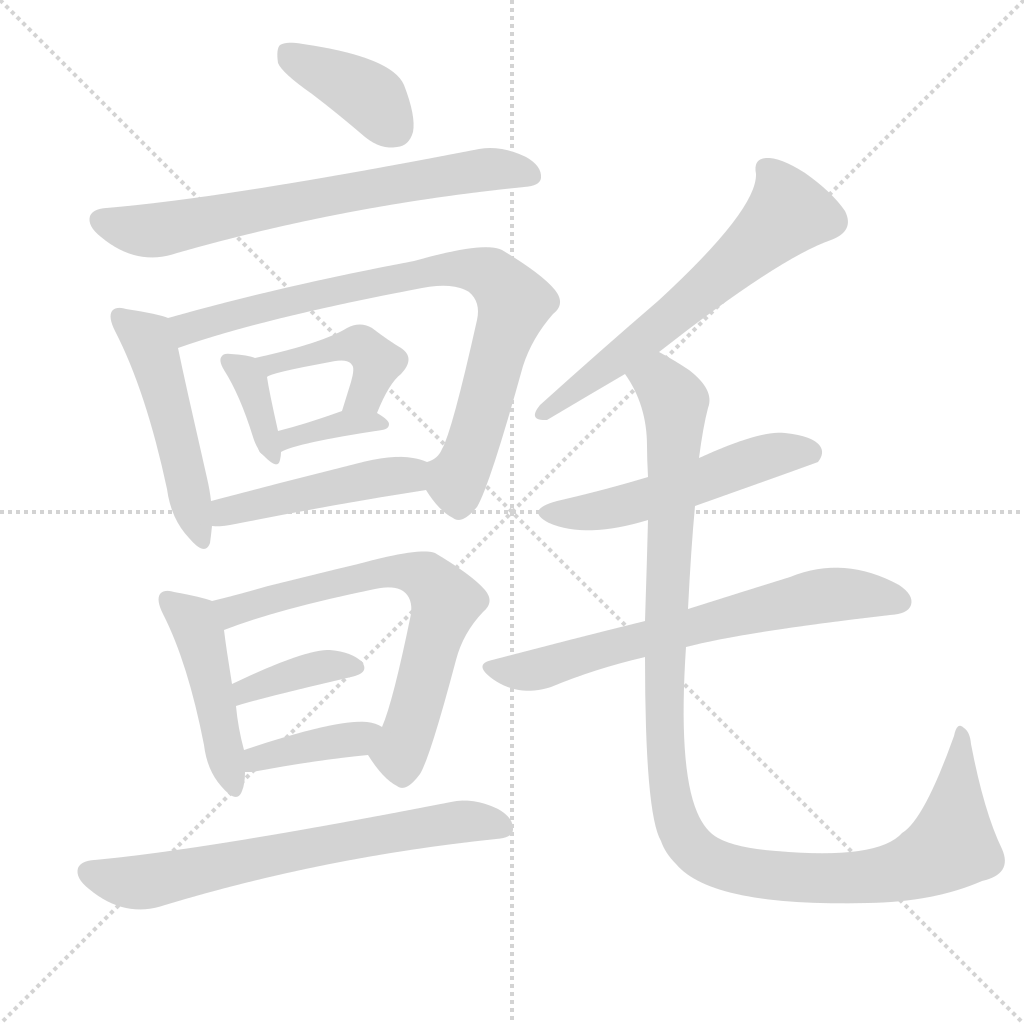
Pronounced zhan.
According to the Shuowen Jiezi (Shuowen), it refers to felted hair. Others say it means to twist, to hold, or to trample. Because hair is trampled into a sheet, it is called zhan (felt).
According to the Shiming, zhan means to extend; it is when hair adheres together in a dense manner.
In the Rites of Zhou (Zhouli), Office of Heaven, Supervisor of Hides: In autumn, collect hides; in winter, collect leathers; provide the fine hair to make felt. Also, in the Supervisor of Residences: When the King performs the great sacrifice to the Supreme Deity, he spreads out a felt mat on a table. The commentary explains that the table is a bed; when felt is placed on a bed, it is called a felt mat.
In the Qimin Yaoshu, the method for making felt is described: Use a mix of spring hair and autumn hair. Autumn hair is tight and strong, while spring hair is soft and weak; using them separately is too unbalanced, so they must be mixed. Felt made during the peach-blossom water of the third month is the best. Generally, when making felt, it does not need to be thick and large. Only when it is tight, thin, and evenly blended is it considered of good quality.
It is used interchangeably with zhan. In the History of the Former Han (Qianhan Shu), in the Biography of Wang Bao: Carrying felt and wearing fur. In the Biography of Wang Ji: Upon fine felt mats. In the Biography of Su Wu: Gnawing on snow and eating felt hair. All of these are the same as zhan.
Also pronounced zhen. In the Heshen Poem by Yang Fang: Sitting in the cold, leaning against a felt mat. The upper character rhymes with shen, and the lower character rhymes with chen.
Textual research: In the Rites of Zhou, Office of Heaven, Supervisor of Hides, it says provide the fine hair to make felt. According to the original text, fine hide has been corrected to fine hair.