Xu Collection, Middle Volume
Radical: Rain (yǔ)
Kangxi stroke count: 15
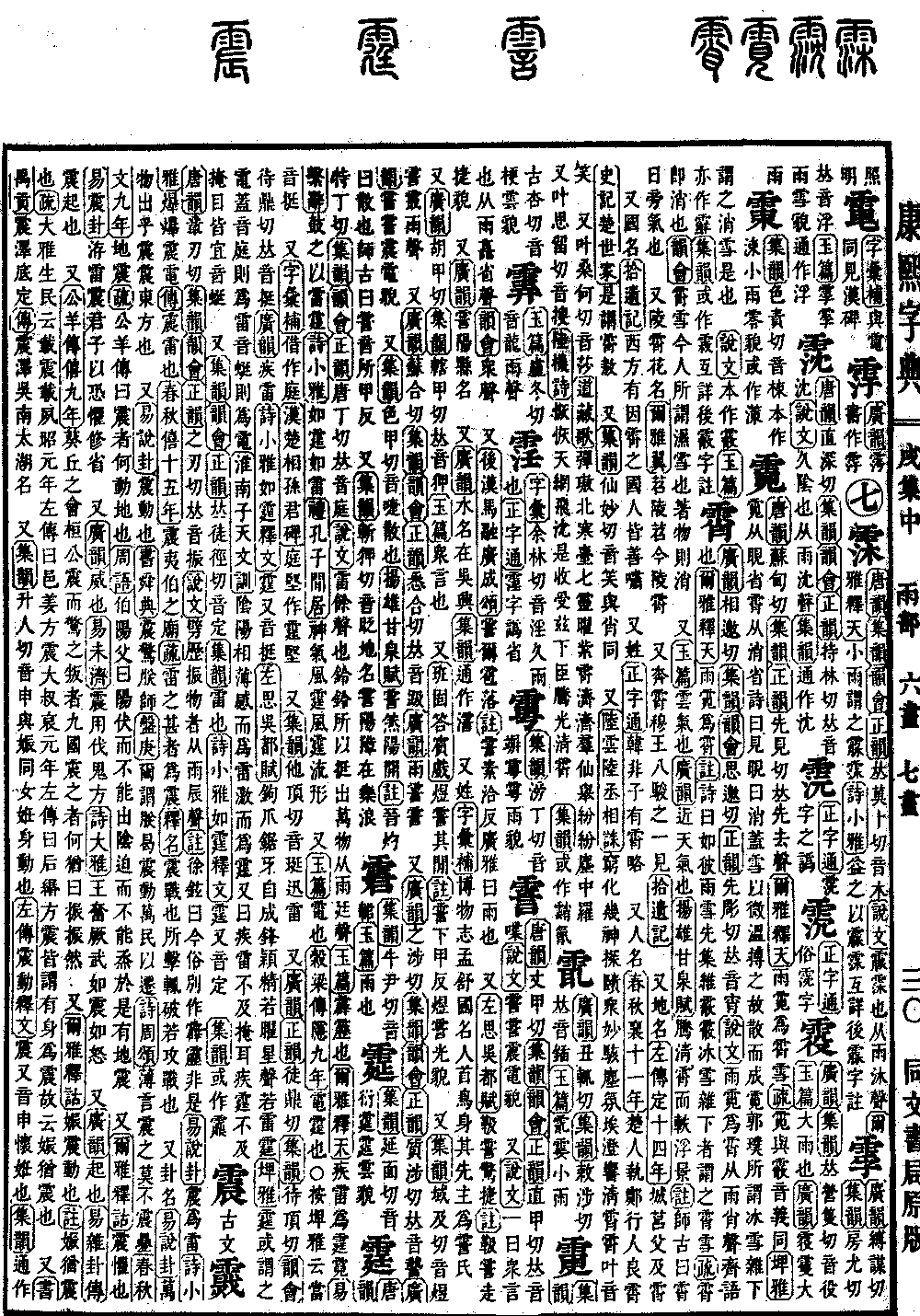
Page 1374, Entry 21
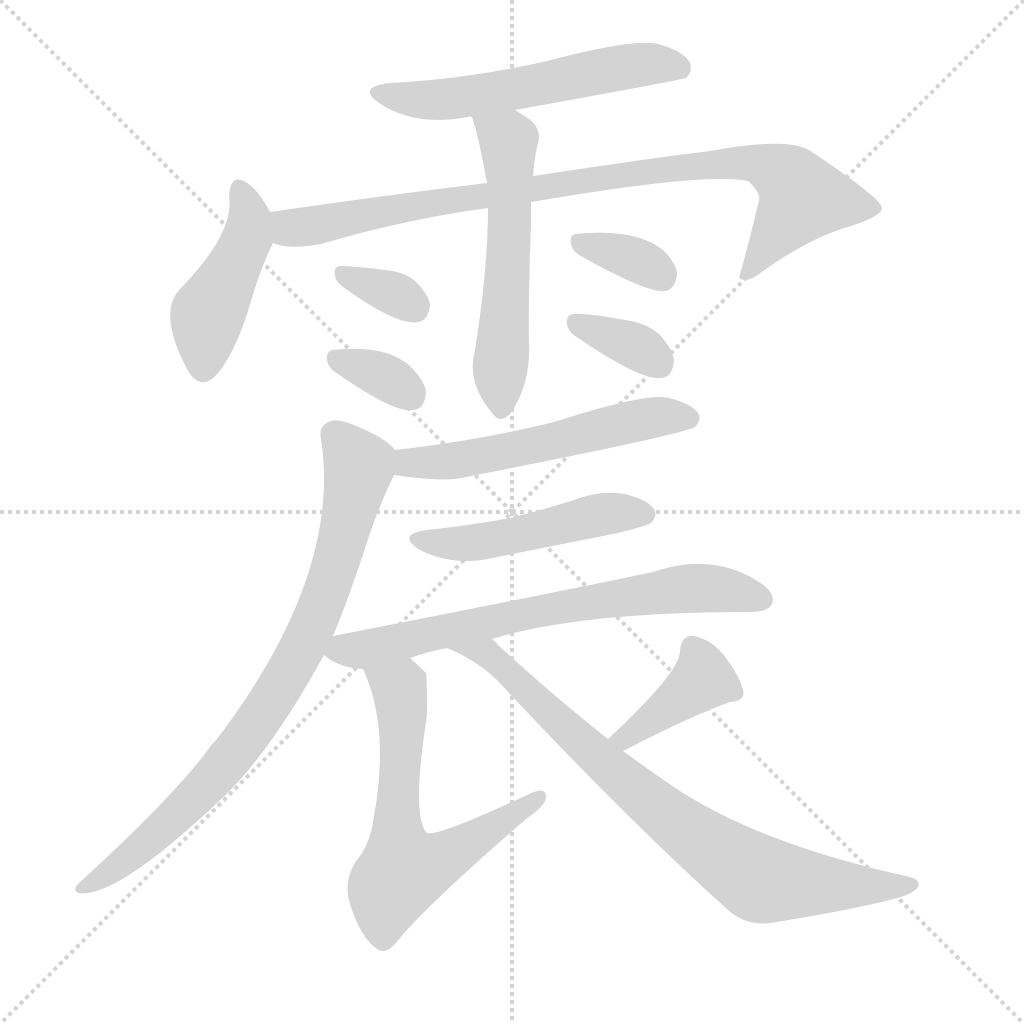
Archaic form. Pronounced zhen.
According to the Tang Rhyme (Tangyun), the Jiyun, the Yunhui, and the Zhengyun, the pronunciation is zhen.
According to the Shuowen Jiezi, it refers to the clap of thunder that shakes objects. It is composed of the radical for rain and the phonetic element chen. Xu Xuan notes that contemporary common usage distinguishes this as pili (thunder), which is incorrect.
Book of Changes (Yijing), Explanation of the Trigrams: Zhen represents thunder.
Book of Odes (Shijing), Lesser Odes: Thunder and lightning.
Commentary: Zhen means thunder.
Spring and Autumn Annals (Chunqiu), 15th year of Duke Xi: Thunder struck the temple of Yibo.
Subcommentary: That which is severe thunder is called zhen.
Shiming: Zhen means to battle, implying that whatever it strikes is shattered as if by a military attack.
Also, the name of a hexagram.
Book of Changes (Yijing), Explanation of the Trigrams: All things emerge from zhen. Zhen is the east.
Also, Book of Changes (Yijing), Explanation of the Trigrams: Zhen means to move.
Book of Documents (Shangshu), Canon of Shun: It shook my army.
Pan Geng: You say to me, why disturb the ten thousand people by moving them?
Book of Odes (Shijing), Odes of Zhou: To shake them; there was none who did not tremble.
Spring and Autumn Annals (Chunqiu), 9th year of Duke Wen: Earthquake.
Subcommentary: The Gongyang Commentary asks, what is zhen? It is the moving of the earth.
Discourses of the States (Guoyu): Boyang Fu said that when the yang principle is suppressed and cannot emerge, and the yin presses upon it, there is an earthquake.
Also, Erya, Explanation of Words: Zhen means to fear.
Book of Changes (Yijing), Hexagram of Zhen: Repeated thunder is zhen; the superior man uses this to fear and cultivate self-reflection.
Also, Guangyun: Authority.
Book of Changes (Yijing), Hexagram of Weiji: Use authority to attack the Guifang.
Book of Odes (Shijing), Greater Odes: The King displayed his martial prowess, as if trembling, as if enraged.
Also, Guangyun: To arise.
Book of Changes (Yijing), Miscellaneous Hexagrams: Zhen means to arise.
Also, Gongyang Commentary, 9th year of Duke Xi: At the meeting of Kuiqiu, Duke Huan intimidated and shocked them, and nine states rebelled. What is the meaning of shocking them? It is akin to saying they were shaken up.
Also, Erya, Explanation of Words: Shen (pregnancy) means to move.
Note: Shen is synonymous with zhen.
Subcommentary: The Greater Odes, Shengmin, says: She was pregnant, she was fast. The Zuo Commentary, 1st year of Duke Zhao, says: Lady Yi was pregnant with Duke Dai. The Zuo Commentary, 1st year of Duke Ai, says: Consort Min was pregnant. All these refer to being with child as zhen, hence it is said that shen is like zhen.
Also, Book of Documents (Shangshu), Tribute of Yu: Zhen Lake was settled.
Commentary: Zhen Lake is the name of Lake Tai, located south of Wu.
Also, Jiyun: Pronounced shen. It is synonymous with shen (pregnancy). It refers to a woman conceiving and feeling the movement of the fetus.
Zuo Commentary, notes on zhen, says: Zhen is also pronounced shen, meaning to be pregnant. Jiyun notes it is commonly written as a variant.
Also, Jiyun: One source says that female palace servants or slaves are called shen.
Also, Yunhui and Zhengyun: Pronounced zhen. To be angry.
Ban Gu, Eastern Capital Rhapsody: Manifesting sudden rage, the responders rose like clouds. Striking like lightning at Kunyang, exerting wrath like a thunderclap.
History of the Former Han (Qianhan), Biographical Preface: The Champion General of the Cavalry was swift, brave, and resolute. Driving long and striking six times, like a lightning strike or a thunderclap.
Note: Yan Shigu says the pronunciation is zhen.
Also, Zihuibu: Zhendan refers to China.
Book of Liang (Liangshu): The king of the Panpan state addressed the Emperor of Liang as the Emperor of Zhendan. Pronounced zhen.