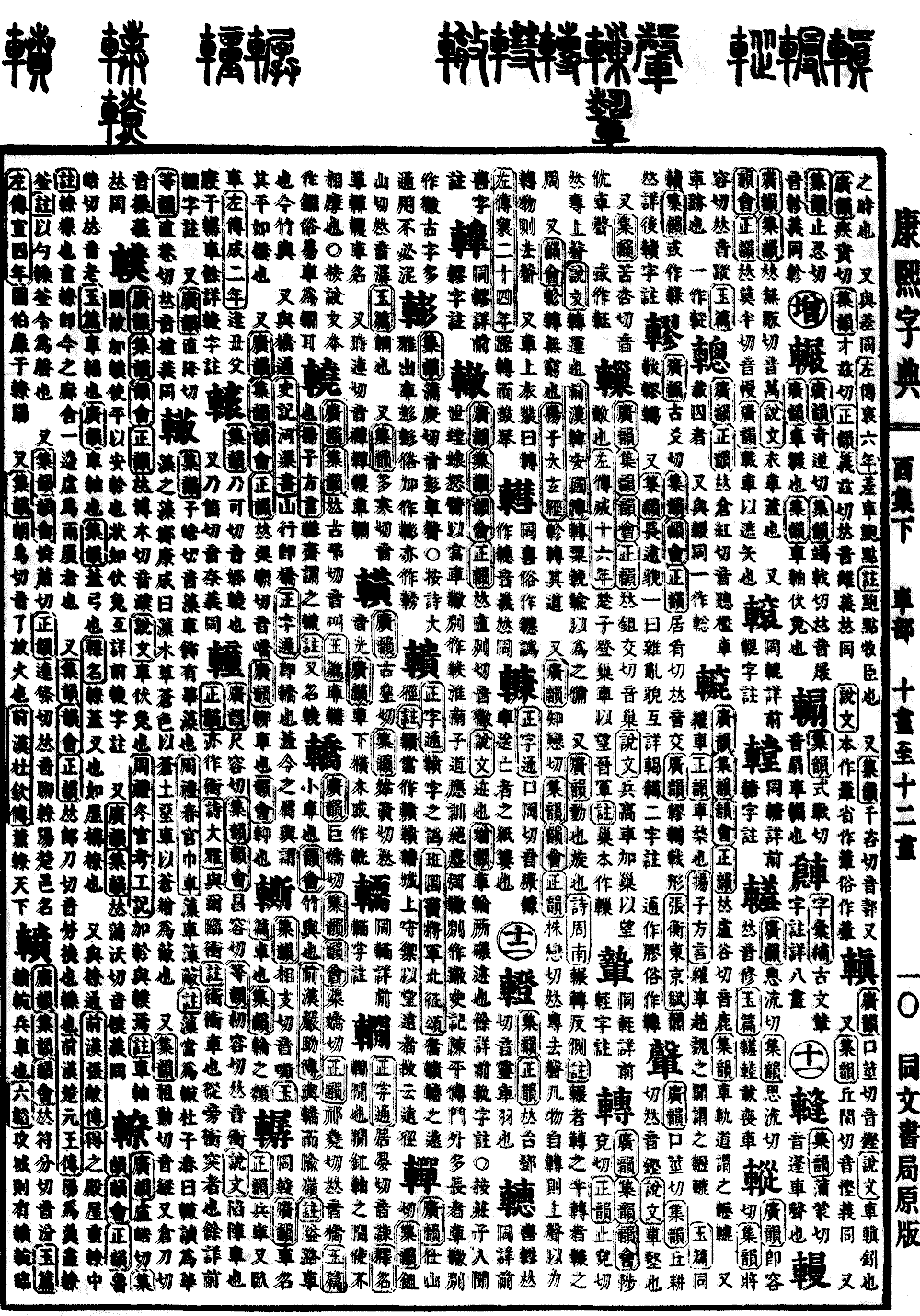
You Collection, Lower Volume
Radical: Carriage (chē)
Page 1248, Entry 18
Pronounced zhuǎn (rising tone).
From Dictionary of Sounds (Guangyun), Collective Dictionary of Sounds (Jiyun), and Collection of Rhymes (Yunhui): Pronounced zhuǎn (rising tone). From Standard Dictionary of Rhymes (Zhengyun): Pronounced zhuǎn (rising tone).
In the Analytical Dictionary of Characters (Shuowen): To transport or convey.
From Biography of Han Anguo in the History of the Former Han (Qianhan shu): To transport grain and haul supplies in preparation for this.
Also, from Dictionary of Sounds (Guangyun): To move, to revolve.
From Book of Odes (Shijing), Zhou Nan section: Tossing and turning from side to side.
Note: To toss is half of a turn, to turn is the completion of a toss.
Also, from Collection of Rhymes (Yunhui): Endless revolving (zhenzhuan). From Tai Xuan Jing by Yang Xiong: Its path revolves endlessly.
Also, from Dictionary of Sounds (Guangyun): Pronounced zhuàn (departing tone). From Collective Dictionary of Rhymes (Jiyun), Collection of Rhymes (Yunhui), and Standard Dictionary of Rhymes (Zhengyun): Pronounced zhuàn (departing tone).
Generally, when an object revolves by itself, it is in the rising tone; when using force to turn an object, it is in the departing tone.
Also, the decorative coverings on a carriage are called zhuan.
From Commentary on the Spring and Autumn Annals (Zuo Zhuan), twenty-fourth year of Duke Xiang: Sitting upon the carriage coverings (zhuan) and playing the zither.