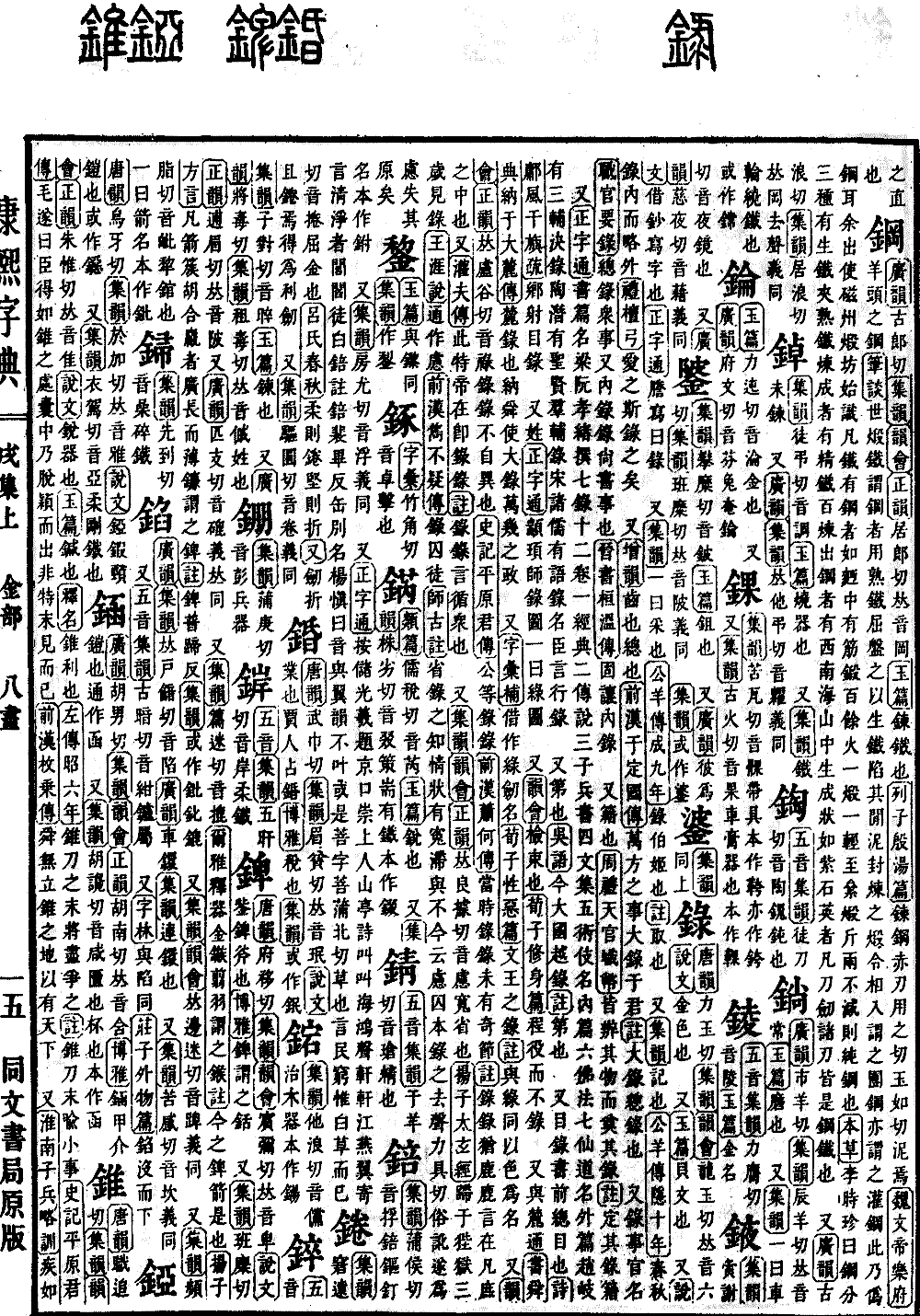
Xu Collection, Upper Volume
Radical: Metal (jīn)
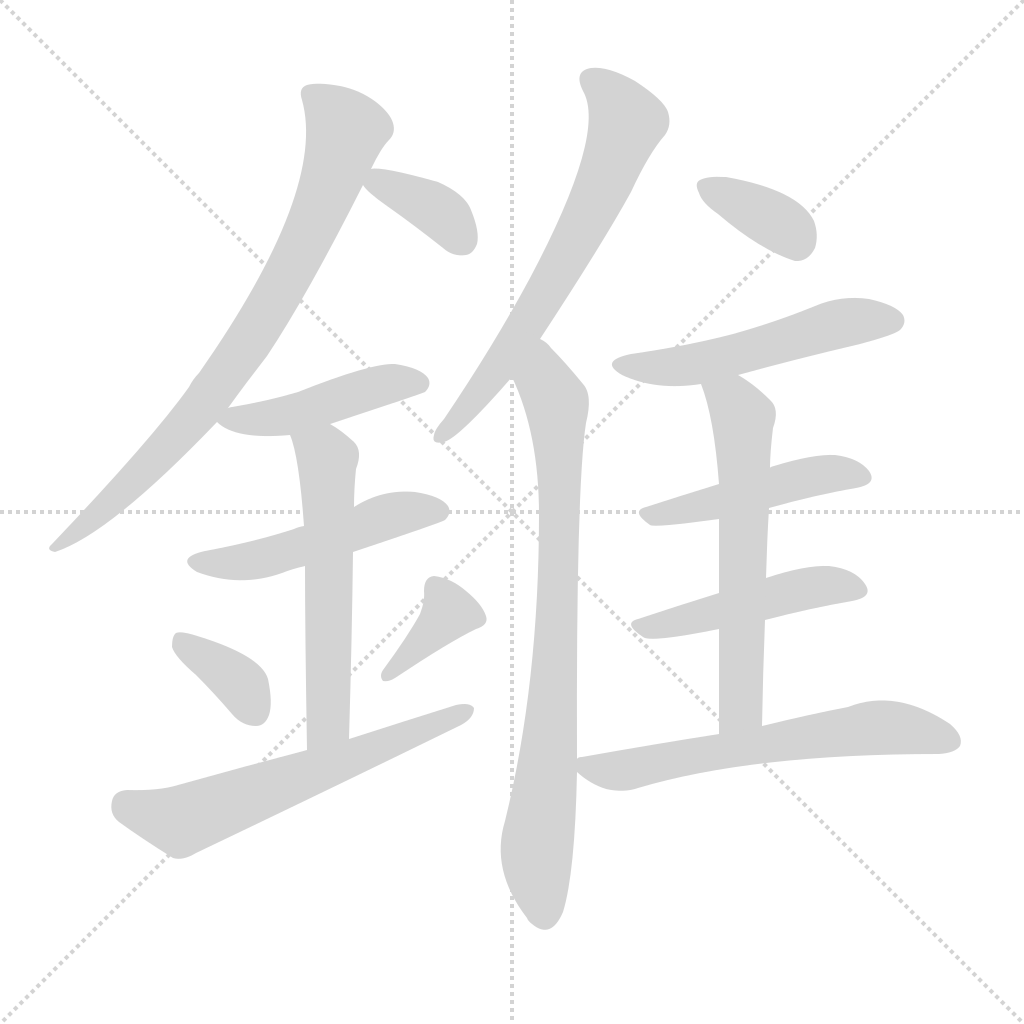
Zhui
Kangxi stroke count: 16
Page 1309, Entry 28
Pronounced zhui.
According to the Explaining Graphs (Shuowen), it is a sharp tool. According to the Jade Chapters (Yupian), it is a needle. According to the Definitions of Names (Shiming), zhui means sharp.
In the Commentary on the Spring and Autumn Annals (Zuo Zhuan), under the sixth year of Duke Zhao, it is written: The tip of an awl or a knife; they will fight to the very end over it. The commentary notes that the tip of an awl or knife is a metaphor for a minor matter.
In the Records of the Grand Historian (Shiji), Biography of Lord Pingyuan, Mao Sui says: If your servant had been placed in a bag like an awl, the tip would have appeared, so it is not just the tip that would be seen.
In the History of the Former Han (Qian Han Shu), Biography of Mei Cheng, it is written: Shun did not have a piece of land the size of an awl, yet he possessed the world.
Furthermore, in the Huainanzi, Principles of Military Strategy, it is written: As fast as an awl or an arrow. The commentary notes that an awl is an arrow with a metal tip and feathered shaft.
Furthermore, "hair awl" is a term for a brush. In the History of the Five Dynasties (Wudai Shi), Biography of Shi Hongzhao, it is written: To pacify the court and settle turmoil, one must use long spears and great swords; of what use are these hair awls?