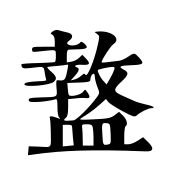
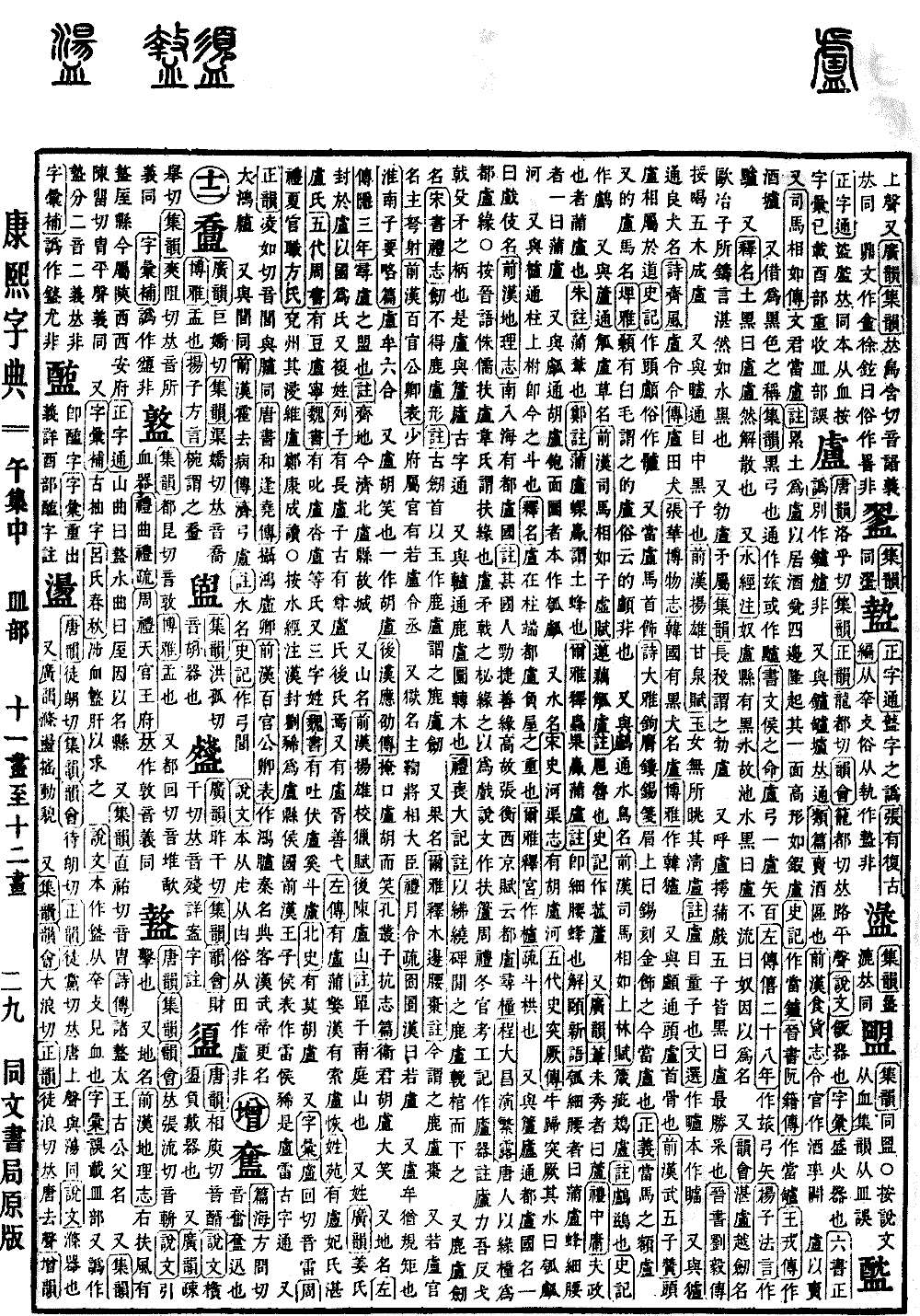
Wu Collection, Middle Volume
Radical: Vessel (mǐn)
Zhou
Kangxi stroke count: 17
Page 797, Entry 13
Tang Rhyme (Tangyun), Collected Rhymes (Jiyun), and Rhyme Meeting (Yunhui) cite the pronunciation as zhou (level tone). In the Explaining Graphs and Analyzing Characters (Shuowen Jiezi), it is defined as striking or pulling. Also a place name. According to the Former Han Geography Treatise (Qianhan Dilizhi), there is Zhouzhi County in the Youfufeng region, which currently belongs to Xi'an Prefecture in Shaanxi. According to the Correct Character Guide (Zhengzitong), a bend in a mountain is called zhou, and a bend in a river is called zhi, which is how the county received its name.
Also, according to the Collected Rhymes (Jiyun), pronounced zhou (falling tone). In the Poetry Commentary (Shichuan), Zhuzhou is the name of the ancient Duke Danfu, the Grand King. Also, according to the Collected Rhymes (Jiyun), pronounced liu (level tone), with the same meaning. Also, according to the Supplement to the Dictionary (Zibu), it is an ancient form of the character chou. In the Spring and Autumn of Master Lu (Lushi Chunqiu), it is written that one wades through blood and draws out the liver to seek it. In the Explaining Graphs and Analyzing Characters (Shuowen Jiezi), it was originally written with the radical for to tap (pu), meaning to see blood. The Dictionary (Zihui) mistakenly categorized it under the vessel (mǐn) radical. It is also erroneously written as a different form, separated into two pronunciations and meanings, which is incorrect. The Supplement to the Dictionary (Zibu) notes it is erroneously written as another form, which is even more incorrect.