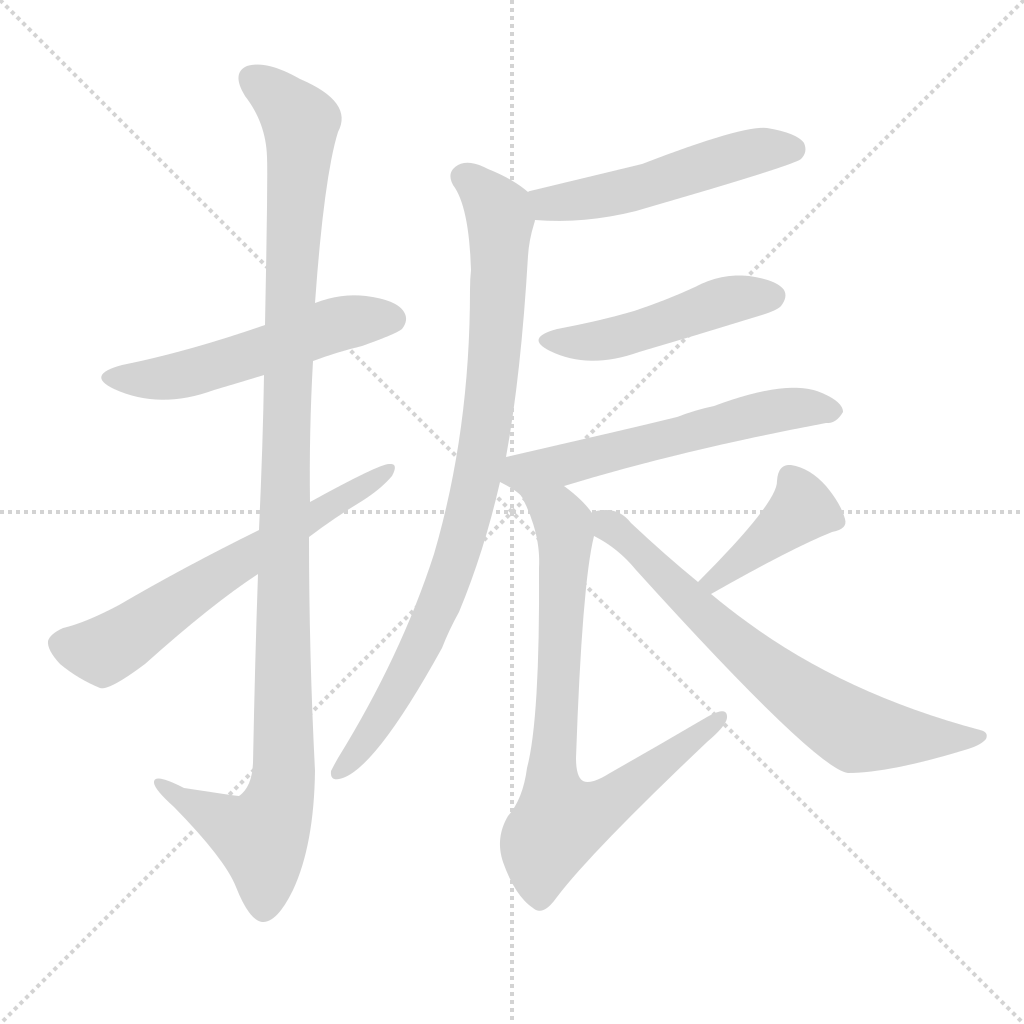
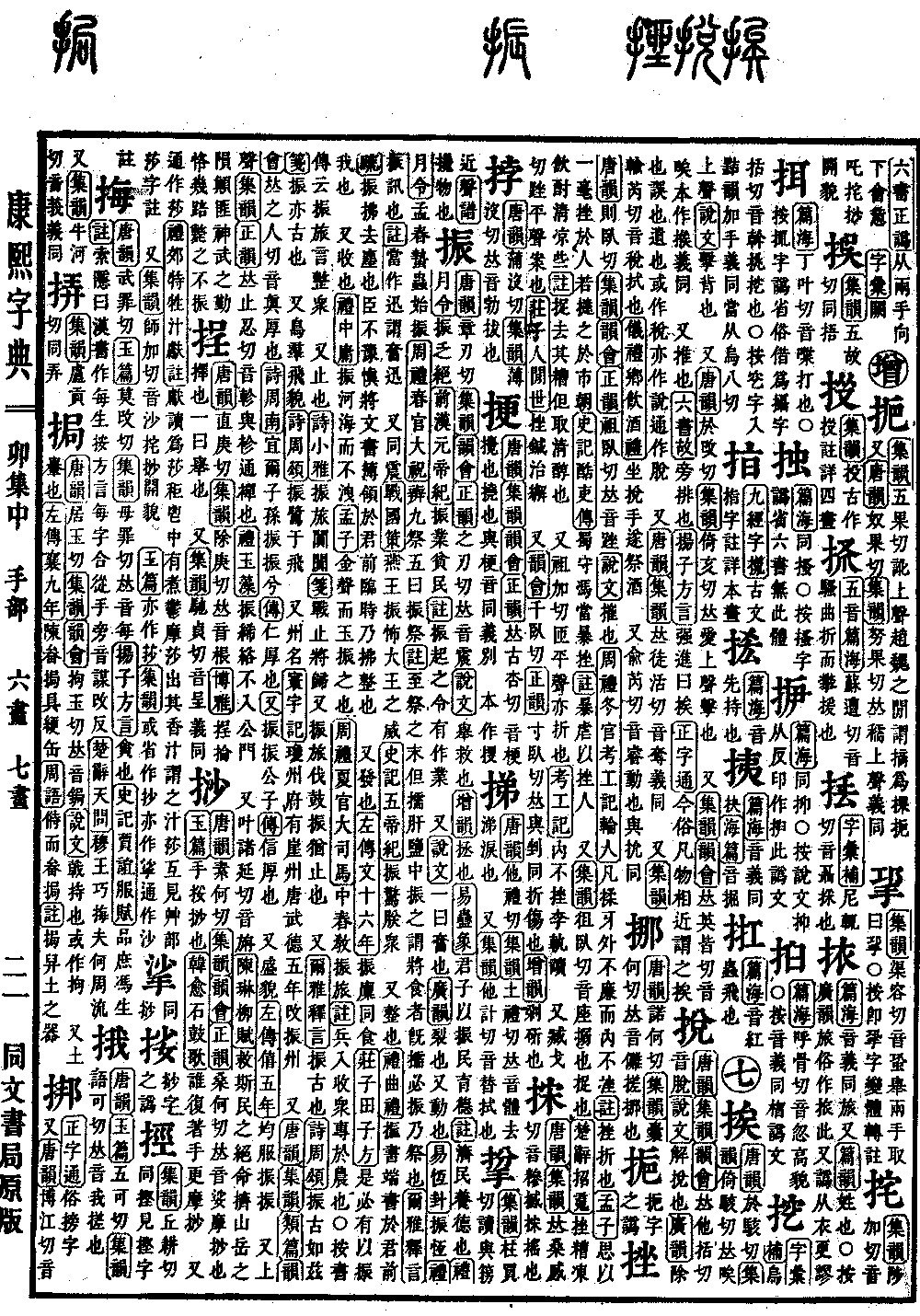
Mao Collection, Middle Volume
Radical: Hand (shǒu)
Kangxi Strokes: 11
Page 431, Entry 28
Pronounced zhen (falling tone).
From Shuowen Jiezi: To lift up and save.
From Zengyun: To rescue.
From the Book of Changes (Yijing), commentary on the Gu hexagram: The superior man thereby rescues the people and nourishes their virtue. Commentary: To aid the people and cultivate virtue.
From the Book of Rites (Liji), Monthly Ordinances: To provide relief to the destitute and impoverished.
From the History of the Former Han (Qianhan Shu), Annals of Emperor Yuan: To provide aid to the destitute. Commentary: To lift them up so they may have livelihoods.
Also, from Shuowen Jiezi: One definition is to rouse or strive.
From Guangyun: To rend; also to move.
From the Book of Changes (Yijing), Heng hexagram: To rouse perseverance.
From the Book of Rites (Liji), Monthly Ordinances: In the first month of spring, the hibernating insects begin to stir.
From the Rites of Zhou (Zhouli), Spring Officials, Grand Invocation: Distinguishing the nine types of sacrifice, the fifth is the shaking sacrifice. Commentary: At the end of the sacrifice, one dips the liver into salt and shakes it; this implies that the person who is about to partake has already dipped it, so it must be shaken before the sacrifice is performed.
From Erya, Interpretation of Words: To shake is to be quick. Commentary: It should be written as the character meaning swift, signifying energetic movement.
Also the same as to shake or vibrate.
From Strategies of the Warring States (Zhanguo Ce): The King of Yan was shaken with fear at your majesty's power.
From the Records of the Grand Historian (Shiji), Annals of the Five Emperors: To shock and alarm my masses.
Also, to set in order.
From the Book of Rites (Liji), Record of Customary Propriety: To shake out and straighten a document when in the presence of the ruler. Sub-commentary: To shake means to dust off; a subject who has not been careful beforehand and brings documents into the presence of the ruler, only cleaning them at the last moment, is arranging them.
Also, to issue or distribute.
From the Zuo Tradition (Zuozhuan), 16th year of Duke Wen: To open the granaries and eat together.
From the Zhuangzi, Tian Zifang: This must have something with which to inspire me.
Also, to contain or collect.
From the Doctrine of the Mean (Zhongyong): To hold the rivers and seas without leaking.
From the Mencius: Using the sound of bells to begin the music and the sound of chimes to conclude it.
From the Rites of Zhou (Zhouli), Summer Officials, Grand Marshal: In mid-spring, teach the mobilization of troops. Commentary: When the army returns, it gathers the people to focus on farming. Records and commentaries state that the mobilization of troops refers to organizing the military.
Also, to stop.
From the Book of Odes (Shijing), Lesser Odes: The troops are returning, the sound is continuous. Commentary: Military operations have ceased and the troops are returning. Also, the beating of drums to signal the end of a battle. Here, to shake is synonymous with to stop.
Also, from Erya, Interpretation of Words: To shake is to be ancient.
From the Book of Odes (Shijing), Eulogies of Zhou: From of old it has been thus. Commentary: Here, to shake also means ancient.
Also, the appearance of birds flying in groups.
From the Book of Odes (Shijing), Eulogies of Zhou: The egrets are flying in a group.
Also, the name of a prefecture.
From the Universal Geography (Huanyu Ji): Qiongzhou Prefecture contains Yazhou; in the fifth year of the Wude reign of the Tang dynasty, it was renamed Zhenzhou.
Also pronounced zhen.
Thick or generous.
From the Book of Odes (Shijing), Odes of Zhou and the South: May your descendants be prosperous and generous. Commentary: Meaning benevolent and thick.
Also: The prosperous and generous son. Commentary: Honest and sincere.
Also, an appearance of grandeur.
From the Zuo Tradition (Zuozhuan), 5th year of Duke Xi: Uniformly dressed and grand.
Also in the rising tone.
Pronounced zhen.
Interchangeable with the character for a single-layered garment.
From the Book of Rites (Liji), Jade Pattern: One wearing a single-layered garment of fine or coarse hemp may not enter the official gate.
Also, rhyming with zhan.
From the Rhapsody on the Willow (Liu Fu) by Lin: To save these people from their desperate fate, to prop up the falling mountains. Were it not for the diligent piety of the gods, I would have fallen and died unable to rise.