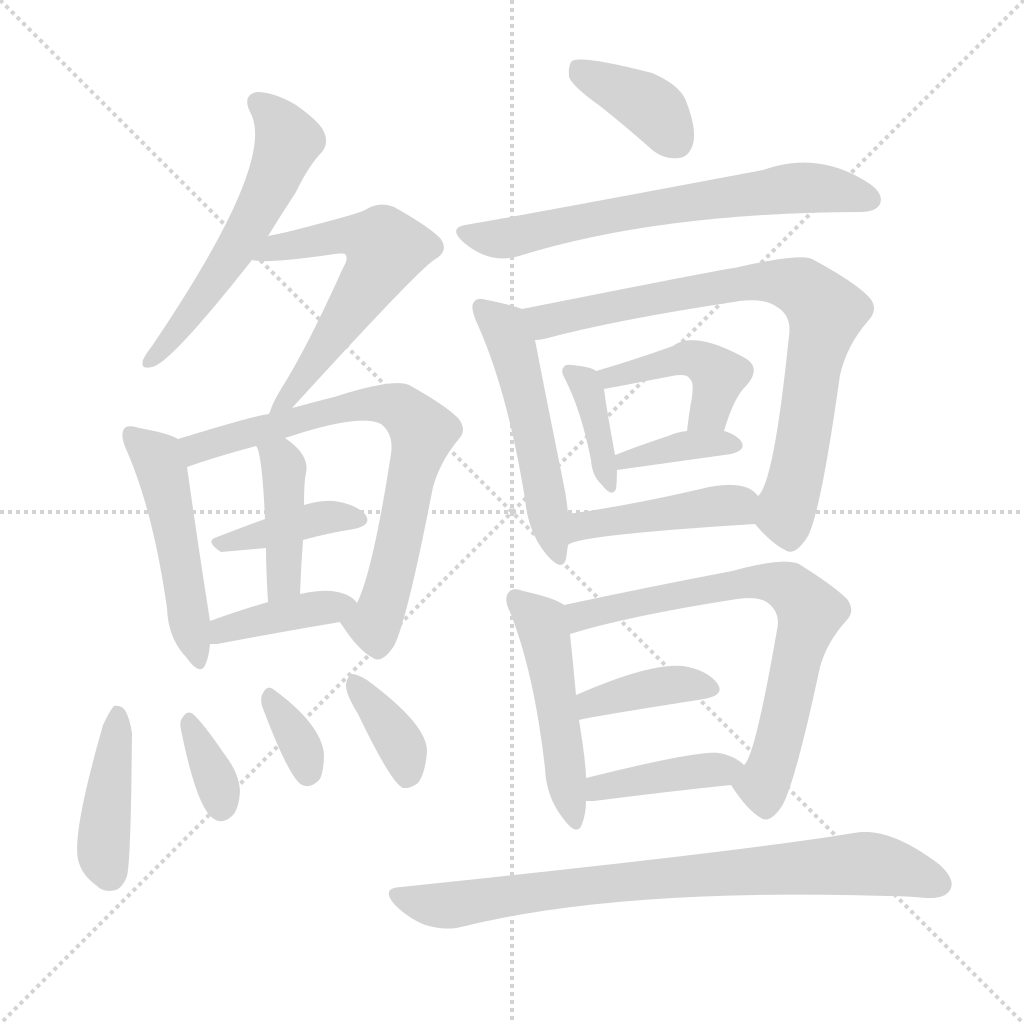
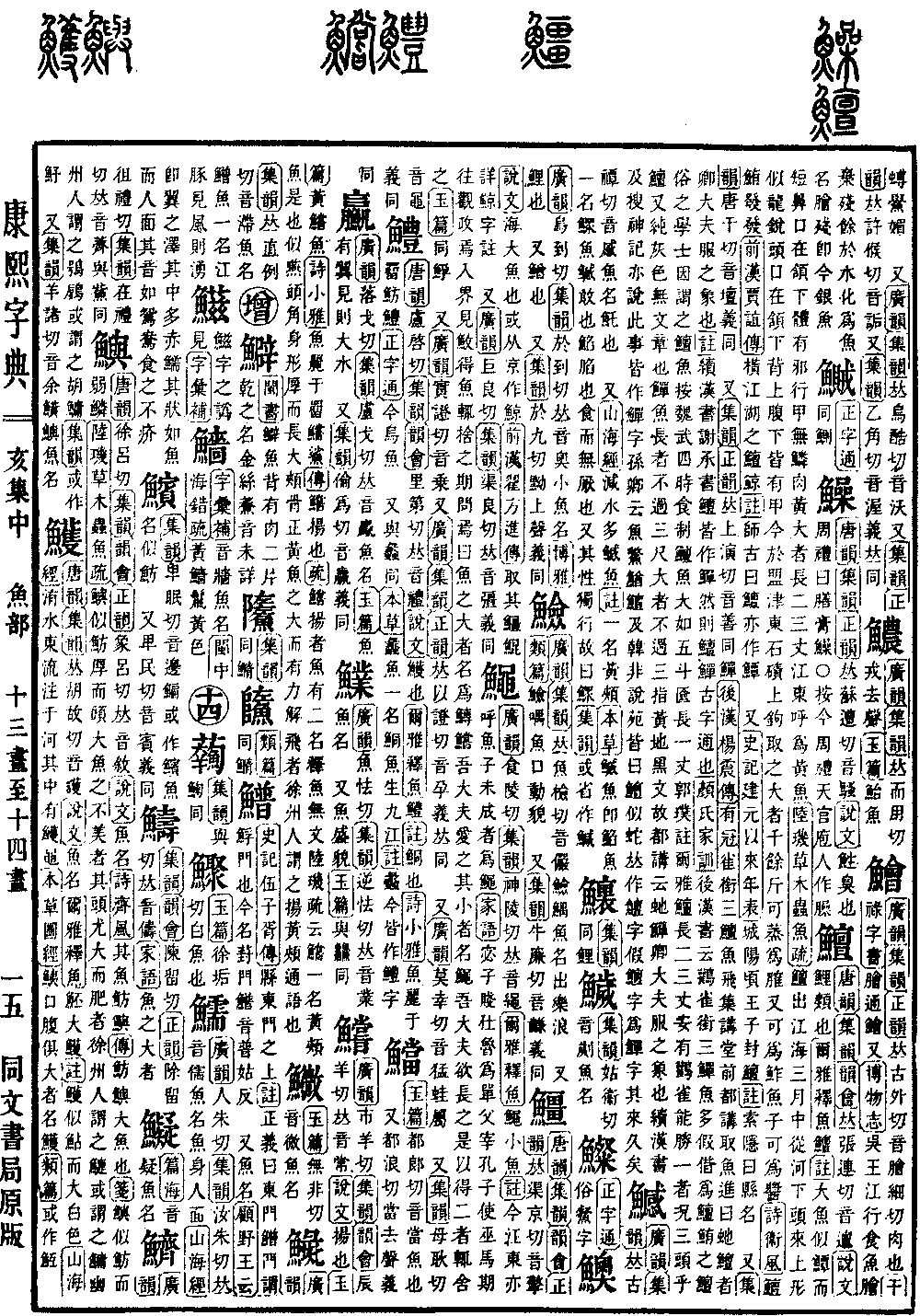
Hai Collection, Middle Volume. Radical: Fish (yú).
Kangxi Stroke Count: 24. Page 1479, Entry 05.
Pronounced zhan.
Shuowen Jiezi (Explaining Graphs and Analyzing Characters): A type of carp.
Erya: Explanations of Fish: Zhan.
Commentary: A large fish. It resembles the sturgeon but has a short snout, a mouth situated under the chin, and an body covered with diagonal plates. It has no scales and yellow flesh. The largest ones reach twenty to thirty feet in length. In the Jiangdong region, it is called the yellow fish.
Lu Ji: Commentary on the Plants, Trees, Insects, and Fish: The zhan originates in the rivers and seas. In the third month, they travel upstream from the mouth of the river. Their shape resembles a dragon with a pointed head and a mouth under the chin; they have plates on both their backs and bellies. Today, they are caught with hooks on the stone shoals east of Mengjin. The largest weigh over a thousand jin and can be steamed. They can also be made into pickled fish, and the fish roe can be made into paste.
Book of Odes (Shijing), Wei Feng: The zhan and the tuna are abundant.
Book of Han (Hanshu), Biography of Jia Yi: Traversing the zhan and whales of the Yangtze River.
Commentary: Yan Shigu says: Zhan is also written as xun.
Also, Records of the Grand Historian (Shiji), Chronological Table since the Jianyuan Era: The King of Chengyang, Qing, had a son enfeoffed at Zhan.
Commentary: Suoyin says: It is the name of a county.
Also, Collection of Rhymes (Jiyun): Pronounced tan. Meaning is the same.
Also, Collection of Rhymes (Jiyun) and Corrected Rhymes (Zhengyun): Pronounced shan. Identical to shan (eel).
Book of Later Han (Hou Hanshu), Biography of Yang Zhen: A crested bird held three zhan fish in its beak, flew, and landed in front of the lecture hall. The lecturer took the fish and presented them, saying: The snake-like zhan is an omen representing the robes of high officials.
Commentary: The Sequel to the Book of Han (Xu Hanshu) and the book by Xie Cheng both write zhan as shan. Thus, zhan and shan were used interchangeably in ancient times.
Family Instructions of the Yan Clan (Yanshi Jiaxun): The Book of Later Han (Hou Hanshu) says: A stork held three eel fish in its beak. This is often a loan for the zhan of zhan-wei (the sturgeon). Common scholars therefore call it the zhan fish. According to the Four Seasons Dietary Regulations of Wei Wu, the zhan fish is as large as a five-dou vessel and ten feet long. Guo Pu's commentary on the Erya says the zhan is twenty to thirty feet long. How could a stork carry one, let alone three? Furthermore, the zhan is pure gray without patterns. The eel is no longer than three feet and no thicker than three fingers, with a yellow background and black markings. Therefore, the lecturer said: The snake-like zhan is an omen representing the robes of high officials. The Sequel to the Book of Han (Xu Hanshu) and the In Search of the Supernatural (Soushen Ji) also recount this event, all using the character for eel. Xun Kuang (Xunzi) says: fish, turtles, loaches, and zhan. Also, Han Fei and the Garden of Stories (Shuoyuan) all say the zhan resembles a snake, using the character zhan. The borrowing of the character zhan for the character shan has been common for a long time.