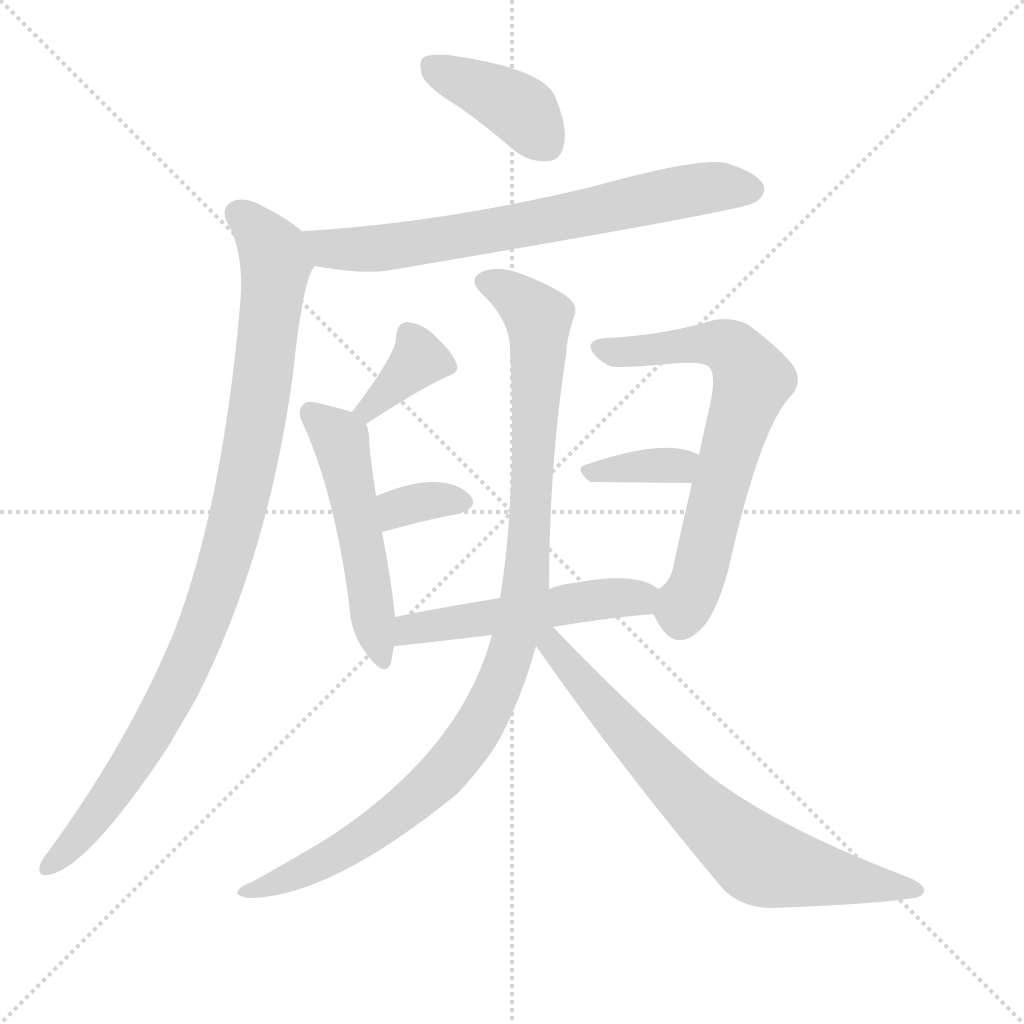
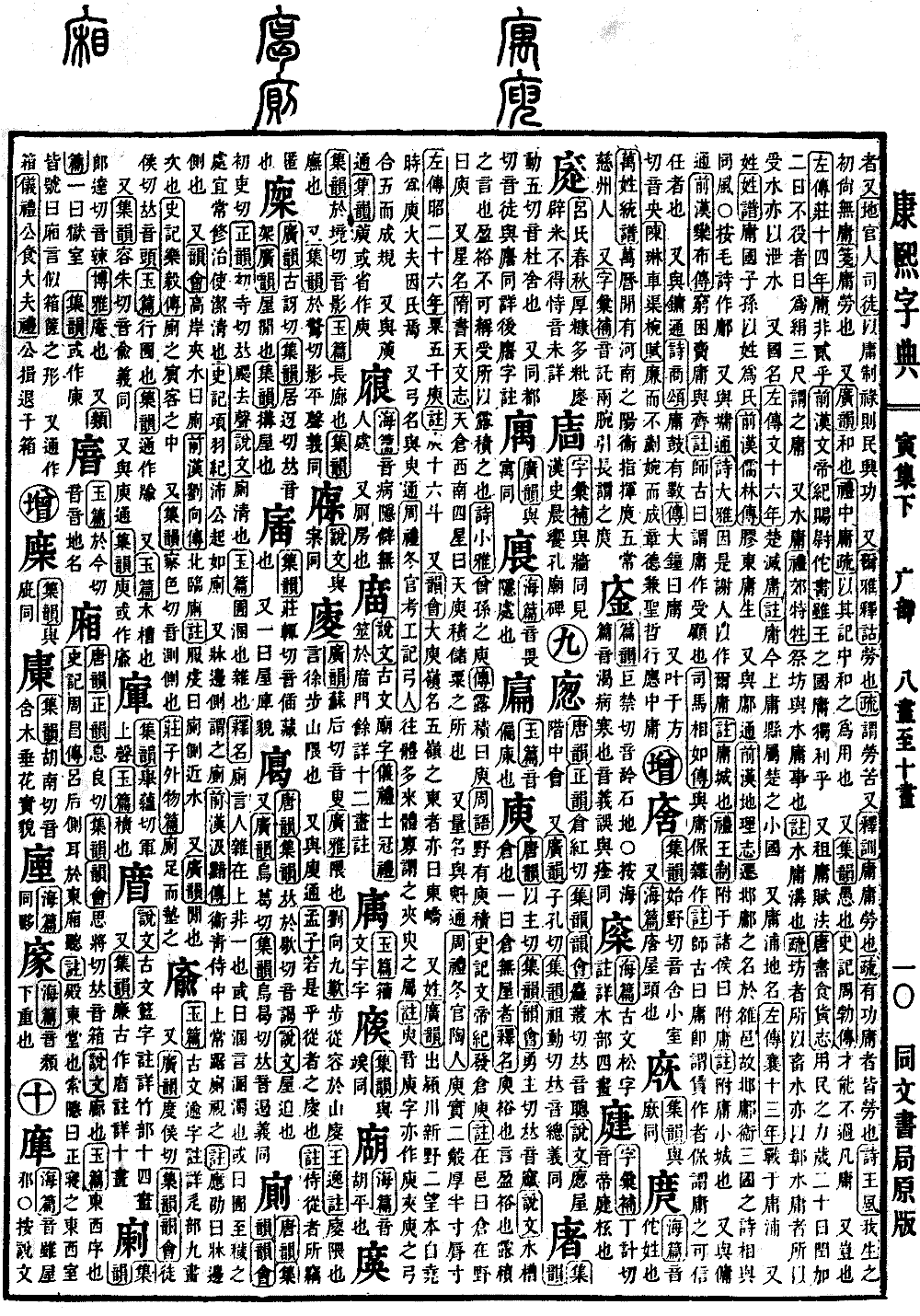
Yin Collection, Lower Volume
Radical: Wide (guǎng)
Kangxi strokes: 12
Page 348, Entry 14
Pronounced yu (rising tone).
Shuowen Jiezi (Explanation of Graphs and Analysis of Characters) defines it as a water-trough granary. Another theory suggests it is a storehouse without a roof.
Shiming (Explication of Names) states: The term yu signifies abundance. It refers to the practice of storing grain in the open air, implying such a surplus that it cannot be contained, necessitating open-air storage.
Book of Odes (Shijing), Xiaoya: The granaries of the great-grandson.
Commentary: Open-air storage is called a yu.
Discourses of the States (Guoyu): In the fields, there are piles of grain stored in the open.
Records of the Grand Historian (Shiji), Annals of Emperor Wen: Opened the granaries and the outdoor grain piles.
Annotation: That which is within city walls is called a cang (granary), while that which is in the wilderness is called a yu.
Also the name of a star formation.
Book of Sui (Suishu), Treatise on Astronomy: The four stars to the southwest of the Celestial Granary star are called Tianyu (Celestial Yu), which is the place where grain is stored.
Also a unit of volume. Interchangeable with the character jia.
Rites of Zhou (Zhouli), Winter Officials, Potters: The capacity of a yu is two hu, with walls half an inch thick and a rim one inch wide.
Zuo Commentary (Zuo Zhuan), 26th Year of Duke Zhao: Five thousand yu of millet.
Annotation: One yu is equal to sixteen dou.
Also according to the Rhyme Compendium (Yunhui): Dayu is the name of a mountain range, the easternmost of the Five Peaks. It is also called Dongqiao.
Also a surname.
Guangyun (Broad Rhymes): Originates from the two great commanderies of Yingchuan and Xinye. The lineage originally derived from a title of nobility held during the reign of Emperor Yao, from which the surname was adopted.
Also a type of bow. Interchangeable with the character yu.
Rites of Zhou (Zhouli), Winter Officials, Records of the Artisans, Bow Makers: A bow with more outward curvature and less inward curvature is called a category of jia-yu.
Explication of Texts (Shiwen): The character yu is pronounced as yu. The annotation is written as yu. It states that for this type of jia-yu bow, five of them joined together form a circle.
Also interchangeable with the character representing a variant.
Jiyun (Collection of Rhymes): Sometimes written in a simplified form.
Critical Evaluation:
Rites of Zhou (Zhouli), Winter Officials, Records of the Artisans, Bow Makers: Outward curvature is greater and inward curvature is less, which is called a category of jia-yu.
Annotation: The character yu is pronounced as yu, and the character is also written as yu. For this type of jia-yu bow, five of them joined together form a circle. Following the original text, the section after the annotation is revised to: The Explication of Texts (Shiwen) pronunciation is yu. The annotation is written as yu. It states that for this type of jia-yu bow, five of them joined together form a circle.