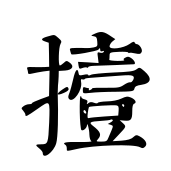
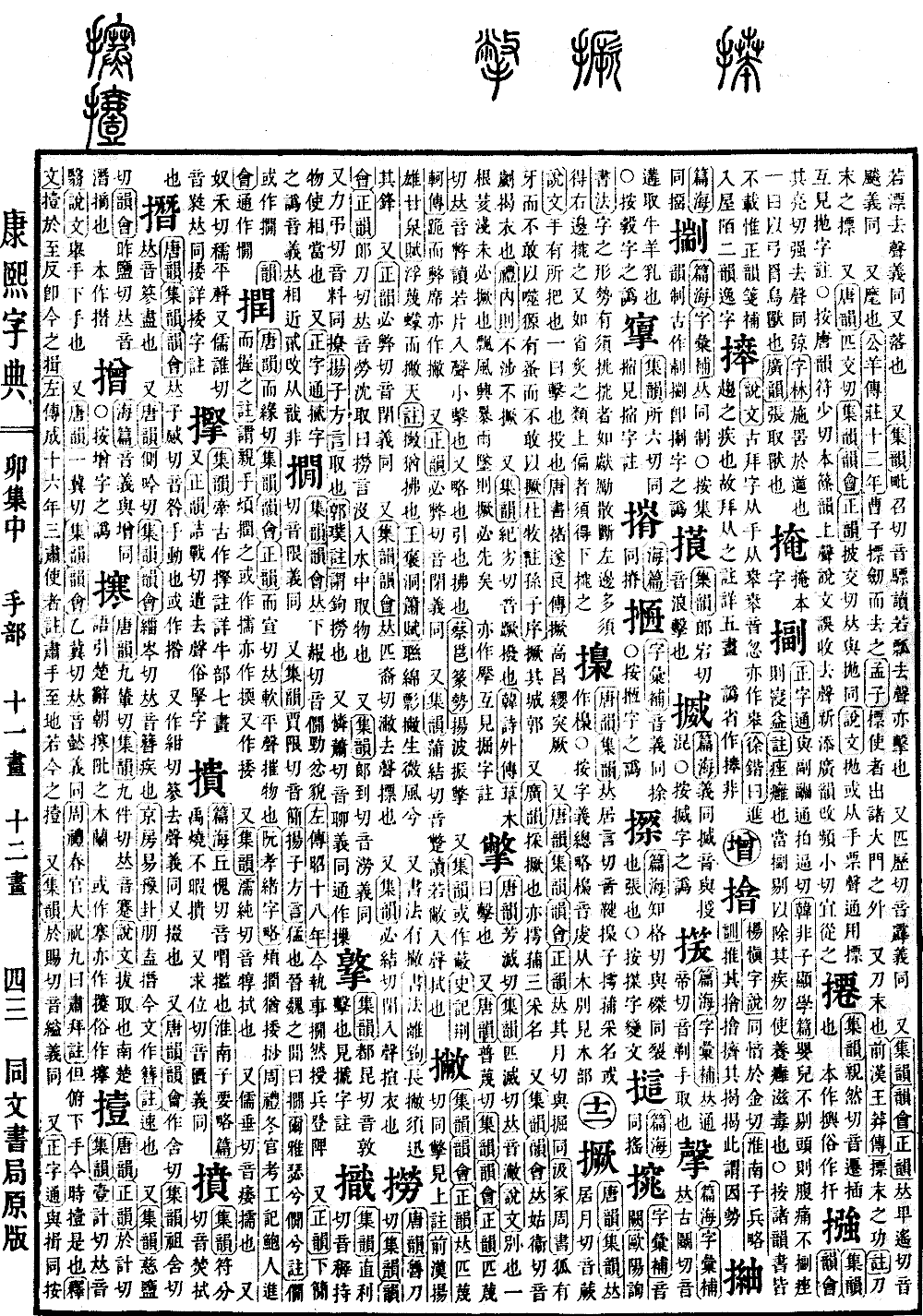
Mao Collection, Middle Volume. Radical: Hand (shǒu). Kangxi Stroke Count: 16. Page 453, Entry 34.
Pronounced yi (falling tone). According to the Explaining Graphs and Analyzing Characters (Shuowen Jiezi), it refers to the act of raising the hands and then lowering them, which is a form of ritual etiquette.
Also pronounced yi (falling tone). The meaning is the same. In the Rites of Zhou (Zhouli), section on the Ministry of Spring, specifically the Grand Invocation, the commentary notes that it is simply bowing the body and lowering the hands, which is the same as the modern act of bowing (yi). The Explanation of Texts (Shiwen) states that it is pronounced yi (falling tone) and corresponds to the modern act of bowing (yi). In the Commentary on the Zuo Tradition (Zuo Zhuan), in the entry for the sixteenth year of Duke Cheng, the commentary describes bowing with the hands reaching the ground, similar to the modern act of bowing.
Also pronounced yi (falling tone). The meaning is the same. According to the Correction of Characters (Zhengzitong), it is the same as bowing (yi). Note: The act of raising the hands and then lowering them is bowing (yi). Although the pronunciation has shifted to the departing tone, the meaning remains unchanged. The Records of the Six Scripts (Liushu Gu) suggests that the phonological analysis provided by Sun Mian is erroneous, and this assessment is correct.