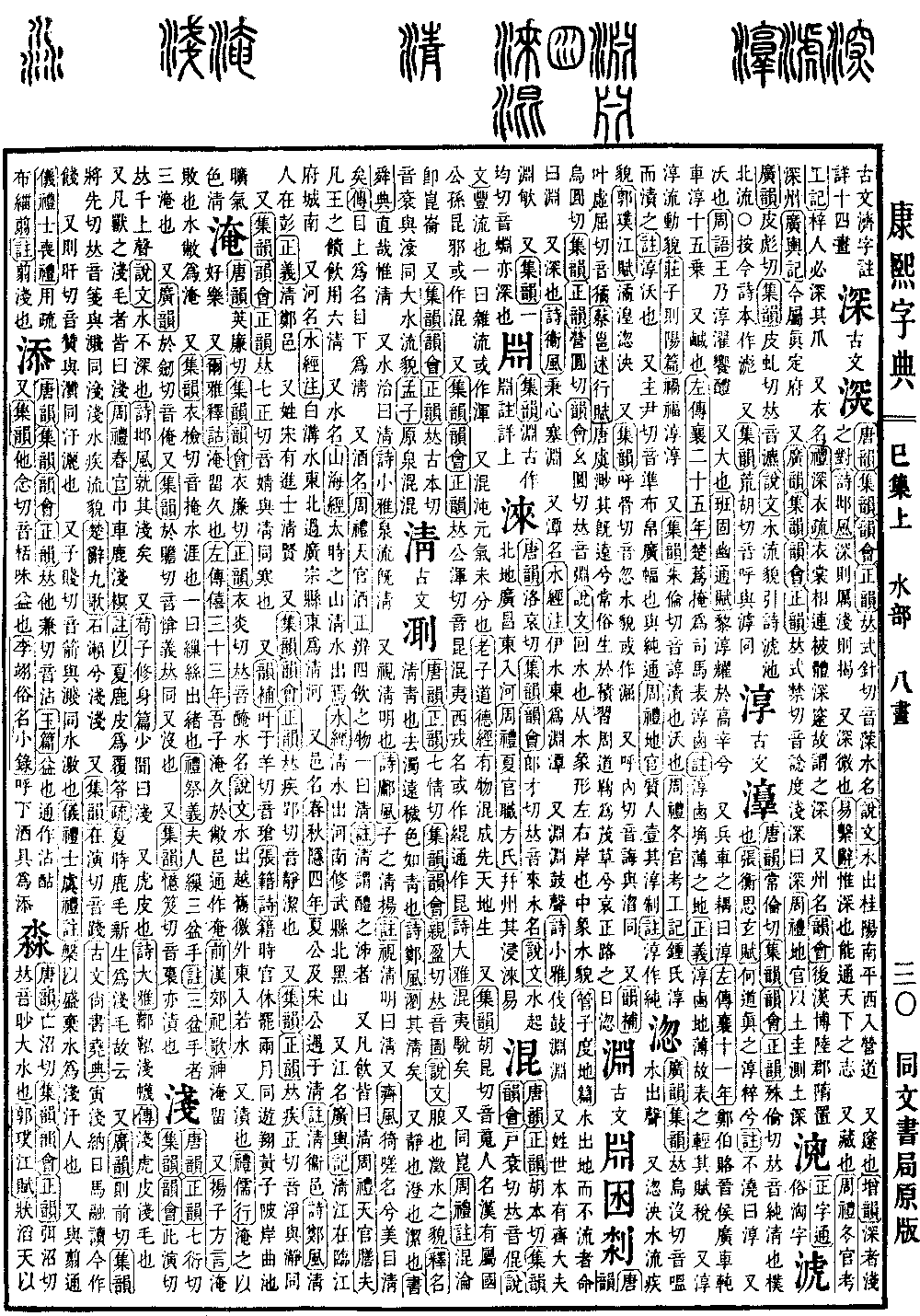
Si Collection, Upper Volume
Radical: Water (shuǐ)
Kangxi Strokes: 12
Page 632, Entry 17
Pronounced yan (level tone).
Pronounced yan (level tone).
Pronounced yan (level tone).
The pronunciation is the same as the character for pickling. This refers to the name of a river.
The Explaining and Analyzing Characters (Shuowen Jiezi) records: This river originates beyond the frontier of Yuexi and flows east into the Ruo River.
It also refers to soaking or moistening.
Book of Rites (Liji), section on The Conduct of the Scholar (Ruxing): To use music and hobbies to nurture and influence one's character.
Also, in the Er Ya (Erya), section on Explaining Ancient Terms (Shigu), it means to stay or linger, referring to a long duration or a prolonged stay.
Zuo Commentary (Zuozhuan), Year 33 of Duke Xi: You have stayed in our humble dwelling for too long.
This meaning is also synonymous with the character yan.
History of the Former Han (Qian Hanshu), Hymns for Suburban Sacrifices (Jiaosi Ge): The spirits linger.
Also, in Yangzi's Dialects (Fangyan): Yan refers to spoilage or decay. When water spoils, it is called yan.
Also, in the Collection of Rhymes (Jiyun), it is pronounced yan (rising tone), with the same sound as the character for cover. It refers to the edge of the water.
Another theory suggests it refers to the act of pulling the end of the silk thread when reeling silk.
Book of Rites (Liji), section on Meaning of Sacrifices (Jiyi): The lady, when reeling silk, immerses her hands into the basin three times.
The commentary explains: The meaning of three basin immersions is to soak them three times.
Also, in the Extensive Dictionary of Rhymes (Guangyun), it is pronounced yan (falling-rising tone), with the same sound as the character for I.
Also, in the Collection of Rhymes (Jiyun), it is pronounced yan (falling tone), with the same sound as that character. The meaning is the same.
It also refers to being submerged or flooded.
Also, in the Collection of Rhymes (Jiyun), it is pronounced yi (entering tone), with the same sound as the character for fragrant. This also means to soak or moisten.
Textual Research:
Book of Rites (Liji), section on The Conduct of the Scholar (Ruxing): "Soaking with good music." Note: In the original text, the order of "good" and "music" has been corrected.
Also used interchangeably with the character yan.
History of the Former Han (Qian Hanshu), Hymns for Suburban Sacrifices (Jiaosi Ge): "The spirits linger." Note: In the original text, the characters have been corrected to read as the variant form.