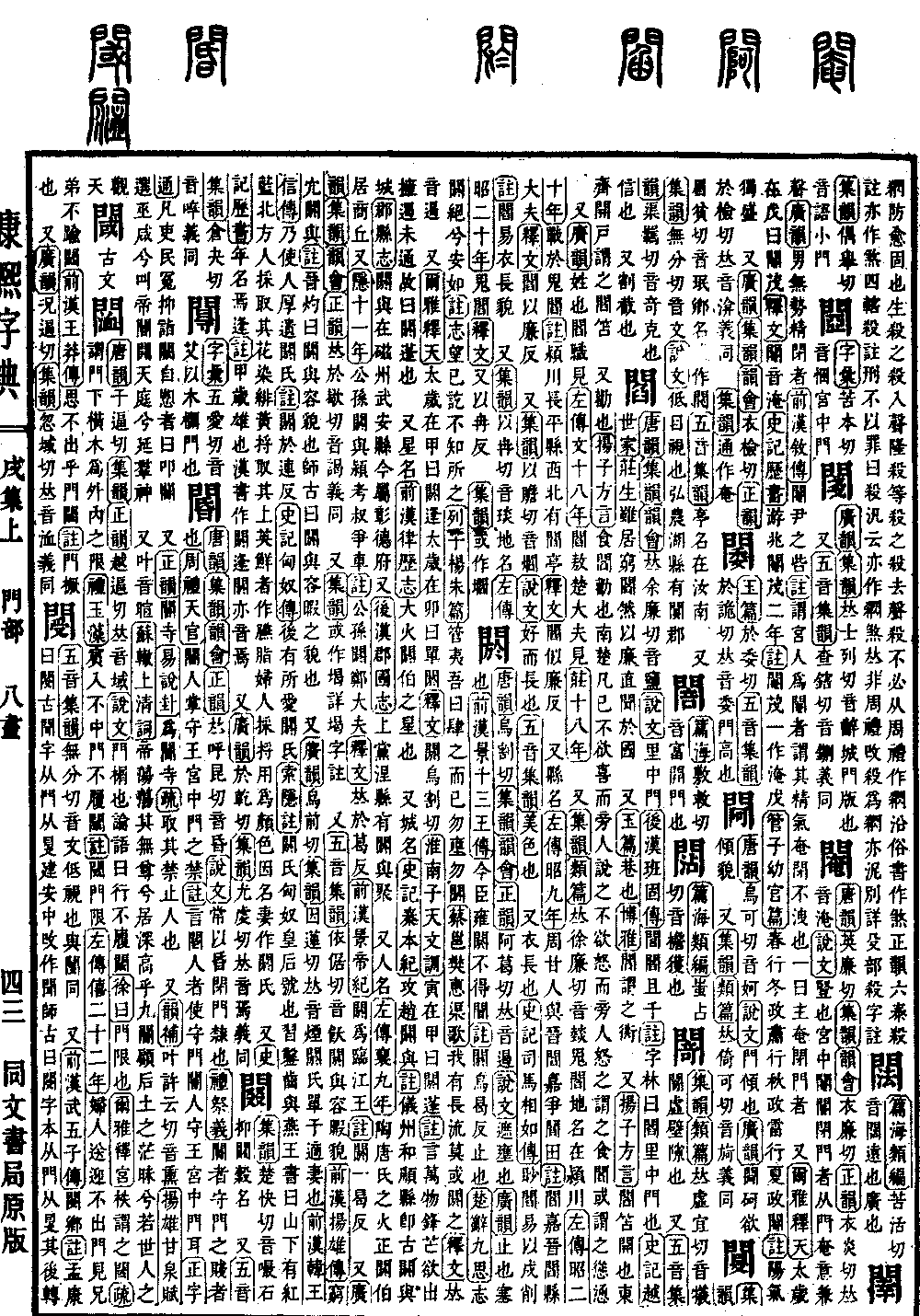
Xu Collection, Upper Volume
Radical: Gate (mén)
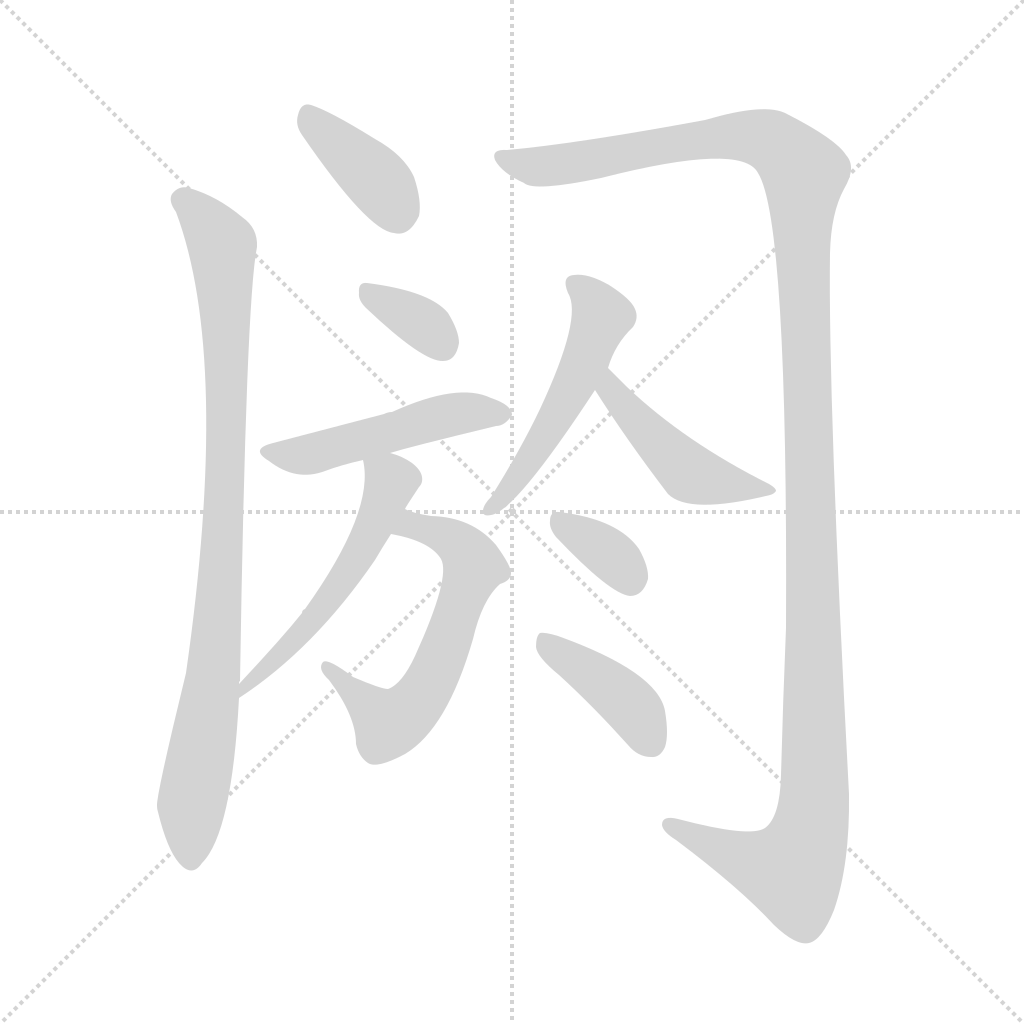
Entry: Yan (閼)
Kangxi stroke count: 16
Page 1337, Entry 01
Pronounced e.
As defined in the Shuowen Jiezi (Shuowen), it means to block or obstruct.
In the Guangyun, it means to stop or to plug.
In the Biography of the Thirteen Kings of Emperor Jing from the Book of Han (Hanshu), it is written: Now, the subject is blocked and unable to be heard. The commentary notes that it is pronounced e and means to stop.
In the Nine Sighs (Jiusi) from the Songs of Chu (Chuci), it is written: My aspirations are cut off and I know not where to go. The commentary notes that it means my aspirations and hopes have ended.
In the Liezi, Yang Zhu chapter, it is written: Guan Yiwu said: Let it be, do not obstruct it, do not block it.
In Cai Yong's Song of Fan Hui Canal (Fan Hui Qu Ge), it is written: I have a long-flowing stream, may no one obstruct it. The commentary notes it is pronounced e.
Also, per the Erya, Explaining the Heavens (Shitian): When the Great Year is in jia, it is called yanpeng; when the Great Year is in mao, it is called shan'e. The commentary notes it is pronounced e.
In the Huainanzi, Records of Astronomy (Tianwen Xun), it is written: The year of yin in jia is called yanpeng. The commentary notes: It refers to the myriad things whose blades are about to emerge but are held back and not yet through, thus it is called yanpeng.
Also, a star name.
In the Book of Han, Records of Rites and Music (Lüli Zhi), it is written: Great Fire is the star of Yanbo.
Also, a city name.
In the Records of the Grand Historian (Shiji), Annals of Qin (Qin Benji), it is written: Attacked the Zhao city of Eyu. The commentary notes: It is in Heishun County of Yizhou, which is the ancient Eyu city. The Treatise on Counties and Prefectures (Junxian Zhi) states: Eyu is in Wu'an County of Cizhou, now belonging to Zhangde Prefecture.
In the Book of the Later Han (Hou Hanshu), Treatise on Geography (Junguo Zhi), it is written: Shangdang Nie County has Eyu settlement.
Also, a person's name.
In the Zuo Tradition (Zuozhuan), ninth year of Duke Xiang, it is written: The Fire Official of the Taotang clan, Yanbo, resided in Shangqiu.
In the eleventh year of Duke Yin, it is written: Gongsun E competed over a chariot with Ying Kaoshu. The commentary notes: Gongsun E was a high official of Zheng. The commentary notes it is pronounced e.
In the Book of Han, Annals of Emperor Jing (Jingdi Ji), it is written: E was made Prince of Linjiang. The commentary notes it is pronounced e.
Also, pronounced ye. Meaning is the same.
Also, found in the Jiyun: Sometimes written as a variant form (e). See the note under the character (e).
Also, pronounced yu. Eyu (a variant term), describing a leisurely appearance.
In the Book of Han, Biography of Yang Xiong, it is written: Exhausted and obstructed. The commentary notes: Jin Zhuo said: Eyu refers to one's appearance. Yan Shigu said: Eyu is the appearance of leisure.
Also, pronounced yan. Yanzhi (a variant term), the title of a Xiongnu Chanyu's primary wife.
In the Book of Han, Biography of King Xin of Han, it is written: Sent people to give generous gifts to the Yanzhi. The commentary notes it is pronounced yan.
In the Records of the Grand Historian (Shiji), Biography of the Xiongnu, it is written: Later, there was a beloved Yanzhi. The commentary notes: Yanzhi is the title of the Xiongnu empress. Xi Zuochi, in a letter to the Prince of Yan, wrote: Under the mountain, there is safflower. People of the north gather the flowers to dye fabrics red and yellow; they harvest the fresh, tender parts of the flower to make rouge. Women gather it to use as cosmetic color, and thus they call their wives Yanzhi.
Also, in the Records of the Grand Historian (Shiji), Records of the Calendar (Lishu), the year is named Yanfeng. The commentary notes: This is the masculine year of jia. The Book of Han writes it as Yanpeng. Yan is also pronounced yan.
Also, pronounced yan. Meaning is the same.