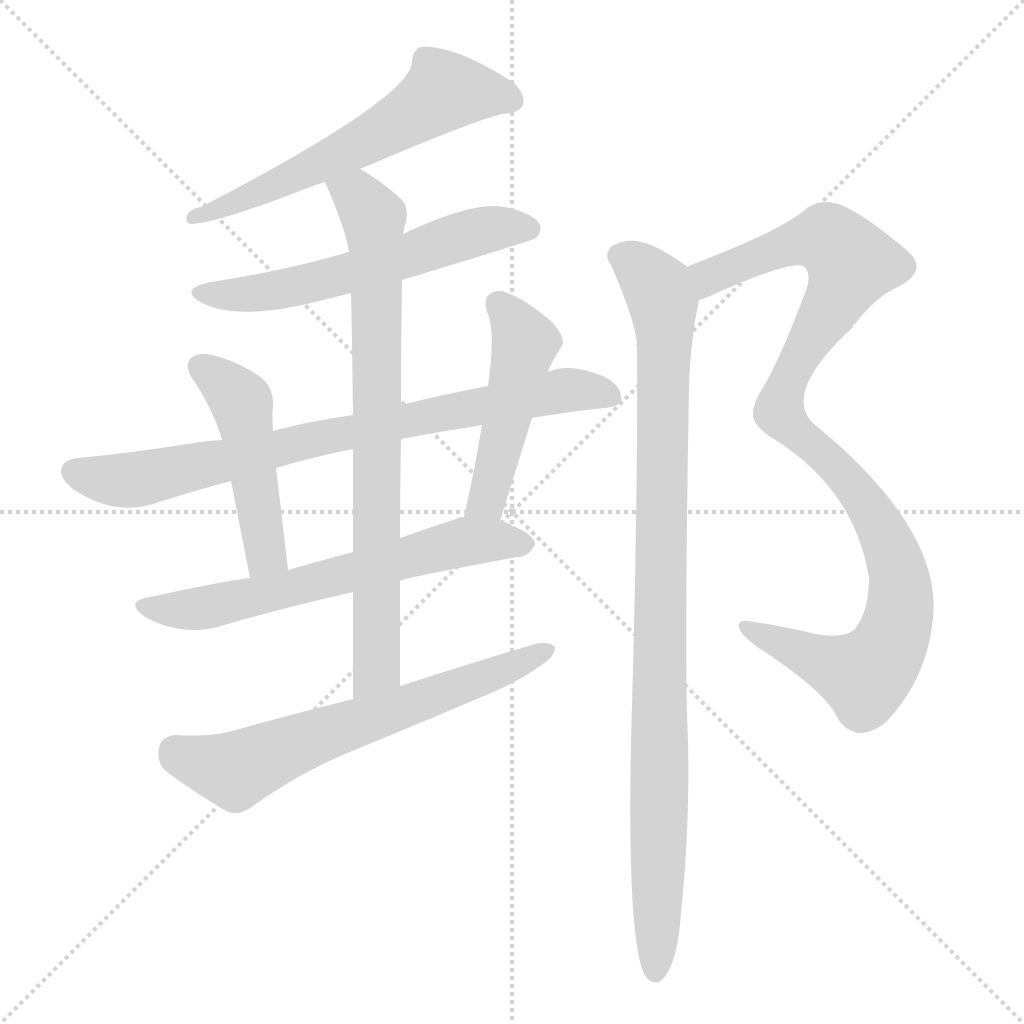
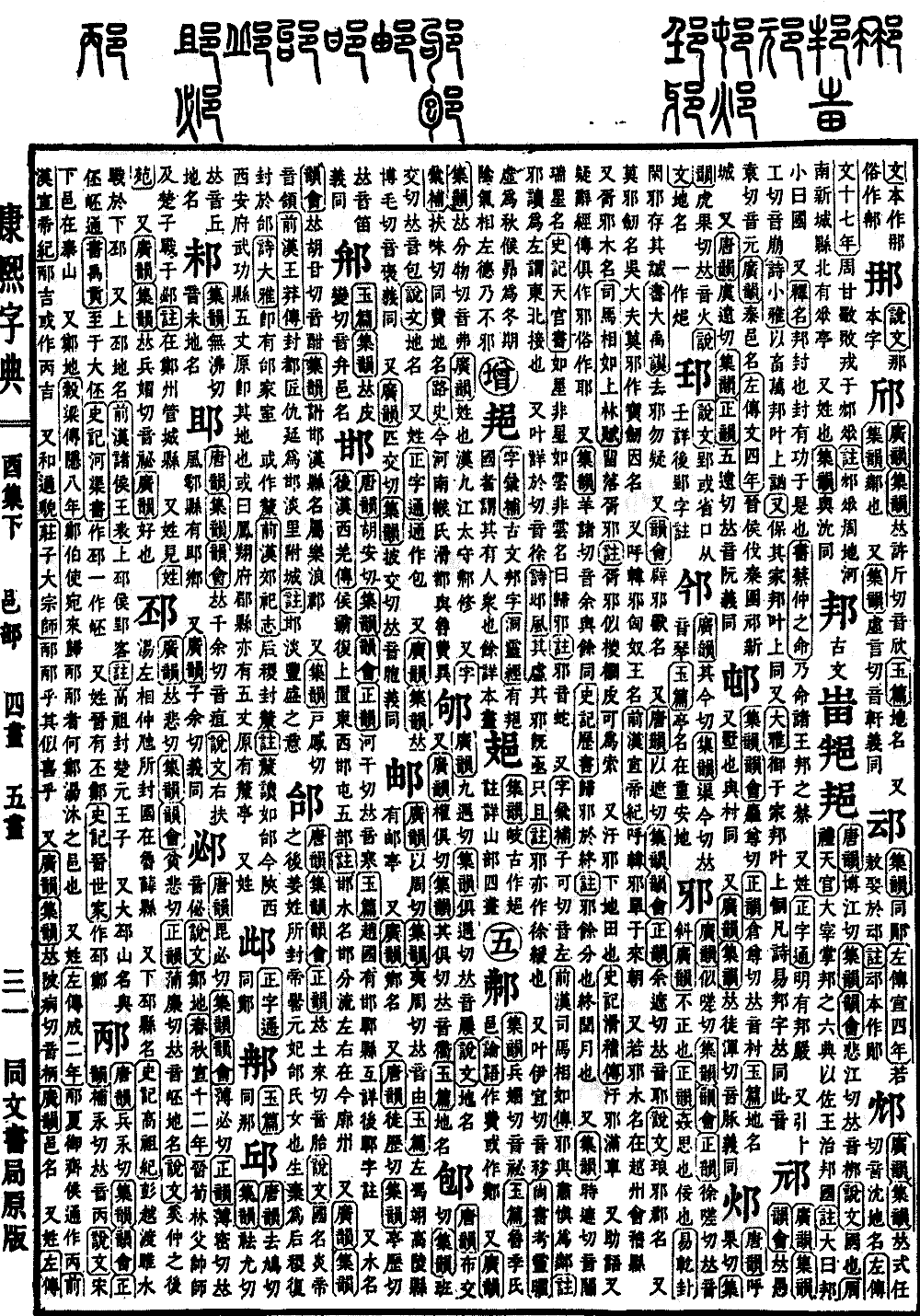
You Collection, Lower Volume; Radical: City (yì); Character: 邮; Kangxi stroke count: 15; Page 1269
From Tang Rhyme (Tangyun), pronounced yuqiu; from Collected Rhymes (Jiyun) and Correct Rhyme (Zhengyun), pronounced yuqiu, with the sound you. Explaining Characters (Shuowen) says: A house for official couriers at the border. Broad Rhymes (Guangyun) says: You means a post station. Comprehensive Customs (Fengsutong) says: During the Han dynasty, you was changed to zhi, and zhi also referred to a post station. They were established based on the measured distance. Augmented Rhymes (Zengyun) says: A horse relay station was called zhi, and a foot relay station was called you. Explaining Words (Shìyán) in Er Ya (Erya) says: You means to pass by. The commentary says: It refers to a place that a road passes through. Also, Collected Rhymes says: A hut in the fields. The Sacrificial Ox (Jiāotèshēng) in the Book of Rites (Liji) mentions: A youbiaozhui. The commentary says: You is like a post pavilion, referring to a pavilion built for field officials to reside at the connected field paths on the edge of the fields, used to supervise the people's farming. Also, Correct Rhyme says: To pass by. It is interchangeable with you. The Royal Regulations (Wangzhi) in the Book of Rites states: Punishments for transgressions should be attached to the matter. The commentary says: You means transgression. Li means to be attached. When punishing people for their faults, the punishment should be attached to the specific matter, and one must not use other pretexts or personal whims to punish. From the Annals of Emperor Cheng (Chengdi Ji) in the Book of Han (Qian Han Shu): To make manifest Our transgressions. Also, Correct Rhyme says: The utmost. The lowest and highest ranks in an assessment are also called dianyou. From King Mu of Zhou (Mu Wang Pian) in Liezi (Liezi): The gentlemen of Lu were the most confused. The commentary says: You is interchangeable with you. Also, Broad Rhymes says: Dudou, an ancient official title. Explaining Names (Shimíng) says: An official responsible for punishing transgressions, assessing merits and demerits, and inspecting affairs in various counties. From the Biography of Tao Qian (Tao Qian Zhuan) in the Book of Jin (Jin Shu): The commandery sent a Dudou to the county. Also, Gaoyou, a prefecture name. Also, a surname. From the Second Year of Duke Ai (Ai Er Nian) in the Zuo Commentary (Zuozhuan): There was You Wuxu. Also, Collected Rhymes says: Pronounced shiwei, with the sound chui. A place name. Located in Wey. Also, pronounced yuyi, with the sound yi, rhyming with the preceding word. From Minor Odes (Xiaoya) in the Book of Odes (Shijing): I know not its transgressions. Rhymes with qi on the line above. Correct Character Compendium (Zhengzitong) says: Explaining Characters originally had the character . It consists of and . refers to a distant border. The common simplified form is 邮. Collected Rhymes writes it as 缷. Emendation: In the Biography of Tao Kan (Tao Kan Zhuan) in the Book of Jin: The commandery sent a Dudou to the county. It is respectfully noted that the cited passage is from the Biography of Tao Qian, so Kan should be changed to Qian.