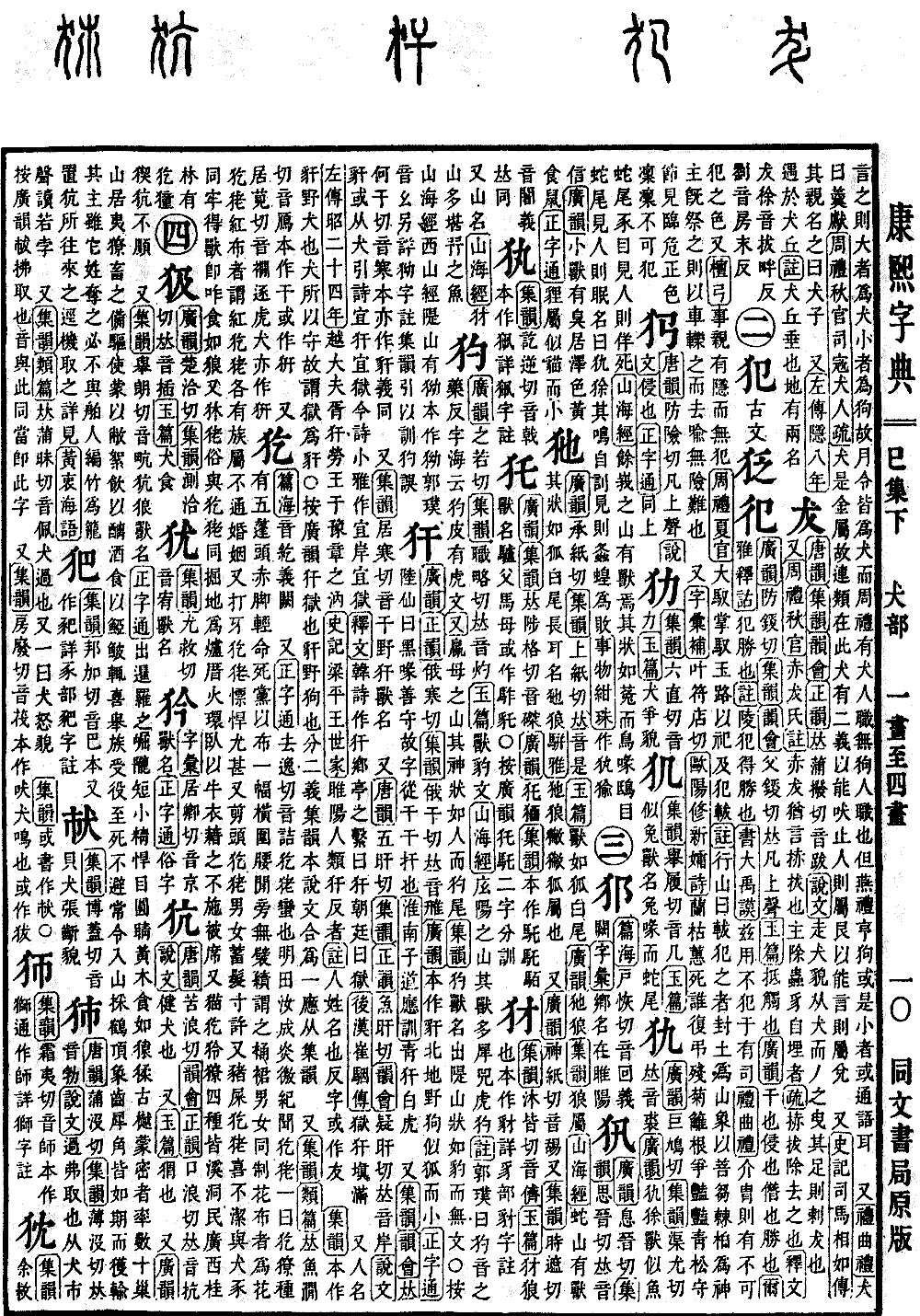
Si Collection, Lower Volume
Radical: Dog (quǎn)
Kangxi Strokes: 13
Page 706, Entry 14
Pronounced yóu.
According to the Explaining Graphs and Analyzing Characters (Shuowen Jiezi), a type of ape. Formed from the radical for dog with a phonetic component suggesting a chieftain.
The Collected Rhymes (Jiyun) notes that it lives in the mountains, climbs trees upon hearing human voices, and descends when no one is present; because of this, the term for indecision is derived from this animal. Sometimes written in a variant form.
Approaching the Animals (Erya) states: The you is like a muntjac and is adept at climbing trees. Commentary: It is skilled at climbing trees.
Record of Rites (Liji), Section: Summary of the Rules of Propriety (Quli): Used to allow the people to resolve suspicions and uncertainties and to determine hesitant indecision. Commentary: You and yu are two beasts, both of which are hesitant in movement; people who are frequently indecisive resemble them, hence the term youyu.
Huainanzi, Strategy for Military Affairs (Binglue Xun): Strike at their hesitance, press upon their indecision.
Also, according to Explaining Graphs and Analyzing Characters (Shuowen Jiezi), in the Longxi region, a puppy is called a you.
Also, according to the Extended Rhymes (Guangyun), to resemble.
Book of Odes (Shijing), Section: Odes of Shao (Shaonan): It is fate that is not like this. Commentary: You means like.
Also, Odes of Xiao Ya (Xiaoya): For the virtuous gentleman, his character is not like this.
Record of Rites (Liji), Section: Regulations for Mourning (Sangfu): The son of a brother is considered as a son (youzi).
Also, according to the Collected Rhymes (Jiyun), a term meaning to be able to stop.
Book of Odes (Shijing), Section: Odes of Wei (Weifeng): Be careful in your actions, it is acceptable that you do not stop. Commentary: You means acceptable.
Also, originally written as you.
Book of Odes (Shijing), Section: Odes of Xiao Ya (Xiaoya): Able to strengthen their strategies. Commentary: You means path/way. Commentary: You means to scheme or military planning.
Also: The schemes are crooked and twisted. Commentary: Schemes for the way of government.
Also, Odes of Da Ya (Daya): The king's strategies are truly substantial. Commentary: You means to scheme.
Also, according to the Extended Rhymes (Guangyun), still or furthermore.
Record of Rites (Liji), Section: Tan Gong: The Master also still practiced the ancient way.
Also, Book of Odes (Shijing), Section: Odes of Zhou (Zhou Song): The small and large mountains, truly planning in harmony with the river. Commentary: You means to plan; small and tall mountains are all ordered in sacrifice according to the charts of mountains and rivers.
Also, yiyou (hesitant/lingering).
Record of Rites (Liji), Section: Tan Gong: The gentleman is lingering and hesitant. Commentary: A balance between speed and leisure.
Songs of Chu (Chu Ci), Section: Nine Songs (Jiuge): You, my lord, do not depart, lingering.
Also, Guanzi, Section: Earthly Grounds (Diyuan Pian): The lower soil is called five-you; the appearance of five-you is like manure.
Also, History of the Former Han Dynasty (Qian Han Shu), Section: Treatise on Geography: Qiuyou County, belonging to Linhuai Commandery.
Also, a surname.
Standard Compendium (Zhengzitong): Song dynasty figure You Daoming.
Also, pronounced yáo.
Collected Rhymes (Jiyun): Originally written as a variant. Refers to chanting or singing. Sometimes written as yao.
Also interchangeable with yao (to shake).
Record of Rites (Liji), Section: Tan Gong: Chanting this you, in this you dancing. Commentary: You should be read as yao, meaning the body is swaying; the people of Qin used similar sounds for you and yao.
Also, pronounced jiū.
Also, pronounced yòu.
Also, rhymes with yòu, pronounced yòu.
Book of Odes (Shijing), Section: Odes of Xiao Ya (Xiaoya): When you are in good relations, do not treat each other as strangers.
(Editor's Note: The reference to Odes of Wei in the text has been corrected from the original Odes of Wei as the context pertains to Odes of Wei.)