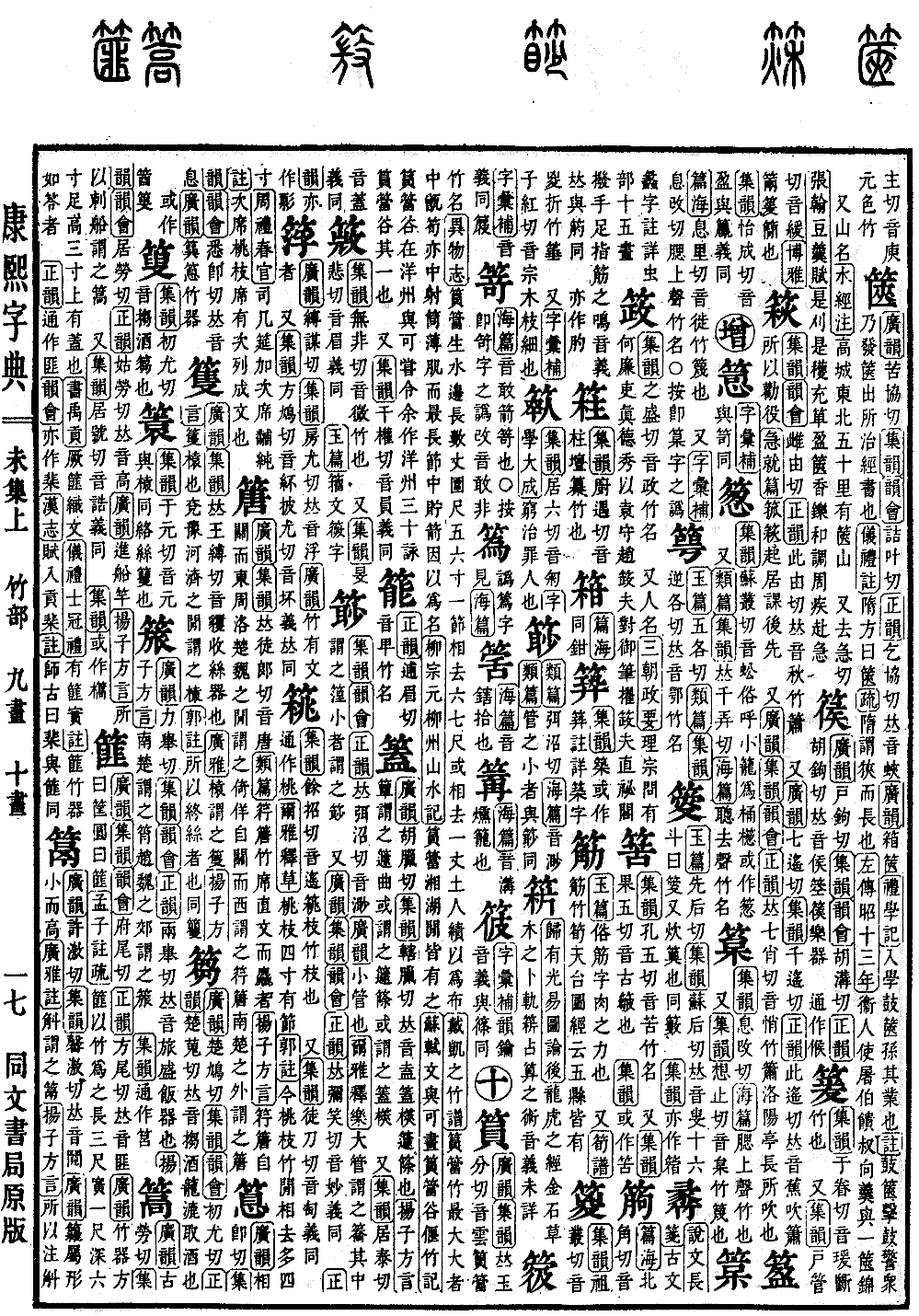
Wei Collection, Upper Volume
Radical: Bamboo (zhú)
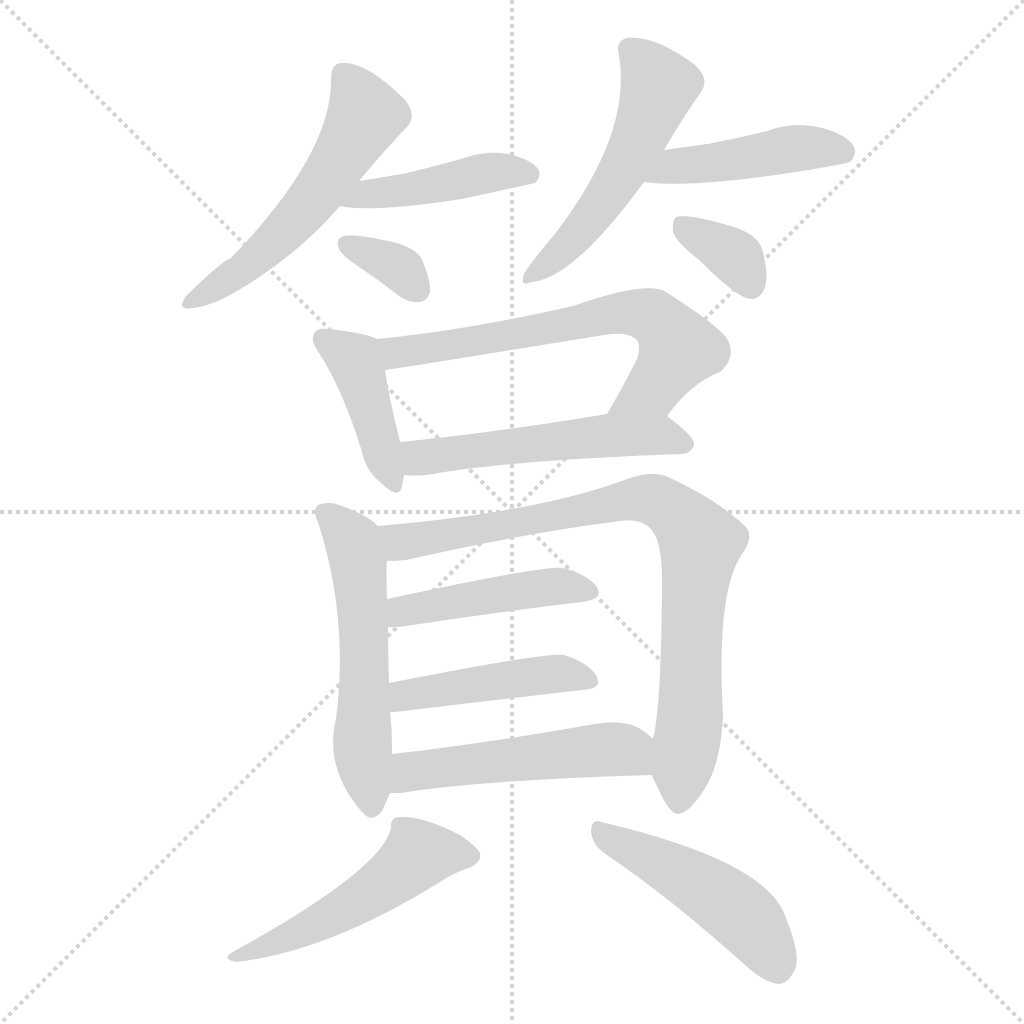
Yun
Kangxi stroke count: 16
Page 893, Entry 30
According to the Expanded Rhymes of the Guangyun (Guangyun) and the Collected Rhymes (Jiyun), the pronunciation is yun. Yun-dang is a type of bamboo.
The Record of Strange Things (Yiwuzhi) states: Yun-dang grows by the water, reaching a height of several zhang, with a circumference of one foot and five or six inches. The distance between the bamboo nodes is six or seven feet, and sometimes as much as one zhang. The local people use it to weave into cloth.
Dai Kaizhi’s Bamboo Manual (Zhupu) states: Yun-dang bamboo is the largest type of bamboo. The largest ones can hold a steamer in the middle. The bamboo shoots are suitable for making arrow containers. The bamboo walls are thin, but the bamboo stalks are the longest. The bamboo segments can be used to store arrows, which is how it got its name.
Liu Zongyuan’s Record of Mountains and Rivers in Liuzhou (Liuzhou shanshui ji) states: Yun-dang bamboo is found in both the Hunan and Hubei regions.
Su Shi’s Record of Wen Yuke Painting Bamboo in Yun-dang Valley (Wen Yuke hua yundang gu yanzhu ji) states: Yun-dang Valley is located in Yangzhou. Yuke once asked me to compose the Thirty Odes of Yangzhou, and Yun-dang Valley was one of them.
Also according to the Collected Rhymes (Jiyun), it is pronounced yuan. The meaning is the same. It is also pronounced yuan.