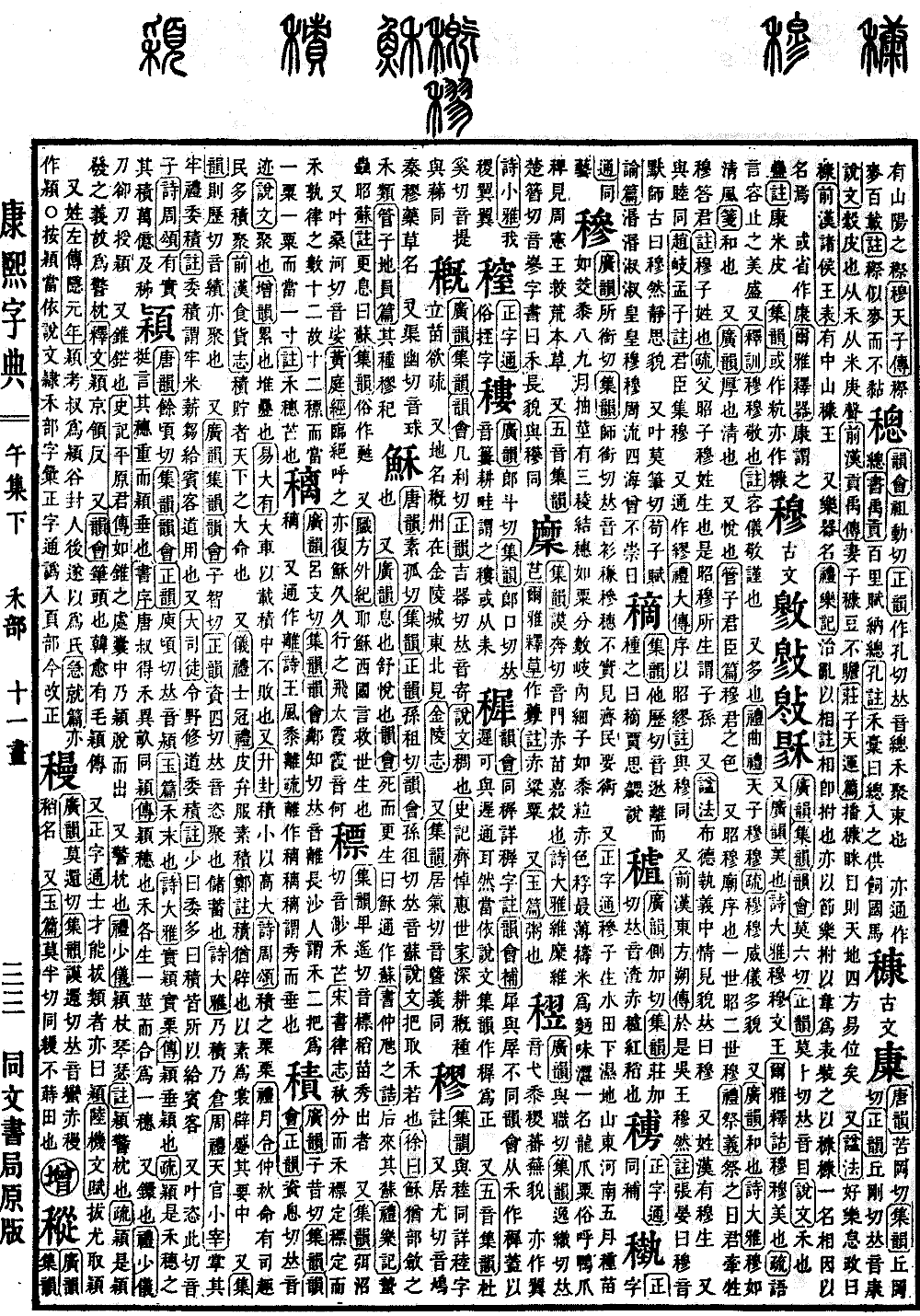
Wu Collection, Lower Volume
Radical: Grain (hé)
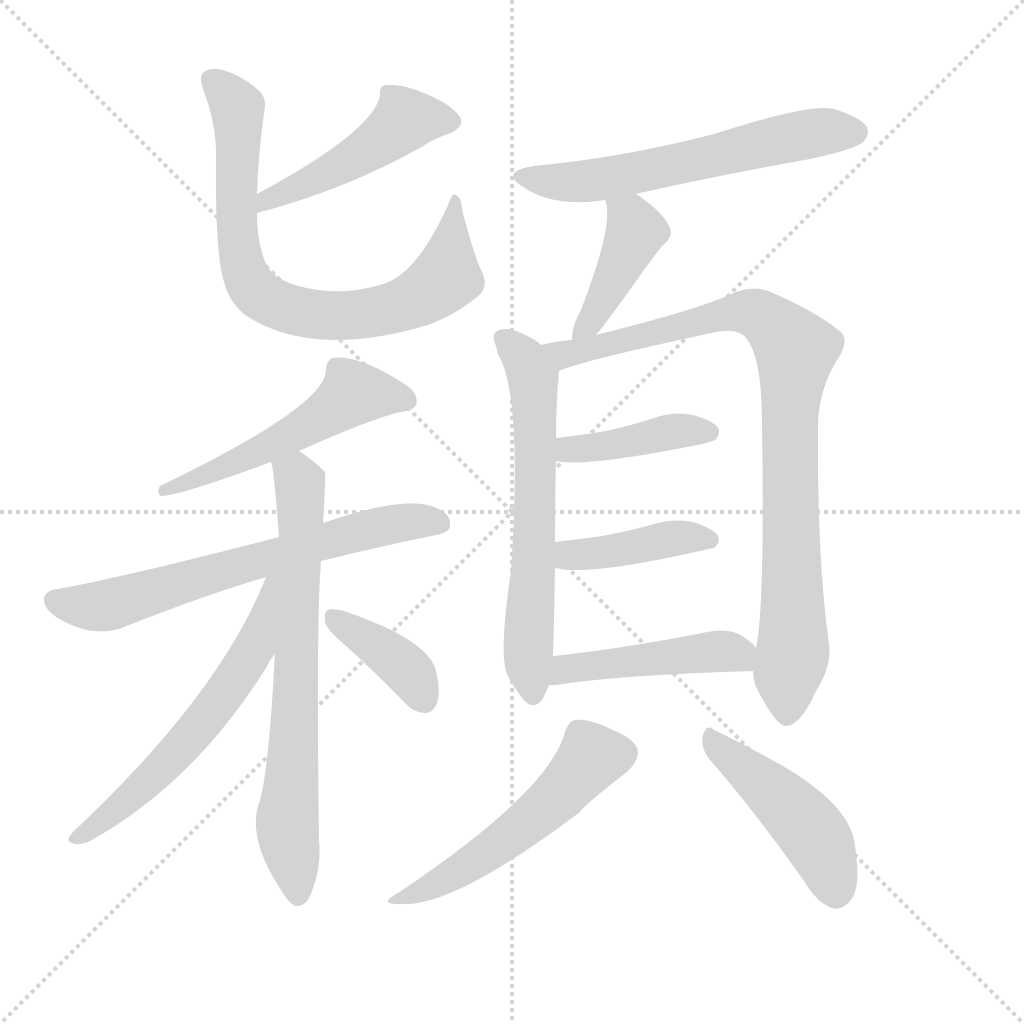
Ying; Kangxi stroke count: 16
Page 859, Entry 25
Pronounced ying (rising tone).
In the Jade Chapter (Yupian), it refers to the tip of a grain ear.
In the Book of Odes (Shijing), it describes grain kernels that are full and cause the ear to droop.
The commentary states that ying refers to the drooping tip of the ear.
The sub-commentary explains that ying is the part of the grain ear that stands up, describing how the ear is heavy and the tip hangs low.
In the Book of Documents Preface (Shuxu), it describes Tang Shu receiving a grain sprout where a single ear grew from different fields.
The commentary explains that ying refers to the ear itself, where grain stalks grow from separate stems but join into one ear.
It also refers to the ring at the end of a knife handle.
In the Book of Rites (Liji), it states that when handing a knife to someone, the blade should be held towards the back, presenting the ring of the handle to the other person.
It also refers to the tip of an awl.
In the Records of the Grand Historian (Shiji), it is written like an awl placed inside a cloth bag; the tip will immediately pierce through and be revealed.
It also refers to a warning pillow used to keep a person alert.
In the Book of Rites (Liji), it mentions the arrangement of pillows, staffs, lutes, and zithers.
The annotation states that ying refers to the warning pillow.
The sub-commentary states that ying carries the meaning of waking and inspiring, hence it refers to the warning pillow.
The textual explanation notes that ying is pronounced like the word for capital (jing) combined with the word for collar (ling).
According to the Dictionary of Rhymes (Yunhui), it also refers to the tip of a writing brush. Han Yu wrote the Biography of Brush Tip (Mao Ying Zhuan).
According to the Correction of Characters (Zhengzitong), a person of outstanding talent is also called ying.
In Lu Ji’s Exposition on Literature (Wenfu), it refers to selecting the excellent and extracting the outstanding.
It also serves as a surname.
In the Zuo Tradition (Zuo Zhuan), Ying Kaoshu was a border official of Yinggu. His descendants subsequently adopted this as a surname.
In the Quick Guide to Learning Characters (Jijiupian), it is also written as ying.
Note: The character ying should be classified under the grain radical as per the Explaining Graphs and Analyzing Characters (Shuowen Jiezi). The Compendium of Characters (Zihui) and the Correction of Characters (Zhengzitong) incorrectly classified it under the page radical; this is now corrected.