You Collection, Lower Volume
Radical: City (yì)
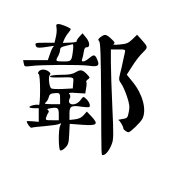
郼
Kangxi strokes: 16
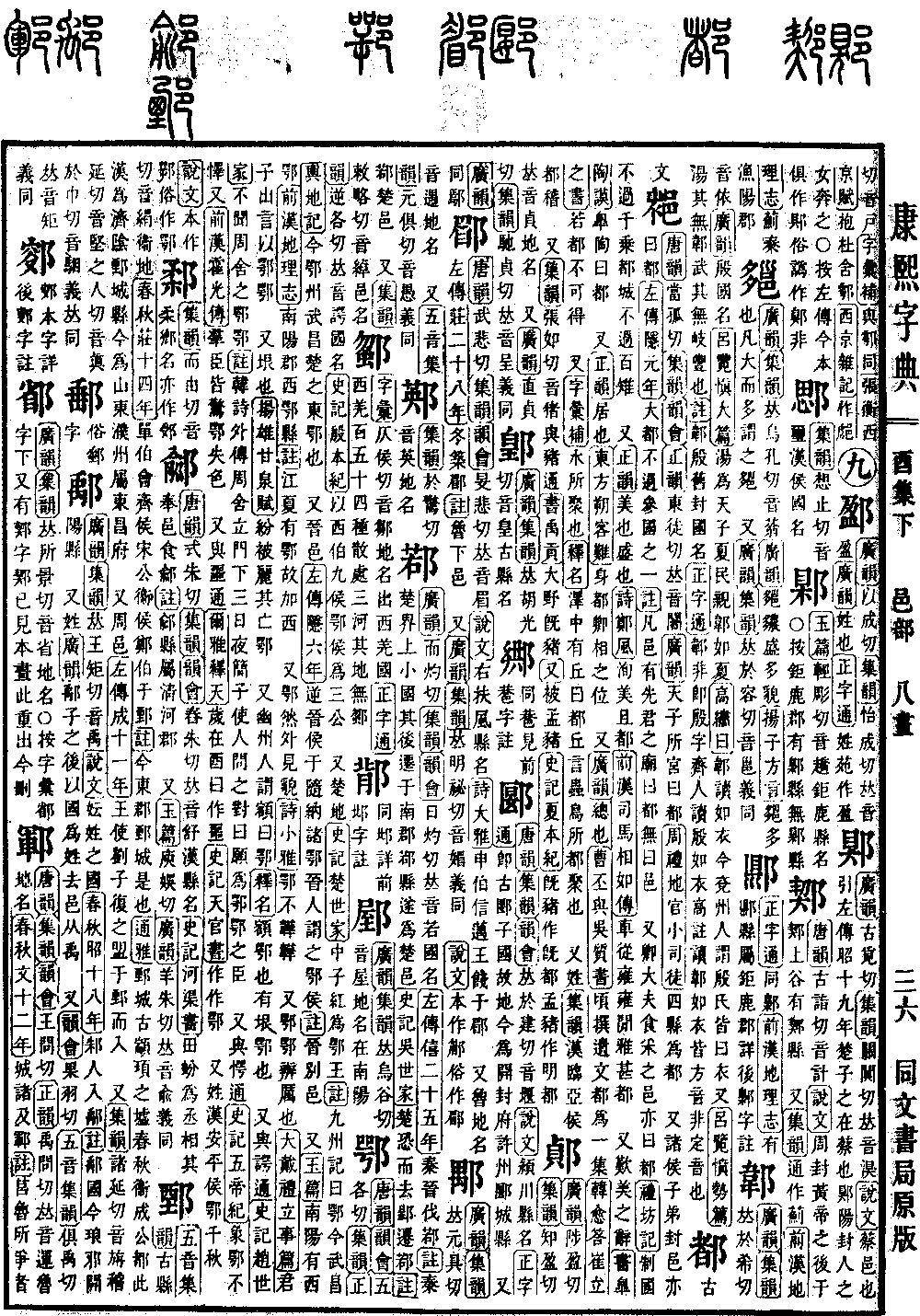
Page: 1274, position 08
According to the Guangyun (Guǎngyùn) and Jiyun (Jíyùn) dictionaries, the pronunciation is given as 'yū xī qiè', sounding like 'yī'.
The Guangyun (Guǎngyùn) records it as the name of a vassal state during the Yin-Shang (Yīn-Shāng) period.
The Lüshi Chunqiu (Lǚshì Chūnqiū), 'Prudence in Great Matters' (Shèndà Piān) records: After Tang (Tāng) became the Son of Heaven, the remaining people of the Xia (Xià) dynasty were as close to the state of Yi (yī) as they were to Xia. Gao You's (Gāo Yòu) commentary states: Yi (yī) is pronounced like 'yī'. Today, people in Yanzhou (Yǎnzhōu) refer to those with the surname Yin (Yīn) as 'yī'.
Also, the Lüshi Chunqiu (Lǚshì Chūnqiū), 'Prudence in Power' (Shènshì Piān) records: If Tang (Tāng) did not have the state of Yi (yī), and King Wu (Wǔ) did not have Mount Qi (Qí), they could not have achieved their great undertakings. Commentary: Yi (yī) was Tang's (Tāng) original enfeoffment state.
The Zhengzitong (Zhèngzìtōng) states: The character Yi (yī) is not the same as the character Yin (yīn). People in the Qi (Qí) region pronounce Yin (yīn) like 'yī', and Gao You's (Gāo Yòu) commentary states that Yi (yī) is pronounced like 'yī'—these are all local dialects, not standard pronunciations.
Verification: The Lüshi Chunqiu (Lǚshì Chūnqiū), 'Prudence in Great Matters' (Shèndà Piān): 'After Tang (Tāng) became the Son of Heaven, the remaining people of the Xia (Xià) dynasty were as close to the state of Yi (yī) as they were to Xia.' Gao You's (Gāo Yòu) commentary: 'Yi (yī) is pronounced like 'yī'. Today, people in Yanzhou (Yǎnzhōu) refer to those with the surname Yin (Yīn) as 'yī'.' Based on the original text, 'Gao Xiu says' has been corrected to 'Gao's commentary'.
The Lüshi Chunqiu (Lǚshì Chūnqiū), 'Prudence in Power' (Shènshì Piān): 'If Tang (Tāng) did not have the state of Yi (yī), and King Wu (Wǔ) did not have Mount Qi (Qí), they could not have achieved their great undertakings.' Commentary: 'Yi (yī) was Tang's (Tāng) original enfeoffment state.' Based on the original text, 'Fènshì Piān' has been corrected to 'Shènshì Piān'. The two characters 'Fēng yě' were omitted after 'King Wu (Wǔ) did not have Mount Qi (Qí)'. The four characters 'cannot achieve success' were added. The commentary 'Yi (yī), an old enfeoffment state name of Yin (Yīn)' has been corrected to 'Yi (yī) was Tang's (Tāng) original enfeoffment state'.