You Collection, Upper Volume
Radical: Speech (yán)
Xùn
Kangxi strokes: 10
Page 1147, Entry 01
Ancient form: Xún
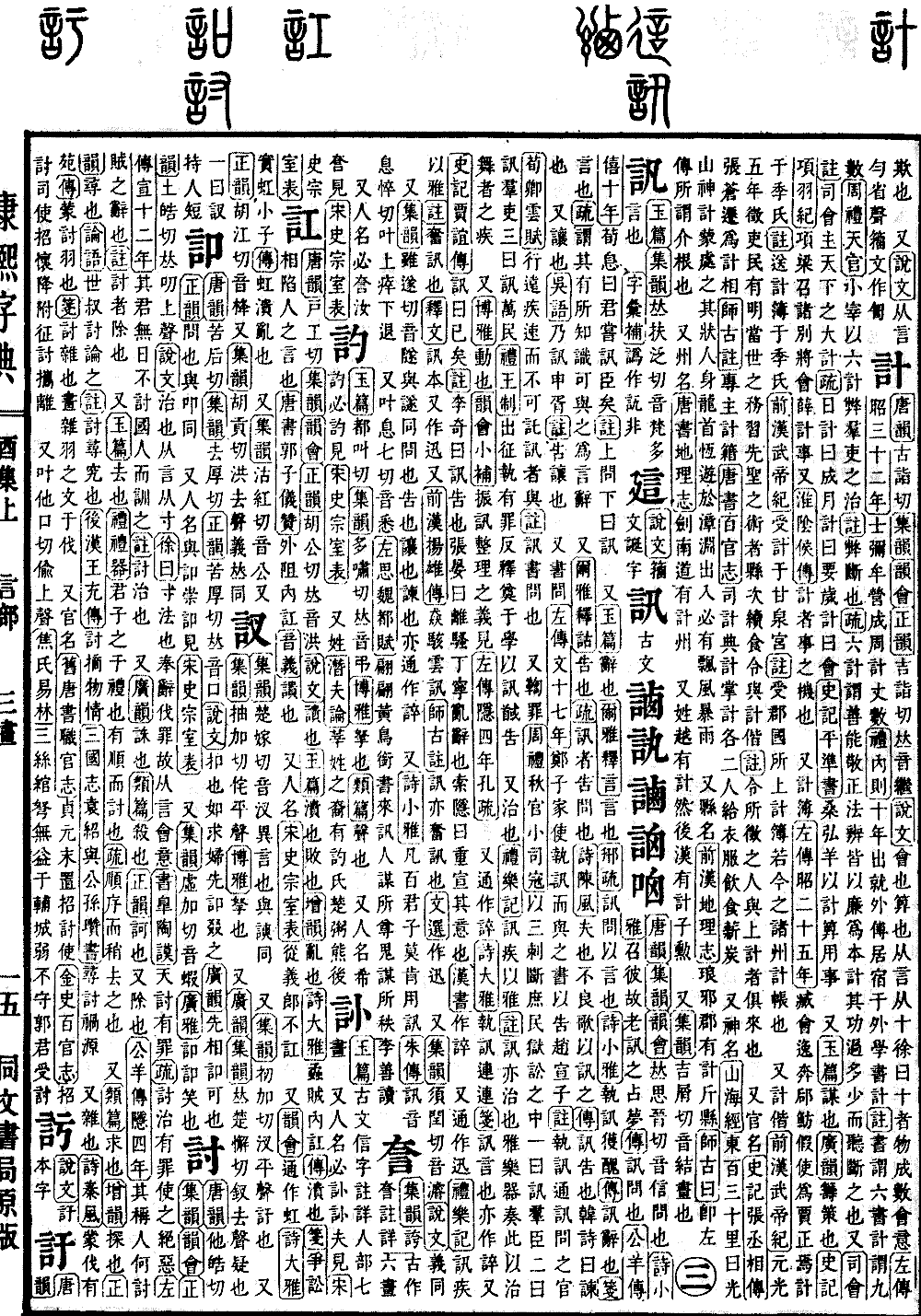
According to Tang Rhymes (Tangyun), Collection Rhymes (Jiyun), and Rhyme Compendium (Yunhui), pronounced xìn. To inquire. Book of Odes (Shijing), Lesser Odes of the Kingdom: Summon the elders and inquire of them regarding dream interpretation. Commentary: Xùn means to inquire. Gongyang Commentary (Gongyang Zhuan), 10th year of Duke Xi: Xun Xi said, the ruler has questioned this subject. Note: When a superior asks a subordinate, it is called xùn. Also, according to Jade Chapters (Yupian), it means to speak. Literary Expositor (Erya), Explanation of Words: It means to speak. Xing Commentary: Xùn is to question using words. Book of Odes (Shijing), Lesser Odes of the Kingdom: Capture those who are interrogated and seize the captives. Commentary: Xùn means words. Mao Commentary: It means speech. Sub-commentary: It refers to those who have knowledge and can be engaged in discourse. Also, according to Literary Expositor (Erya), Explanation of Ancient Terms: To announce. Sub-commentary: Xùn is to announce and inquire. Book of Odes (Shijing), Airs of the States: This man is not good, I sing to address him. Commentary: Xùn means to announce. Han's Odes says it means to remonstrate. Also, to reprimand. Discourses of Wu (Wuyu): Then reprimanded Shenxu. Note: To announce a reprimand. Also, a written letter of inquiry or greeting. Zuo Commentary (Zuozhuan), 17th year of Duke Wen: The Zheng official Zijia sent an official to deliver a letter of inquiry to inform Zhao Xuanzi. Note: To grasp xùn is to communicate via an official inquiry. Xunzi, Cloud Rhapsody: Those who travel far and fast but cannot be entrusted with a message. Note: Xùn means a written inquiry. Also, to interrogate and determine guilt. Rites of Zhou (Zhouli), Autumn Office, Minor Clerk: Use the three investigations to judge the lawsuits of the common people: the first is to interrogate the high officials, the second is to interrogate the minor officials, and the third is to interrogate the common people. Book of Rites (Liji), Royal Regulations: When returning from a military campaign with captured criminals, perform a sacrifice at the school and report the capture of prisoners and the taking of ears. Also, to govern. Book of Rites (Liji), Record of Music: To govern the swiftness through the ya (an ancient musical instrument). Note: Xùn also means to govern. Ya is a musical instrument, played to manage the tempo of the dancers. Also, according to Bo Ya, to move. Small Supplement to the Rhyme Compendium (Yunhui Xiaobu): The phrase zhenxùn means to organize and rectify, as seen in the Zuo Commentary (Zuozhuan), 4th year of Duke Yin, Kong Sub-commentary. Also, it is interchangeable with suì (a variant form). Book of Odes (Shijing), Greater Odes of the Kingdom: Captured prisoners were connected one after another. Commentary: Xùn means speech. It is also written as suì. Also, in Records of the Grand Historian (Shiji), Biography of Jia Yi: It says that the xùn is finished. Note: Li Qi says: Xùn means to announce. Zhang Yan says: It refers to the concluding exhortation in the Encountering Sorrow (Lisao). Commentary on Records of the Grand Historian (Suoyin): It means to reiterate the intent. In the Book of Han (Hanshu), it is written as suì. Also, interchangeable with xùn (to be swift). Book of Rites (Liji), Record of Music: Swift and rapid through the ya. Note: Xùn also means to struggle or be swift. Commentary on the Classics (Shiewen): The original text for xùn is also written as xùn (swift). Also, in the Book of Han (Hanshu), Biography of Yang Xiong: The wind gusts and the clouds rush. Note by Yan Shigu: Xùn also means to rush. In the Selections of Refined Literature (Wenxuan), it is written as xùn (swift). Also, according to Collection Rhymes (Jiyun), pronounced jùn. According to Explanation of Script and Elucidation of Characters (Shuowen), the meaning is the same. Also, according to Collection Rhymes (Jiyun), pronounced suì. Same as zì (variant form). It means to inquire, to announce, to reprimand, and to remonstrate. Also interchangeable with suì. Also, Book of Odes (Shijing), Lesser Odes of the Kingdom: Among all you gentlemen, none are willing to use the xùn. Zhu Commentary: Pronounced xì and cuì. Rhymes with cuì above and tuì below. Also rhymes with xì, pronounced xī. Zuo Si, Rhapsody on the Wei Capital: The fluttering yellow birds come carrying letters to inquire. The plans of men are what is respected, the plans of ghosts are what is ordained. Li Shan reads it as such.