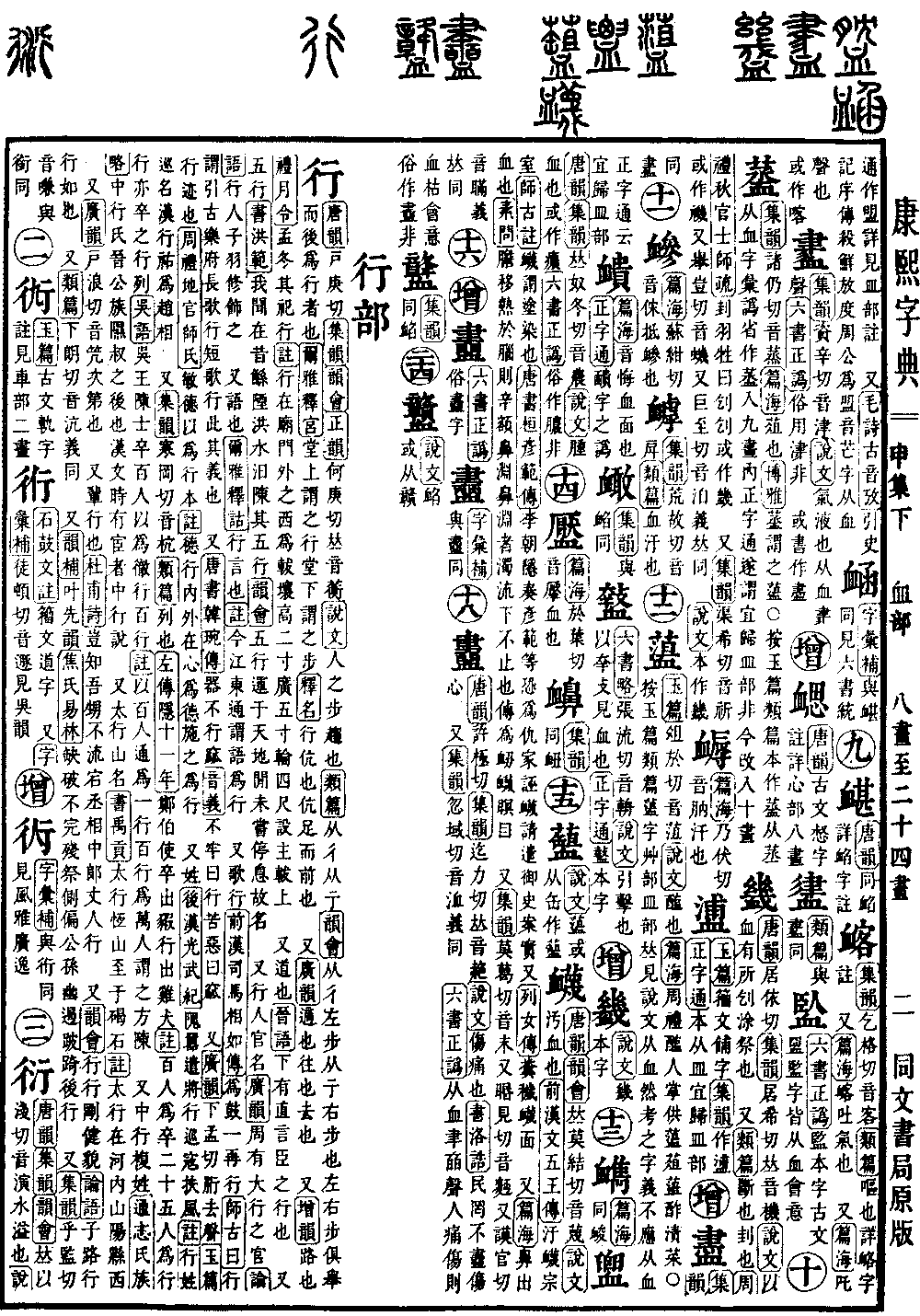
Shen Collection, Lower Volume
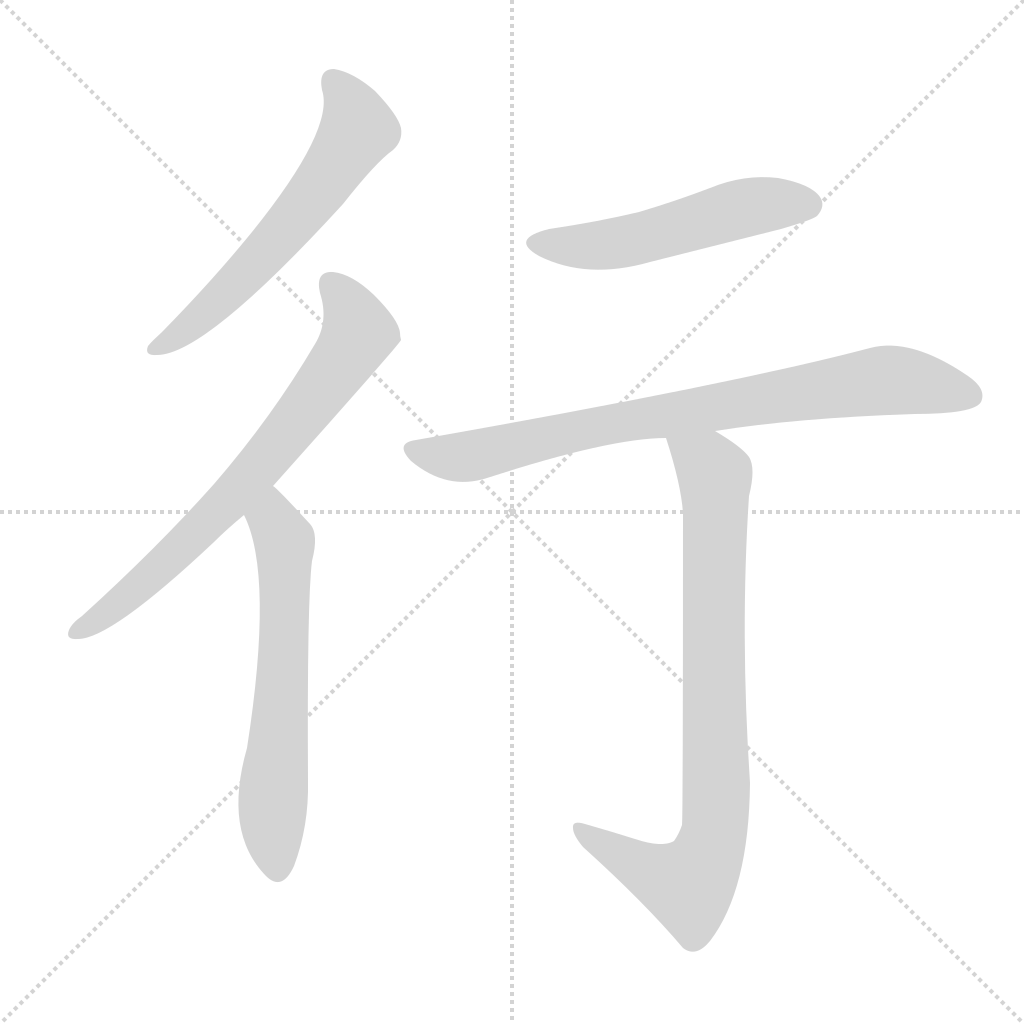
Radical: Walk (xíng)
Page 1108, Entry 31
Pronounced héng.
According to the Explaining Graphs and Analyzing Characters (Shuowen): Human movement.
According to the Classified Chapters (Leipian): Composed of the chì radical and the chù radical.
According to the Collection of Rhymes (Yunhui): The chì component represents the left foot stepping, and the chù component represents the right foot stepping. When both feet move, one can walk.
According to the Progressions of Erudition (Erya): The area in the hall is called xíng, and the area below the hall is called bù.
According to the Explanations of Names (Shiming): Xíng means to resist or raise the foot to move forward.
Also, according to the Broad Rhymes (Guangyun): To be suitable, to go, to leave.
Also, according to the Supplemented Rhymes (Zengyun): A road.
According to the Book of Rites (Liji), Monthly Ordinances (Yueling): In the first month of winter, offer sacrifices to the god of the road. The commentary states: The god of the road is outside the temple gate on the west side; build a mound of dirt two inches high and five inches wide, with a wheel four feet wide, and place the spirit tablet upon it.
Also refers to principles.
According to the Discourses of the States (Jin Yu): When a subject has upright speech, it is the duty of a subordinate.
Also refers to the Five Phases (wǔxíng).
According to the Book of Documents (Shujing), Great Plan (Hongfan): I have heard that formerly, Gun dammed the floodwaters and disrupted the Five Phases.
According to the Collection of Rhymes (Yunhui): The Five Phases circulate between heaven and earth without ceasing, hence they are called xíng.
Also refers to a traveler or a government official.
According to the Broad Rhymes (Guangyun): The Zhou dynasty had an official called the Grand Traveler (Da Xingren).
According to the Analects (Lunyu): The traveler Ziyu embellished it.
Also refers to speech.
According to the Progressions of Erudition (Erya), Explaining Words (Shigu): Xíng means speech. The commentary states: Presently, in the Jiangdong region, speech is commonly called xíng.
Also refers to a song (ge-xing).
According to the Biography of Sima Xiangru in the History of the Former Han (Qianhan): Beat the drum for him once or twice. Shigu says: Xíng means to lead; ancient Music Bureau (Yuefu) poems include the Long Song Song and Short Song Song, which is what this means.
Also, according to the History of the Tang (Tangshu), Biography of Han Wan: The objects are not crude. The sound and meaning notes state: Things that are not sturdy are called xíng, and poor quality is called yú.
Also, according to the Broad Rhymes (Guangyun): Pronounced háng.
According to the Jade Chapters (Yupian): Xíng means records of deeds.
According to the Rites of Zhou (Zhouli), Earth Office, Master (Shishi): Use nimble virtues as the foundation of conduct. The commentary states: Virtuous conduct is divided into inner and outer; when held in the heart it is virtue, and when put into action it is xíng.
Also refers to a surname.
According to the Annals of Emperor Guangwu in the History of the Later Han (Houhan): Wei Xiao sent his general Xing Xun to Fufeng. The commentary notes: Xing is the surname and Xun is the given name. During the Han dynasty, Xing You served as the Chancellor of Zhao.
Also, according to the Collection of Rhymes (Jiyun): Pronounced háng.
According to the Classified Chapters (Leipian): A rank or row.
According to the Zuo Commentary (Zuo Zhuan), 11th Year of Duke Yin: The Earl of Zheng ordered each company (zu) to offer one boar, and each row (háng) to offer one dog and one chicken. The commentary states: One hundred men make a company (zu), and twenty-five men make a row (háng). A row is also the formation of a company.
According to the Discourses of Wu (Wu Yu): The King of Wu arranged his soldiers into one hundred men forming one chè-row, with one hundred chè-rows. The commentary states: One hundred men make one row, and one hundred rows make ten thousand men, known as a square formation.
Also refers to Zhonghang, a compound surname.
According to the Comprehensive Treatise on Clans (Tongzhi): The Zhonghang clan were descendants of Xi Shu of the Jin state ruling house; during the reign of Emperor Wen of Han, there was a eunuch named Zhonghang Yue.
Also refers to Mount Taihang, a mountain name.
According to the Book of Documents (Shujing), Tributes of Yu (Yugong): Mount Taihang and Mount Heng reach as far as Mount Jieshi. The commentary states: Mount Taihang is west of Shanyang County in Henei Commandery.
Also, according to the Broad Rhymes (Guangyun): Pronounced háng. Order or sequence.
Also refers to generation or seniority.
According to Du Fu’s poetry: How could my nephew not be frivolous? The丞相 (prime minister) and 中郎 (chamberlain) are of an elder generation.
Also, according to the Collection of Rhymes (Yunhui): Xíng-xíng, the appearance of being firm and strong.
According to the Analects (Lunyu): Zilu’s appearance of being firm and brave.
Also, according to the Classified Chapters (Leipian): Pronounced háng. The meaning is the same.
Also, according to the Supplement to Rhymes (Yunbu): Rhymes with xiān.
According to Jiao’s Forest of Changes (Yilin): Broken and damaged, not complete; sacrifices are slanted and not straight. Gongsun is imprisoned and isolated, lame and limping, falling into the last row.
Also, according to the Collection of Rhymes (Jiyun): Pronounced qiàn. Same as xián (to hold in the mouth).