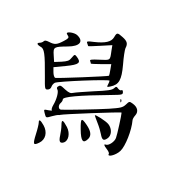
Wei Collection, Lower Volume
Radical: Mortar (jiù)
Kangxi Strokes: 12
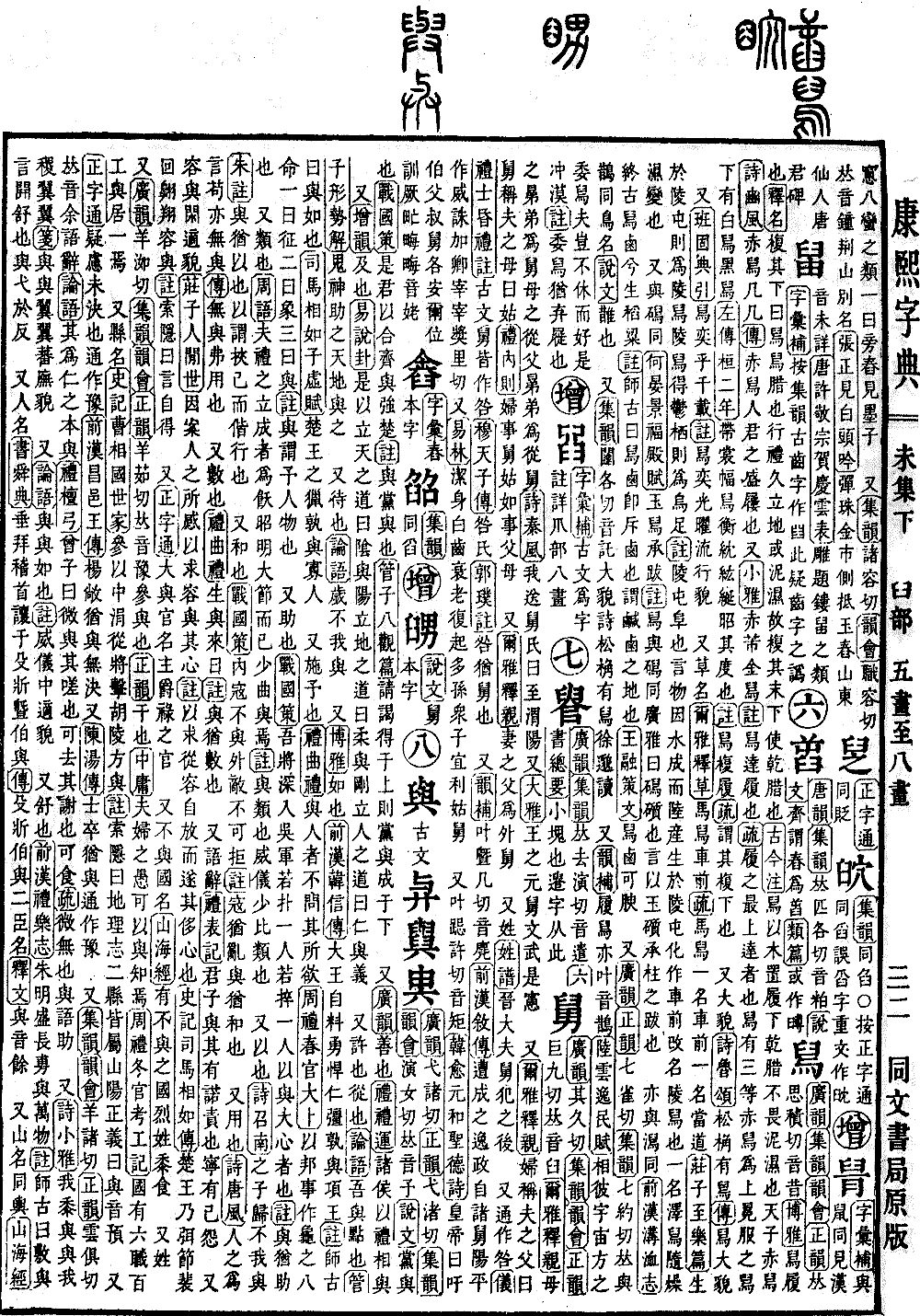
Page 1004, Entry 06
Broad Rhymes (Guangyun), Collection Rhymes (Jiyun), Rhyme Meetings (Yunhui), Correct Rhymes (Zhengyun): Pronounced xi.
Comprehensive Refined Dictionary (Boya): A xi is a type of shoe.
Explanation of Names (Shiming): A shoe with a double wooden sole is called a xi. Xi means dry and cured. Because one must stand for a long time during ceremonies, and sometimes the ground is muddy or wet, an extra layer is added to the sole to keep it dry and resistant to moisture.
Notes Ancient and Modern (Gujinzhu): A xi is a wooden piece placed on the sole of a shoe to keep it dry and resistant to moisture. The Son of Heaven wears red xi.
Book of Odes (Shijing), Bin Odes (Bin Feng): How beautiful are the red xi.
Commentary (Zhuan): Red xi are the most honorable shoes of a sovereign.
Also in the Minor Odes (Xiaoya): Red knee pads paired with golden xi.
Note (Zhu): Xi are common shoes.
Sub-commentary (Shu): They are the finest and most standard type of footwear. Xi are divided into three grades; red xi are the highest grade, worn with ceremonial court dress. Below these are white xi and black xi.
Zuo Tradition (Zuo Zhuan), Second Year of Duke Huan: The wide girdle, lower garment, leggings, double-soled shoes, the horizontal hairpin on the crown, hanging ribbons, cap ties, and the top plate of the crown are all used to display the law.
Note (Zhu): Xi are double-soled shoes.
Sub-commentary (Shu): This refers to the fact that they have double layers on the bottom.
It also means large.
Book of Odes (Shijing), Lu Odes (Lu Song): The pine rafters are large.
Commentary (Zhuan): Xi means large in appearance.
Also Ban Gu, Preface to the Emperor's Rites (Dianyin): The brilliance passes down for a thousand years.
Note (Zhu): Xi-yi means the appearance of brilliance being passed down.
Also a name for a plant.
Approaching Elegance (Erya), Explanation of Grasses (Shi Cao): Ma-xi is the plantain.
Sub-commentary (Shu): Ma-xi is also called "in front of the carriage" or "blocking the path."
Zhuangzi, Ultimate Joy (Zhile): Growing on a mound, it becomes plantain. Plantain nourished by dung becomes crow's-foot grass.
Note (Zhu): Ling-tun means a mound. This refers to things that form because of water but grow on land, and upon growing on a mound, are transformed into plantain, renamed ling-xi. It is also called ze-xi, changing according to dry or wet environments.
It is the same as the character (xi, meaning stone base).
He Yan, Rhapsody on Jingfu Hall (Jingfu Dian Fu): Use jade stone bases to support the bottom of the columns.
Note (Zhu): Xi is the same as (xi). The Comprehensive Refined Dictionary says: (Xi) is a column base, meaning using a jade base to support the bottom of the column.
It is also the same as (xi, meaning saline land).
Former Han History, Treatise on Canals and Rivers (Gouxi Zhi): Since ancient times, rice and grain can even grow in saline land.
Note (Zhu): Shigu says: Saline land refers to salty or alkaline soil.
Wang Rong, Policy Treatise (Cewen): Saline land can be made fertile.
Also in the Broad Rhymes (Guangyun) and Correct Rhymes (Zhengyun): Pronounced que. In the Collection Rhymes (Jiyun): Pronounced que. The same as magpie (que). A type of bird.
Analytical Dictionary (Shuowen): It is a magpie.
Also in the Collection Rhymes (Jiyun): Pronounced tuo. Large in appearance. In the Book of Odes (Shijing) passage "pine rafters have xi," Xu Miao reads it this way.
Also in Rhyme Supplements (Yunbu): Footwear, xi. It also rhymes with que.
Lu Yun, Rhapsody on Retired Scholars (Yimin Fu): Looking at the universe, compared to a discarded shoe, is human life not beautiful, yet one prefers this indifference and tranquility?
Note (Zhu): Wei-xi means like a discarded shoe.
The original character for the stone base (xi) is derived from xi, not from the variant form (xi).