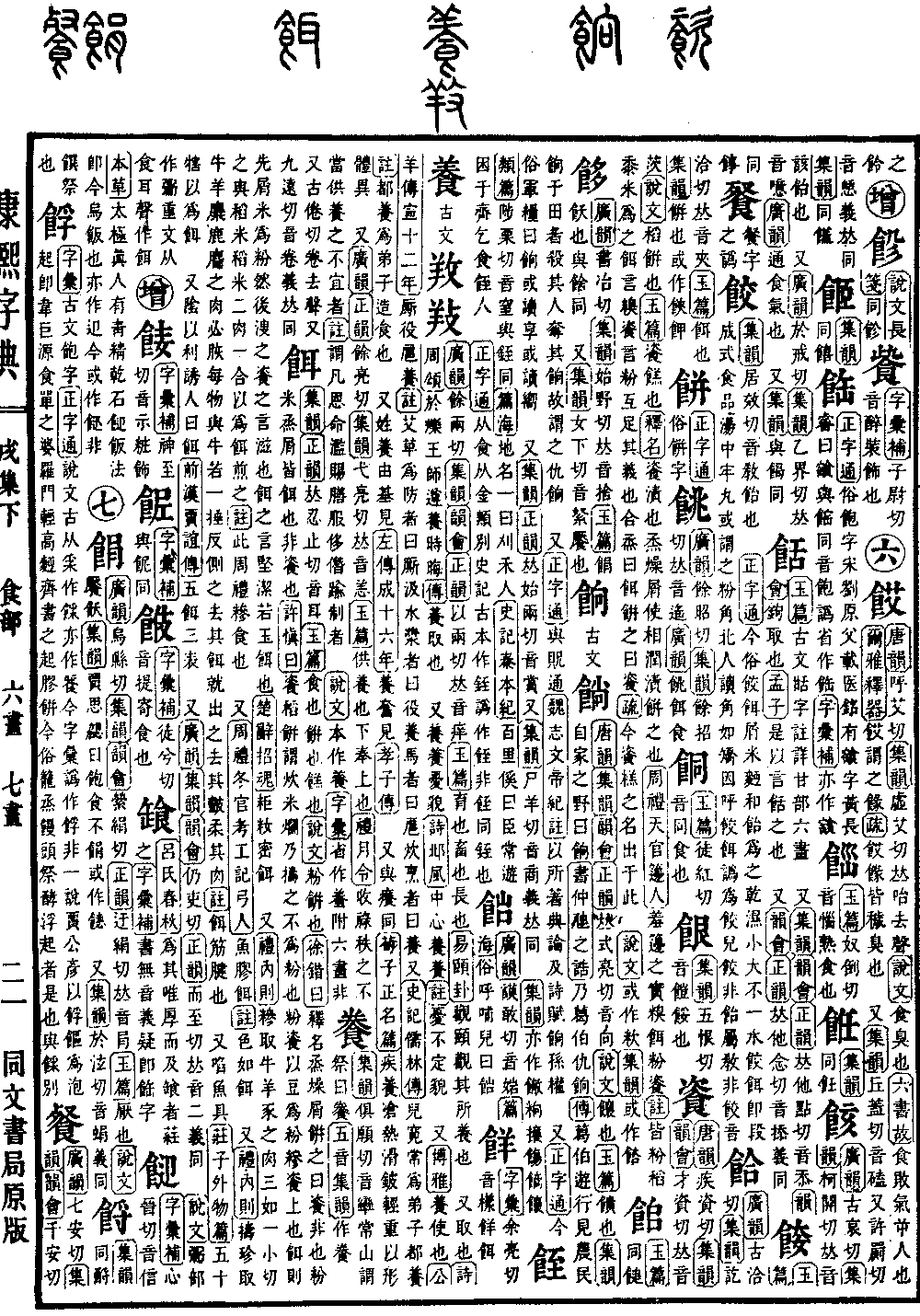
Xu Collection, Lower Volume
Radical: Food (shí)
Kangxi Strokes: 15
Page 1419, Entry 01
Ancient character.
Pronounced xiang (falling tone).
Shuowen Jiezi (Explanation of Simple and Compound Characters): Means to provide food for someone.
Yupian (Jade Chapters): Means to present food as a gift.
Jiyun (Collection of Rhymes): Bringing food to those working in the fields is called xiang.
Book of Documents (Shangshu), Zhonghui’s Announcement: The Count of Ge was an enemy to those providing food.
Commentary: The Count of Ge wandered about and saw farmers being provided with food in the fields. He killed the people and seized their food; therefore, it is said he was an enemy to those providing food.
Also, Zhengzitong (Correction of Character Meanings): Used interchangeably with the character for bestowing a gift.
Records of the Three Kingdoms (Sanguozhi), Biography of Emperor Wen of Wei, Commentary: He presented his own Dian Lun (Authoritative Discourses) and poetic compositions as a gift to Sun Quan.
Also, Zhengzitong: Today, common parlance refers to military rations as xiang, sometimes pronounced xiang (falling tone) or xiang (falling tone).
Also, Jiyun and Zhengyun (Correct Rhymes): Pronounced shang (rising tone).
Also, Jiyun: Pronounced shang. The meaning is the same.
Jiyun: Also written in variant forms.