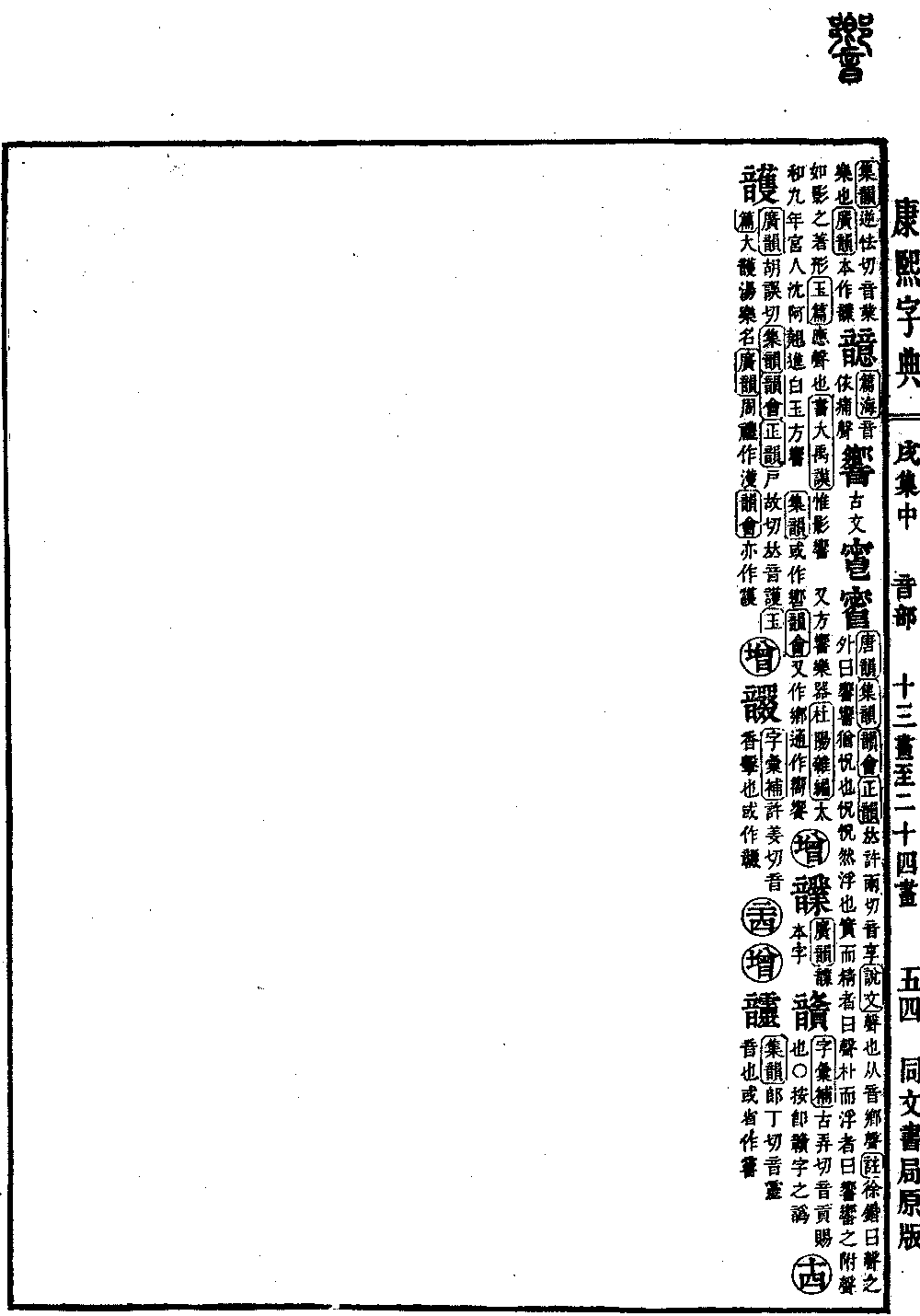
Xu Collection, Middle Volume. Radical: Sound (yīn). Kangxi stroke count: 22. Page 1398, Entry 02. Ancient form.
According to Tang Rhymes (Tangyun), Collection of Rhymes (Jiyun), Rhyme Compilation (Yunhui), and Correct Rhymes (Zhengyun), it is pronounced xiang (falling tone).
According to Explaining Graphs and Analyzing Characters (Shuowen), it means sound. Formed from Sound (yin) and Xiang acting as the phonetic component.
Annotation: Xu Kai states that what is outside of sound is called resonance (xiang). Resonance is like being distracted or vague (huang); it refers to that which is vague and floating. That which is solid and refined is called sound, while that which is simple and floating is called resonance. The attachment of resonance to sound is like a shadow attached to a form.
According to Jade Compendium (Yupian), it means an answering sound.
In the Book of Documents (Shujing), specifically the Counsels of the Great Yu (Da Yu Mo), it is written: Only be like the shadow and the resonance.
Also, fangxiang, a type of musical instrument. According to Du Yang Miscellaneous Records (Du yang za bian), in the ninth year of the Taihe era, the palace woman Shen Aqiao presented a white jade fangxiang.
According to Collection of Rhymes (Jiyun), it is sometimes written as a variant form. According to Rhyme Compilation (Yunhui), it is also written as xiang. It is commonly used interchangeably with xiang and xiang.