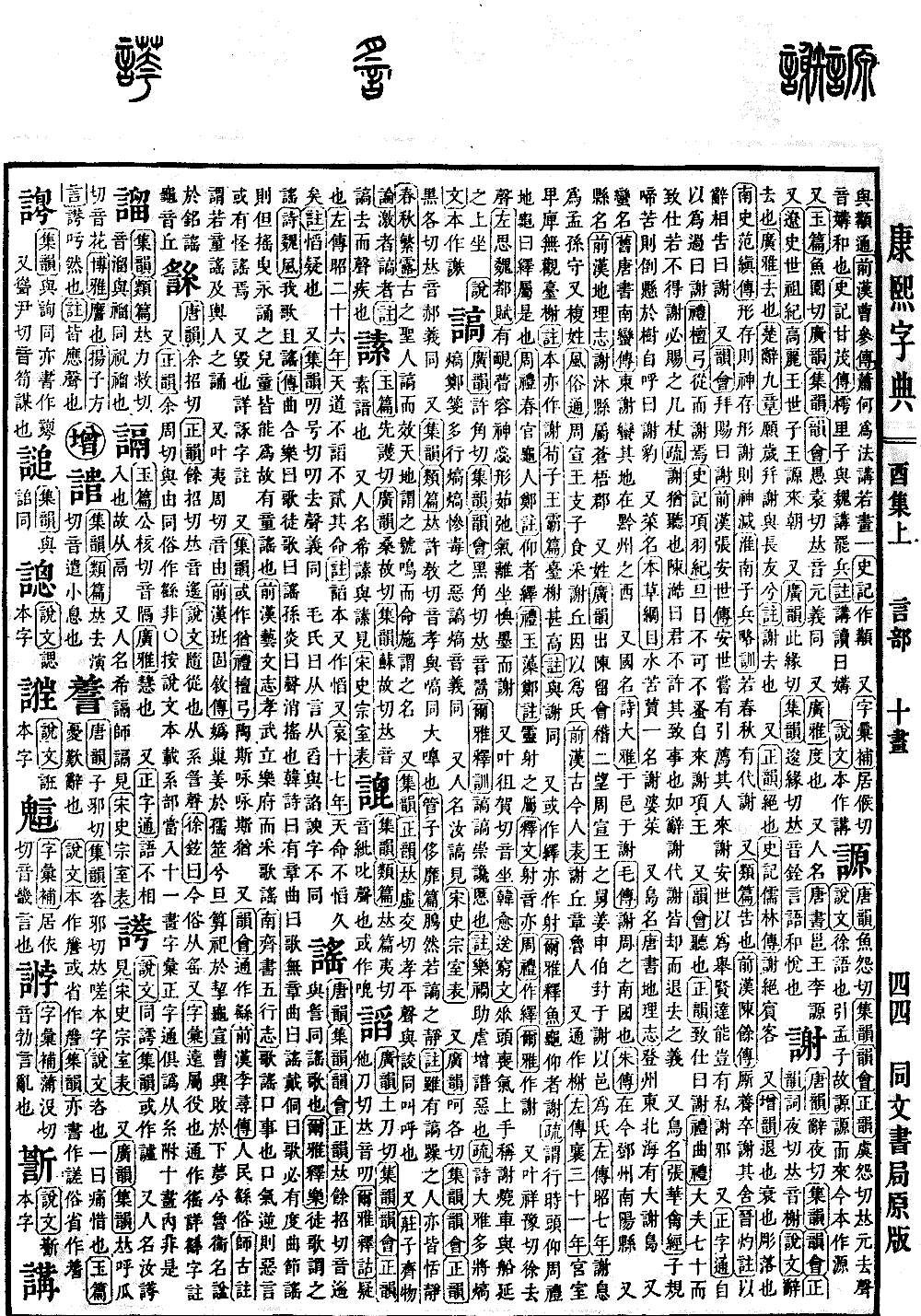
You Collection, Upper Volume
Radical: Speech (yán)
Page 1176, Entry 02
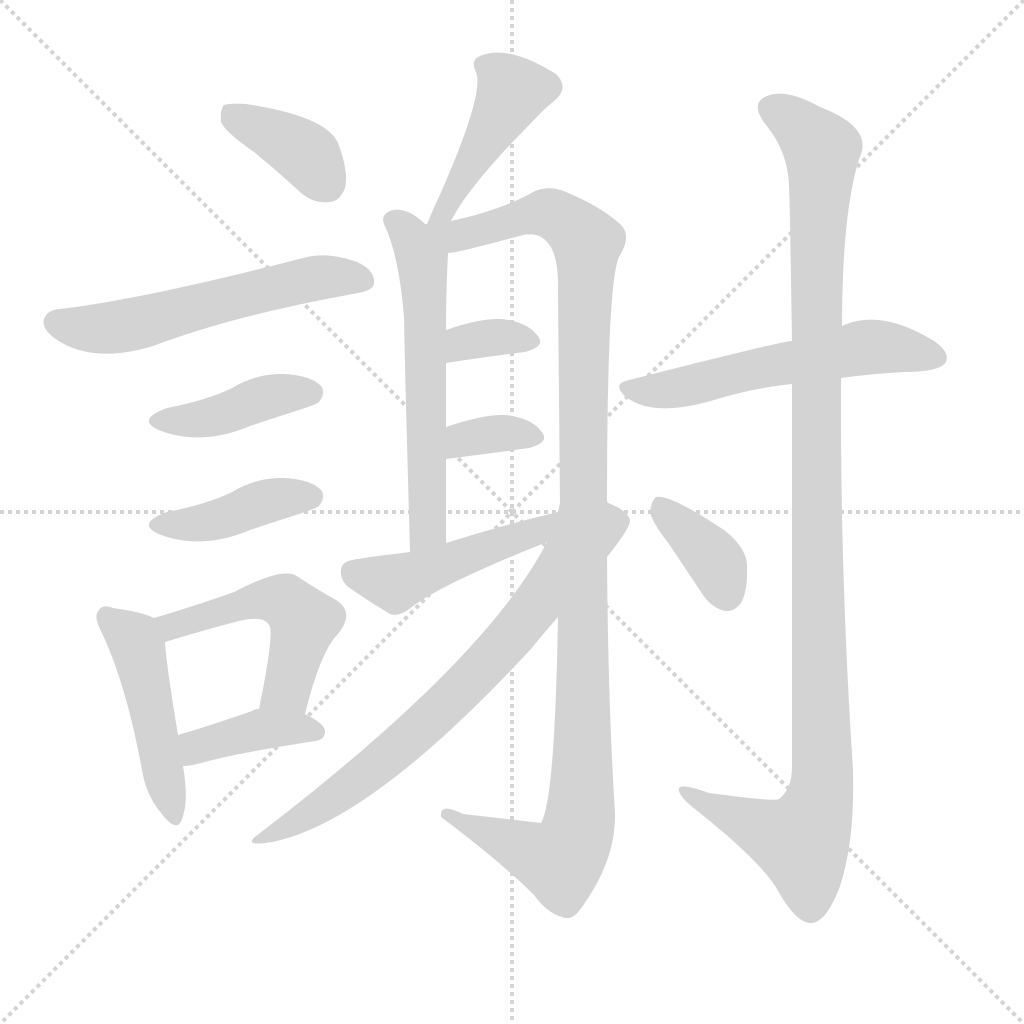
Pronounced xiè.
Pronounced xiè.
According to the Explaining Graphs and Analyzing Characters (Shuowen Jiezi), it means to take leave or depart.
According to the Broad Explication of Characters (Guangya), it means to depart.
Book of Chu (Chu Ci), Nine Chapters: I wish for the years to pass together and for our friendship to endure. Commentary: Xie means to depart.
According to the Correct Rhymes (Zhengyun), it means to cut off or sever.
Records of the Grand Historian (Shiji), Biographies of Confucian Scholars: He severed relations with guests.
According to the Augmented Rhymes (Zengyun), it means to retreat, decline, or wither.
History of the Southern Dynasties (Nan Shi), Biography of Fan Zhen: If the physical form exists, then the spirit exists; if the physical form withers, then the spirit diminishes.
Masters of Huainan (Huainanzi), Military Strategy: Just as the seasons of spring and autumn have their cycles of change.
According to the Classified Chapters (Leipian), it means to inform.
History of the Former Han (Qian Han Shu), Biography of Chen Yu: A menial servant informed his master. Jin Zhuo commentary: Using words to inform someone is called xie.
According to the Rhyme Collection (Yunhui), bowing to offer thanks for a reward is called xie.
History of the Former Han (Qian Han Shu), Biography of Zhang Anshi: Anshi once recommended someone, and that person came to offer thanks. Anshi believed that recommending the worthy was his duty; how could there be a private expression of gratitude?
According to the Essential Guide to Characters (Zhengzitong), admitting one's own fault is called xie.
Book of Rites (Liji), Tan Gong: Following behind to offer an apology.
Records of the Grand Historian (Shiji), Annals of Xiang Yu: Tomorrow I cannot fail to arrive early in person to apologize to King Xiang.
According to the Rhyme Collection (Yunhui), it means to permit.
According to the Correct Rhymes (Zhengyun), resigning from government office to retire is called xie.
Book of Rites (Liji), Qu Li: When an official reaches the age of seventy, he retires; if he is not granted permission, he must be presented with a stool and a staff. Commentary: Xie is like permission. Hao says: This means the sovereign does not allow him to retire. Terms like cixie (declining) or daixie (metabolism) all share the meaning of declining and withdrawing.
Also the name of a bird. Zhang Hua, Record of Birds: The cuckoo (zigui) cries with such sorrow that it hangs upside down in the trees, calling itself the Xie leopard.
Also a type of vegetable. Compendium of Materia Medica (Bencao Gangmu): The water bitter lettuce, also known as the Xie grandmother vegetable.
Also an island name. Old Book of Tang (Tang Shu), Treatise on Geography: There is the Great Xie Island in the sea northeast of Deng Prefecture.
Also the name of a barbarian tribe. Old Book of Tang (Tang Shu), Account of the Southern Barbarians: The Eastern Xie barbarians; their territory is located to the west of Qian Prefecture.
Also a state name. Book of Odes (Shijing), Greater Odes: In the city, in Xie. Mao commentary: Xie is a state to the south of the Zhou Dynasty. Zhu commentary: It is located in the present-day Nanyang County of Deng Prefecture.
Also a county name. History of the Former Han (Qian Han Shu), Treatise on Geography: Xie-Mu County, part of Cangwu Commandery.
Also a surname. According to the Broad Rhymes (Guangyun), it originates from the two commanderies of Liu and Kuaiji. King Xuan of Zhou’s uncle, Jiang Shenbo, was enfeoffed at the land of Xie, and used the fief as a surname.
Zuo Tradition (Zuo Zhuan), Seventh Year of Duke Zhao: Xie Xi, who served as a guard for Mengsun.
Also a compound surname. Comprehensive Customs (Fengsu Tong): A descendant of King Xuan of Zhou held the fief of Xieqiu, and thus used the place name as a surname.
History of the Former Han (Qian Han Shu), Table of Ancient and Modern People: Xieqiu Zhang, a man from the State of Lu.
Also used interchangeably with the character for pavilion (xie).
Zuo Tradition (Zuo Zhuan), Thirty-first Year of Duke Xiang: The palace buildings were low, without viewing pavilions. Commentary: The original text was also written as xie.
Xunzi, Regulations of Kings and Hegemons: The pavilions and terraces were very high. Commentary: The same as xie.
Sometimes written as yi. Also written as she.
Er Ya, Explaining Fish: The turtle with an upward-facing head is called xie. Commentary: This refers to its head pointing upward while walking. The Rites of Zhou (Zhou Li) says the earth turtle is called the yi variety.
Rites of Zhou (Zhou Li), Spring Officials, Zheng Commentary: The upward-facing one is called yi.
Book of Rites (Liji), Jade Pattern, Zheng Commentary: The spiritual she (variant for xie) variety. Explanation of Texts: She is pronounced like yi. In the Rites of Zhou it is written as yi, and in the Er Ya it is written as xie.
Also pronounced similarly to xu in the departing tone. Zuo Si, Rhapsody on the Capital of Wei: With a face of shame, the spirit withers and the body shrinks. Depleted, one leaves the seat to offer an apology for one's shame.
Also pronounced similarly to zuo. Han Yu, Sending Off Poverty: With head hanging and spirit crushed, bowing to offer thanks. Burning the carriage and the boat, inviting it to take the seat of honor.
The Shuowen Jiezi original text was written as a different form.