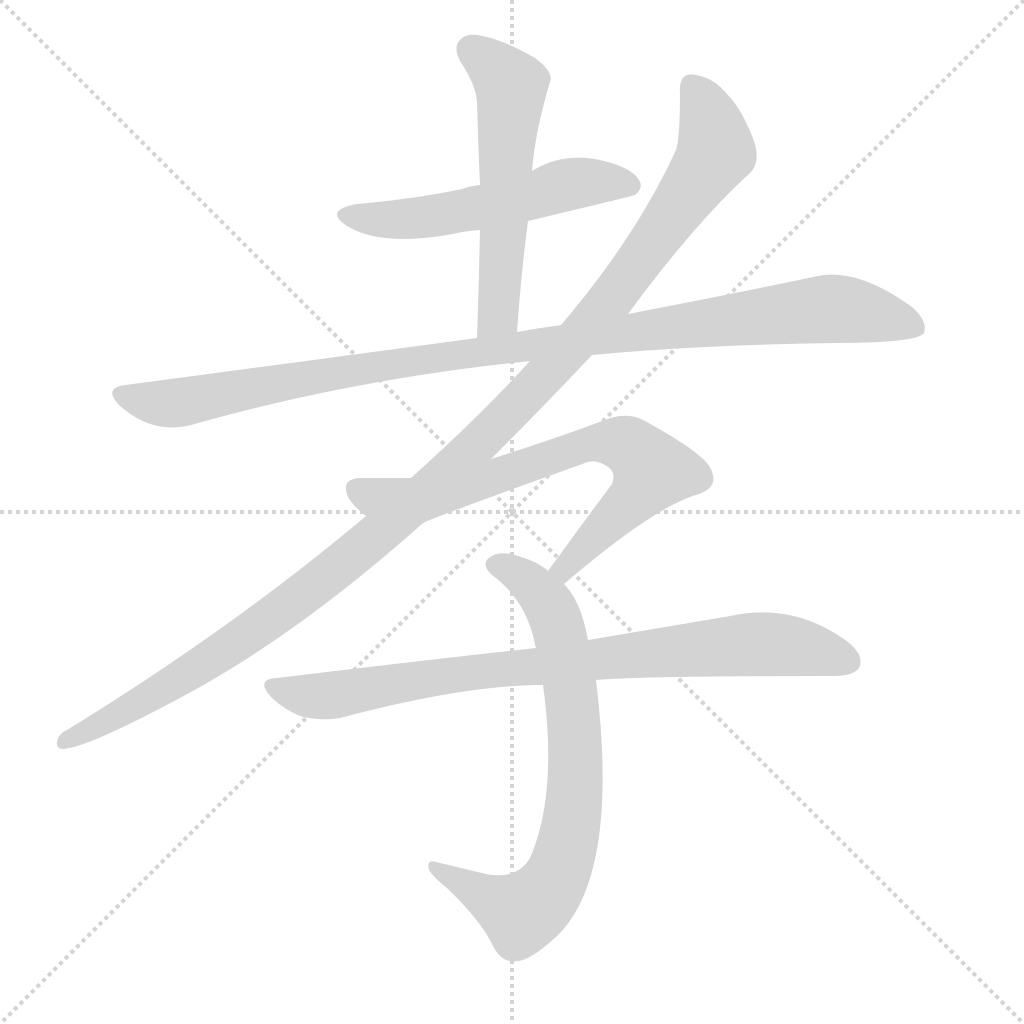
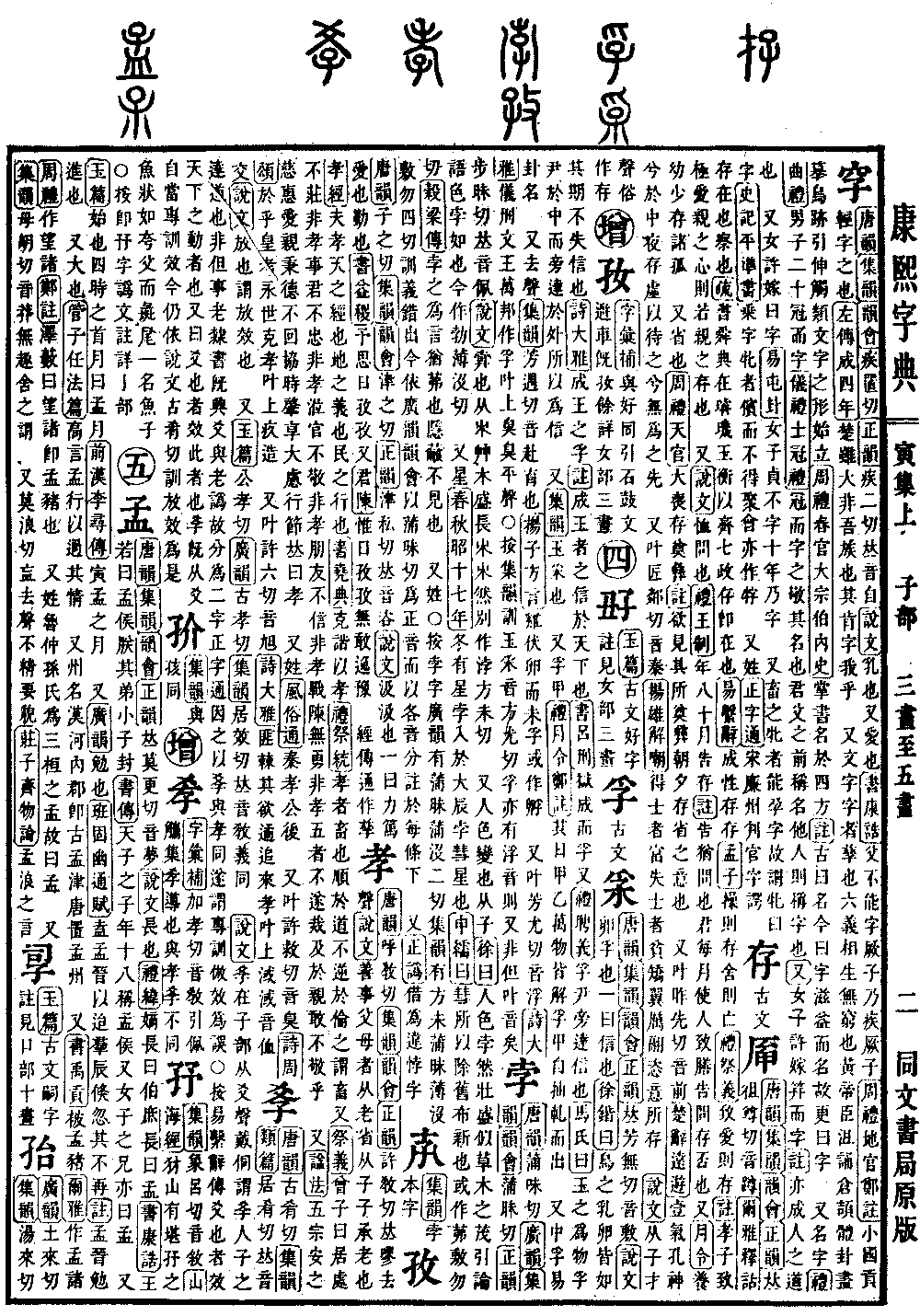
Yin Collection, Upper Volume
Radical: Child (zǐ)
Kangxi Strokes: 7
Page 278, Entry 11
Pronounced xiao (falling tone).
Shuowen Jiezi: One who excels at serving their parents. The character form is composed of an abbreviated form of old and child, representing children serving the elderly.
Classic of Filial Piety (Xiaojing): The way of filial piety is the constant principle of heaven, the criterion of the earth, and the conduct of the common people.
Book of Documents (Shujing), Canon of Yao: Harmony is achievable because of filial piety.
Book of Rites (Liji), Record of Sacrificial Rites: Filial piety is providing nourishment. Following the path and not violating moral obligations is called nourishment.
Also from the Book of Rites (Liji), Record of the Meaning of Sacrifices: Zengzi said: To be undignified in daily life is not filial; to be unfaithful when serving a ruler is not filial; to be disrespectful while holding public office is not filial; to be untrustworthy when dealing with friends is not filial; to be cowardly in battle is not filial. If one fails in these five aspects, disaster will implicate one's parents; how can one not be cautious?
Also in the System of Posthumous Titles: One who can bring peace to kin within the five degrees of mourning, who is compassionate and benevolent, who loves their parents, who maintains virtue without violation, who conforms to the times to establish a foundation, and who possesses deep wisdom and practices integrity—such a posthumous title is called Xiao.
Also a surname.
Customs and Traditions (Fengsu Tong): Originates from the descendants of Duke Xiao of Qin.
Also phonetically shifted to be pronounced chou.
Book of Odes (Shijing), Odes of Zhou: Ah, the great ancestral father, forever able to fulfill the way of filial piety. Rhymes with the preceding lines' jiu and zao.
Also phonetically shifted to be pronounced xu.
Book of Odes (Shijing), Greater Odes: Not rushing to satisfy private desires, but reflecting on the filial piety of the ancestors. Rhymes with the preceding line's yu, where yu is pronounced xu.