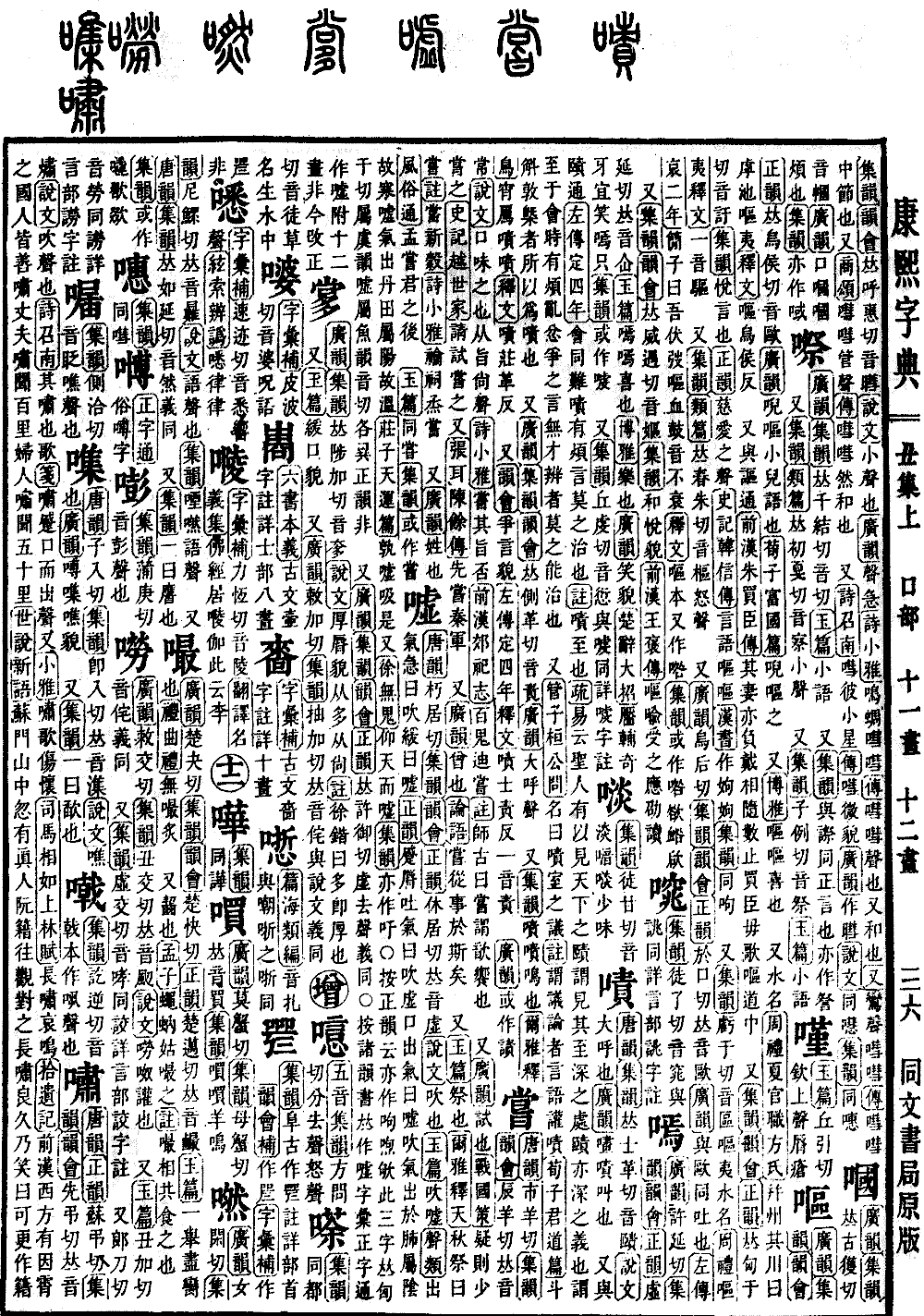
Chou Collection, Upper Volume
Radical: Mouth (kǒu)
Xiao
Kangxi stroke count: 15
Page 206, Entry 01
Pronounced xiao (falling tone).
In the Shuowen Jiezi (Shuowen), it is defined as the sound of whistling.
Book of Odes (Shijing), Shao Nan section: His whistling is like a song.
The commentary notes: To whistle is to purse the lips and produce a sound.
Also in the Xiao Ya section: Whistling and singing, grieving the heart.
Sima Xiangru, Shanglin Fu: A long whistle and a mournful cry.
Shiyi Ji: During the Former Han dynasty, there was a land in the west called Yin-Xiao, where the people were all skilled at whistling. The whistling of a man could reach over a hundred li away, and that of a woman could reach over fifty li away.
Shishuo Xinyu: A true man suddenly appeared in the Sumen Mountains. Ruan Ji went to visit him and whistled at him for a long time. The man smiled and said: You may whistle again. Later, when Ruan Ji had exhausted his intent to whistle, he retreated to about halfway down the mountain, when he heard a clear sound from above, like several sets of wind and percussion instruments playing together, echoing endlessly throughout the valleys and forests. When he looked back, it was the same man whistling.
Also pronounced su (entering tone).
Blowing air as if singing.
Book of Odes (Shijing), Wang Feng section: There is a woman separated from her husband, she whistles mournfully.
The Shiven notes: The character xiao was originally written as a variant form (xiao).
Also pronounced chi (entering tone).
Same as the character for scold (chi).
Book of Rites (Liji), Nei Ze section: Do not whistle, do not point.
See the detailed annotation for the character for scold (chi) above.
The character for xiao is composed of the radical for mouth (kou) and the phonetic element (qiu).
The character for xiao has sixteen strokes.