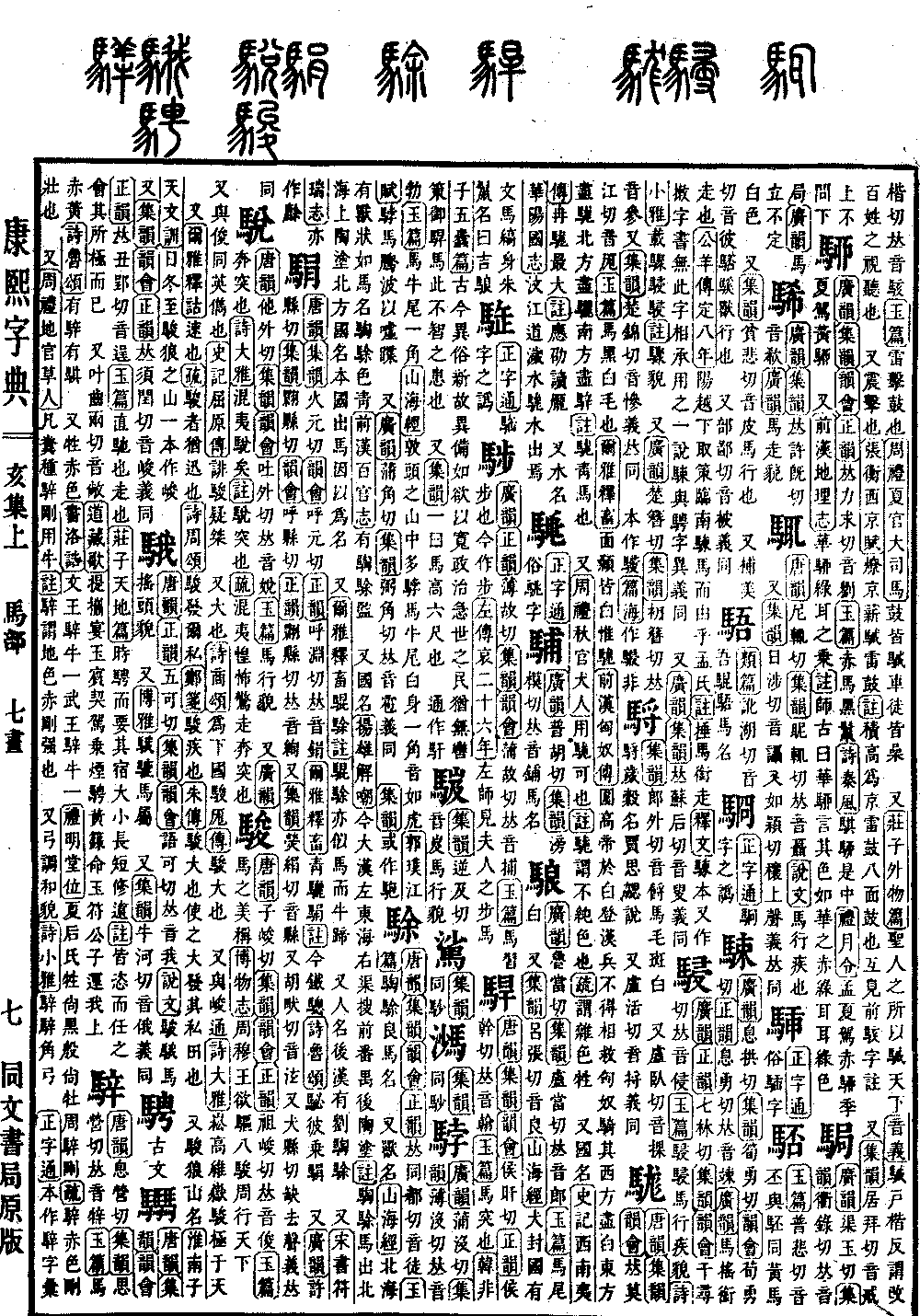
Hai Collection, Upper Volume
Radical: Horse (mǎ)
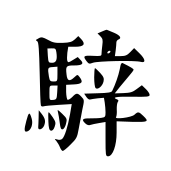
Entry: xing
Kangxi stroke count: 17
Page 1439, Entry 30
Pronounced xing
In the Yu Pian (yù piān), it refers to the reddish-yellow hair color of a horse.
In the Book of Odes (shǐ jīng): There are reddish-yellow horses and dappled grey horses.
It also refers to the reddish color of livestock used for sacrificial purposes.
In the Book of Documents (shàng shū): King Wen used one reddish cow, and King Wu used one reddish cow.
In the Book of Rites (lǐ jì): During the Xia Dynasty, sacrificial animals favored black, the Yin Dynasty used white bulls, and the Zhou Dynasty used strong reddish bulls.
Commentary: Xing means reddish color; gang means strong.
In the Rites of Zhou (zhōu lǐ): For all fertilizing of seeds, the bone marrow of cattle is used for hard, reddish soil.
Annotation: Xing refers to soil that is reddish in color and hard in texture.
It is also used to describe a bow that is well-adjusted.
In the Book of Odes (shǐ jīng): The horn-bow is well-adjusted.
In the Zhengzitong (zhèng zì tōng): Originally written in a variant form, but the Zihui (zì huì) erroneously abbreviated it as xing.
Textual research: In the Book of Rites (lǐ jì), regarding the sacrificial animals of the Xia Dynasty favoring black, the text formerly stated that the Yin Dynasty favored bulls; it has been corrected to white bulls according to the original text.