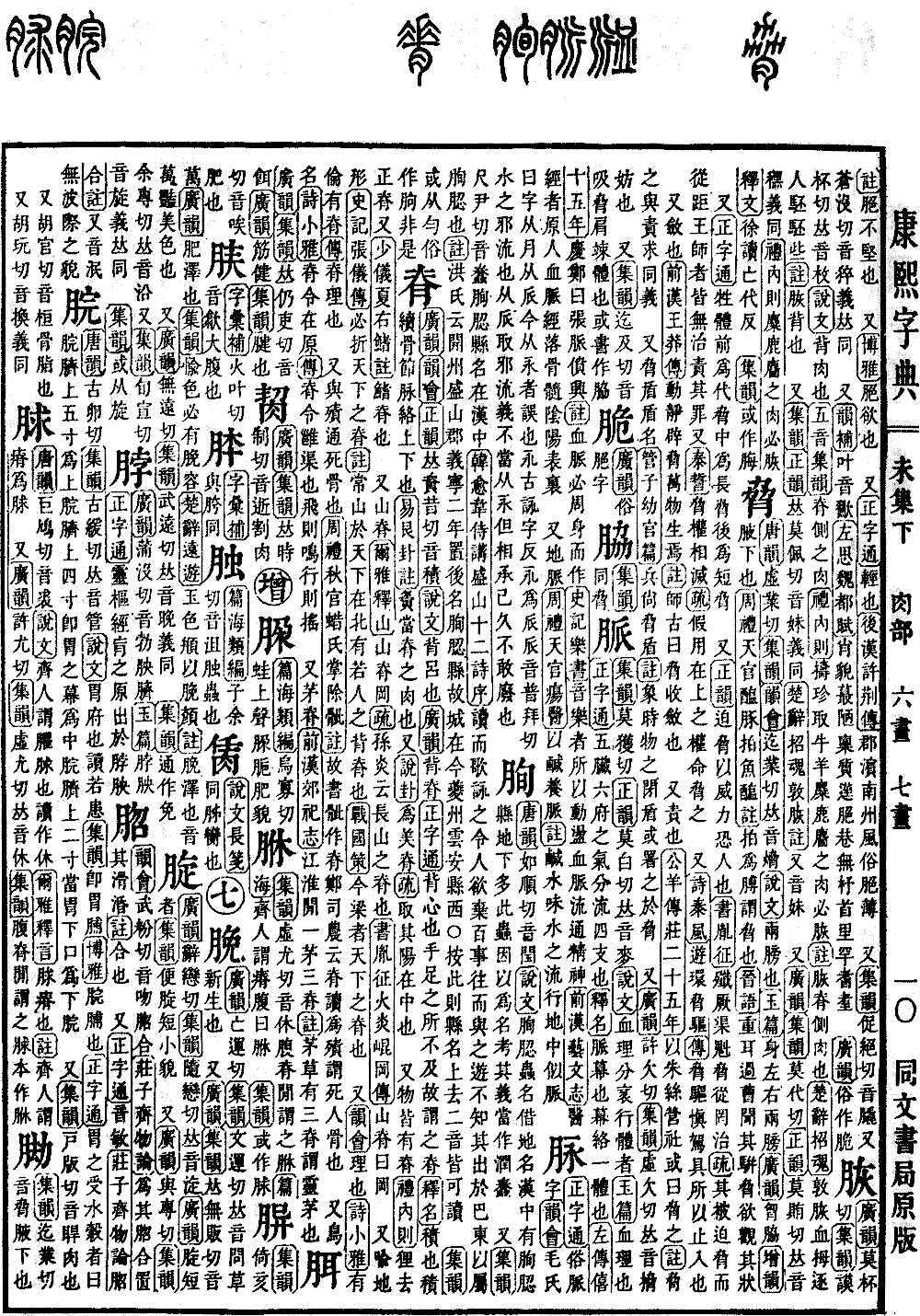
Wei Collection, Lower Volume
Radical: Meat (ròu)
Kangxi stroke count: 12
Page 982, Entry 02
Pronounced xie
Shuowen Jiezi (Explanation of Simple and Compound Characters): The two sides of the torso.
Yupian (Jade Chapters): The two sides of the body, left and right.
Guangyun (Broad Rhymes): The chest and sides.
Zengyun (Additional Rhymes): Below the armpits.
Book of Rites (Zhouli), Heaven Officials, commentary on mincemeat and fish paste: Bo means shoulder, which refers to the sides.
Discourses of the States (Jinyu): When Chong'er passed through Cao, he heard that the ruler had joined ribs and wished to observe this physical trait.
Zhengzitong (Correct Character Dictionary): In the carcass of a sacrificial animal, the front is called the dai-xie, the middle is called the chang-xie, and the back is called the duan-xie.
Zhengyun (Standard Rhymes): To threaten, meaning to terrorize people using power or force.
Book of Documents (Shangshu), Expedition of Yin: Exterminate their ringleaders, but those who followed under duress shall not be punished.
Sub-commentary: Those who were coerced and followed, resisting the royal forces, are not to be held accountable for their crimes.
Great Speech (Taishi): Coercing the power of authority to destroy one another.
Sub-commentary: To borrow the mandate of authority held by those above in order to coerce others.
Book of Odes (Shijing), Odes of Qin: The guide rings on the sides drive the carriage.
Commentary: Side-driving refers to the harness equipment used to keep the horses in line.
To gather or collect.
History of the Former Han Dynasty (Qianhan), Biography of Wang Mang: When it moves or remains still, it gathers and collects, and the myriad things are born.
Commentary: Shigu said that xie means to collect.
To reproach or demand.
Gongyang Commentary (Gongyangzhuan), 25th Year of Duke Zhuang: They encircled the altar with a red silk cord; some say this was to coerce them.
Commentary: To coerce them has the same meaning as to demand something from them.
Xie-dun, a type of shield.
Guanzi (The Book of Master Guan), Young Officials Chapter: The military honors the xie-dun.
Commentary: It represents the closing shield of the season's nature; some say it is worn at the side.
Pronounced xie
To obstruct.
Pronounced xi
Xie-jian, to shrug the shoulders and retract the body.
Sometimes also written in a variant form (xié).