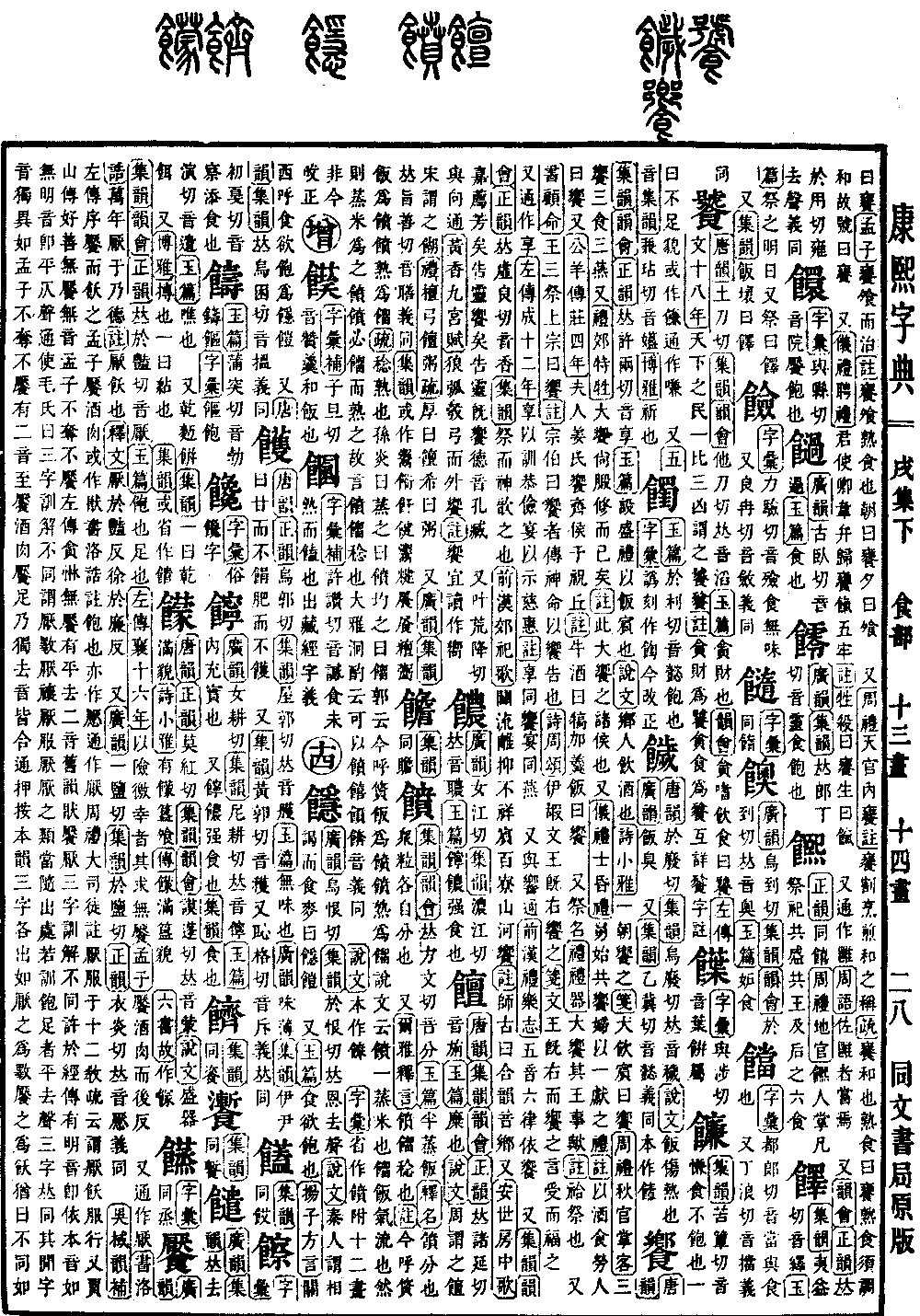
Xu Collection, Lower Volume
Radical: Food (shí)
Kangxi Strokes: 22
Page 1426, Entry 12
Pronounced xiǎng.
In the Tang Rhymes (Tangyun), Collection Rhymes (Jiyun), Rhyme Compendium (Yunhui), and Correct Rhymes (Zhengyun), the pronunciation is listed as xu lǎng, meaning xiǎng.
According to the Jade Chapters (Yupian), to set out a grand banquet to feed guests. According to the Analytical Dictionary of Characters (Shuowen), for villagers to drink wine together.
In the Book of Odes (Shijing), Xiaoya: One morning, [the king] feasted them. The Commentary (Jian) states: A grand banquet for guests is called xiang.
In the Rites of Zhou (Zhouli), Autumn Offices, Keeper of Guests: Three grand banquets, three meals, and three entertainments.
Also, in the Book of Rites (Liji), Jiao Te Sheng: For the grand banquet, one values the dried meat and nothing else. The Commentary (Zhu) states: This refers to the grand banquet for the feudal lords.
In the Ceremonial Rites (Yili), Marriage Rites of the Scholars: The parents-in-law treat the bride to a banquet, using the ceremony of a single offering. The Commentary (Zhu) states: Providing wine and food to honor people is called xiang.
In the Gongyang Commentary (Gongyangzhuan), Year 4 of Duke Zhuang: Lady Jiang feasted the Duke of Qi at Zhuqiu. The Commentary (Zhu) states: To provide beef and wine is called gao (reward); to add soup and rice is called xiang.
Also, a name for a sacrifice. In the Book of Rites (Liji), Ritual Vessels: Is the grand banquet not the king’s business? The Commentary (Zhu) states: It is a collective sacrifice (jia).
In the Book of Documents (Shujing), Testamentary Charge: The king offered three libations; the chief ancestral priest said, [The spirits] have accepted it. The Commentary (Zhu) states: The ancestral priest calling it xiang means to convey the mandate of the spirits and announce it through the banquet.
In the Book of Odes (Shijing), Zhou Song: Great is King Wen, he has accepted the sacrifice. The Commentary (Jian) states: King Wen has accepted and enjoyed the sacrifice, meaning he received it and blessed it.
Also used interchangeably with xiang (to offer). In the Zuo Commentary (Zuozhuan), Year 12 of Duke Cheng: Offerings are used to teach respect and frugality, banquets are used to demonstrate compassion and kindness. The Commentary (Zhu) states: Xiang is the same as xiang; yan is the same as yan.
Also used interchangeably with xiang (to echo/sound). In the History of the Former Han (Qianhan Shu), Treatise on Rites and Music: The five tones and six pitch-pipes echo in brilliance.
Also, in the Collection Rhymes (Jiyun), Rhyme Compendium (Yunhui), and Correct Rhymes (Zhengyun), the pronunciation is listed as xu liáng, meaning xiāng.
According to the Collection Rhymes (Jiyun): When sacrificed, the spirits enjoy the fragrance.
In the History of the Former Han (Qianhan Shu), Hymns for the Suburban Sacrifices: Avoiding the turbulent, suppressing the inauspicious. Honoring the hundred officials, the mountains and rivers accept the sacrifice. The Commentary (Zhu) by Shigu states: In the unified rhyme scheme, it is pronounced xiāng.
Also, in the Anshi Chamber Hymns: The fine offerings are fragrant, the spirits are informed and accept the sacrifice. Once the spirits are informed and have accepted it, the virtuous sound will be most excellent.
Also, it rhymes with huāng jiàng, used interchangeably with xiàng (to face/towards). In Huang Xiang’s Rhapsody on the Nine Palaces (Jiugong Fu): The wolf-bow is drawn and directed outward. The Commentary (Zhu) states: Xiang should be read as xiàng.