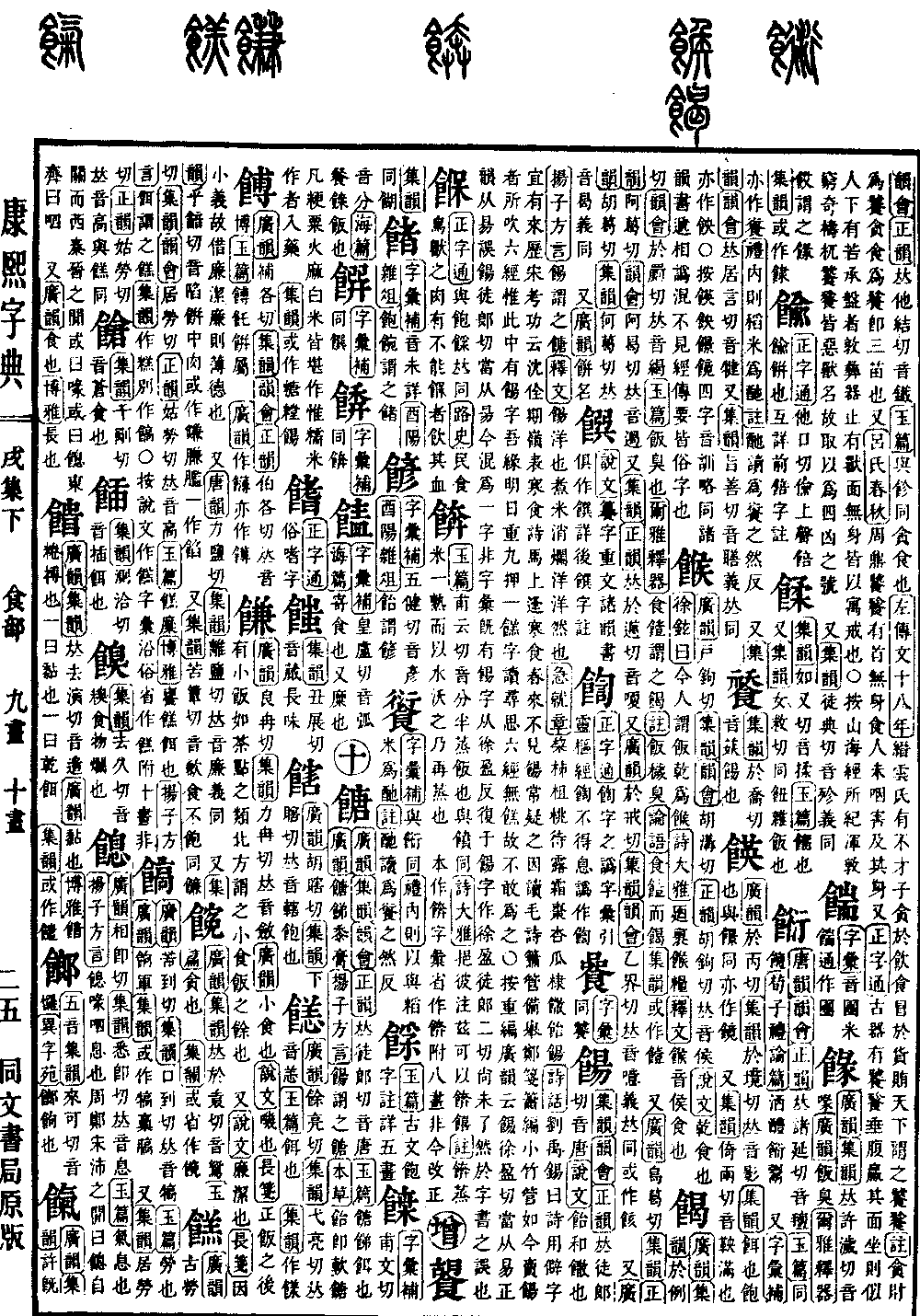
Xu Collection, Lower Volume
Radical: Food (shí)
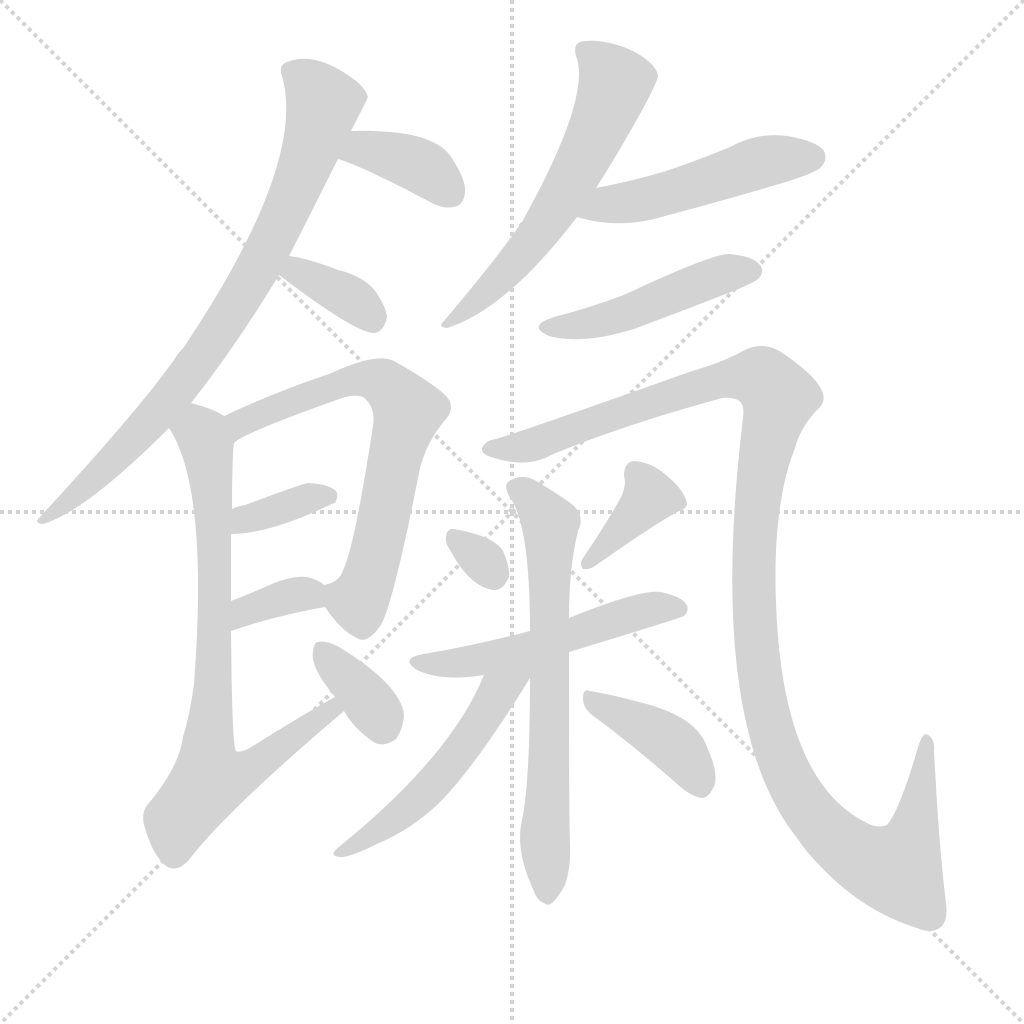
Character: xi
Kangxi strokes: 19
Page 1423, Entry 41
Pronounced xi.
Broad Rimes (Guangyun) and Collected Rimes (Jiyun): xu ji. Rhyme Collection (Yunhui): yu ji.
Jade Chapters (Yupian): To provide provisions or rations.
Book of Rites (Zhouli), Autumn Offices (Qiuguan), Master of Ceremonies (Siyi): To provide cooked meats and raw rations. Commentary: Small ritual gifts are called sun; large ritual gifts are called yong xi.
Discourses of Zhou (Zhouyu): The granary official presents rations. Commentary: This refers to grain and rice.
It also refers to live sacrificial animals. Ceremonial Rites (Yili), Rites of Hosting (Pinli): To provide rations according to the proper ritual. For a high-ranking guest, a full banquet is provided; for general supplies, fodder and grain are given; the entourage all receive rations. Commentary: Whenever a live animal is gifted to someone, it is called xi. Xi implies to receive or to bind.
Sub-commentary: According to the scripture, the host state sends a high official to present cooked meats and rations. The five-fold sacrifice states: one set of cooked food, two sets of raw meat, and two sets of live rations at the west gate. Zheng’s commentary says: Xi means live. For an ox or sheep, it is led by the right hand; for a pig, it is driven from the east; thus, a live sacrificial animal is called xi. In the Analects (Lunyu), regarding the sacrificial sheep for the announcement of the new moon, Zheng’s commentary also states: A live sacrificial animal is called xi. In the Spring and Autumn Commentary (Chunqiu Zhuan), regarding the offering of the stone ox, Fu’s commentary also states: It is a live animal. Thus, any live sacrificial animal is called xi. In the thirty-third year of Duke Xi of the Spring and Autumn Annals (Chunqiu), Zheng Huangwuzi says: The led sacrificial animals are exhausted. Fu considers raw meat to be called xi because it is contrasted with the act of leading, so he defines xi as raw meat. The Preface to the Book of Odes (Shijing) states: Although there are sacrificial animals and cooked rations. Zheng says: Raw meat is called xi, because it is contrasted with the live animal, so he defines xi as raw meat.
Discourses of Lu (Luyu): Horse fodder should not contain weeds. Commentary: This refers to feeding.
According to the Explaining Graphs and Analyzing Characters (Shuowen), the character is originally written with the element for air. Xi refers to providing fodder and rice to guests. The people of Qi came to provide rations to the feudal lords, as seen in the tenth year of Duke Huan of the Spring and Autumn Annals (Chunqiu). Sometimes written with the food radical as xi, or with the element for completion as the character, or borrowing the character for completion; the meaning is the same. It is now commonly written as xi.
Textual verification: The text cites the Earth Offices (Diguan), Master of the Multitude (Situ) section for the granary official presenting rations. This is actually found in the Discourses of Zhou (Zhouyu), not the Earth Offices of the Book of Rites (Zhouli). The reference has been corrected to Discourses of Zhou. In the Sub-commentary to the Ceremonial Rites (Yili), the citation of the Spring and Autumn Commentary (Chunqiu Zhuan) regarding the hiding of the stone ox has been corrected according to the original text.