Xu Collection, Upper Volume
Radical: Gate (mén)
Kangxi Strokes: 20
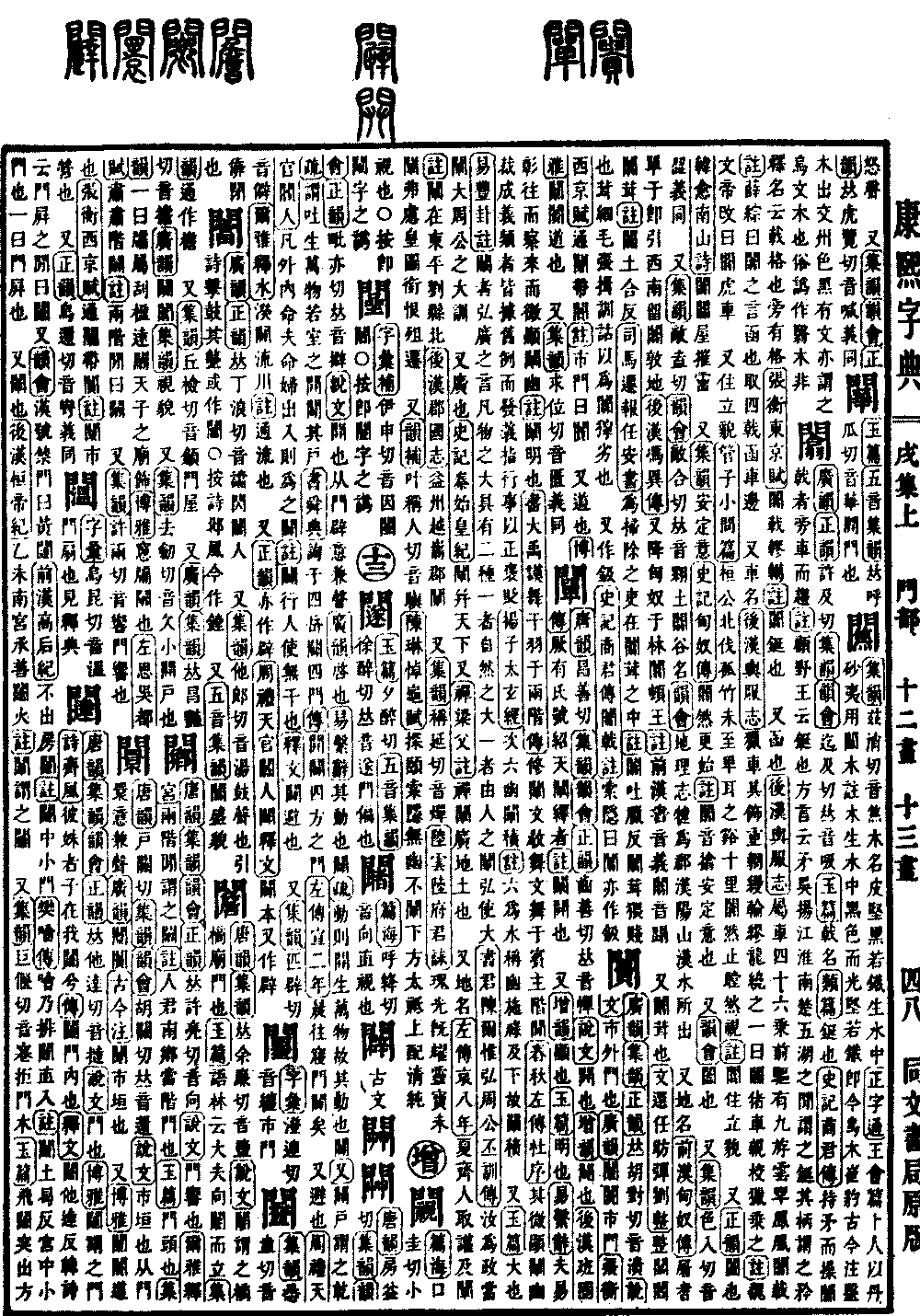
Page 1342, Entry 03
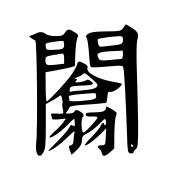
Pronounced xi.
According to the Yupian (Jade Chapters), it refers to a type of halberd.
According to the Leipian (Classified Chapters), it is explained as a short spear (chan).
The Records of the Grand Historian (Shiji), Biography of Shang Yang, records: Carrying a spear and holding a halberd, running beside the carriage. The commentary cites Gu Yewang, who identifies it as a short spear. The Fangyan (Regional Dialects) states: In the regions of Wu, Yang, Jianghuai, Southern Chu, and the Five Lakes, a spear is called a short spear, and its handle is called a jin. The Shiming (Explanation of Names) states: A halberd (ji) means to block or grid, having horizontal branches on the sides.
Zhang Heng in his Rhapsody on the Eastern Capital (Dongjing Fu) wrote: The halberds are tangled and crossed. The commentary states that the term refers to the short spear.
It also carries the meaning of to contain or a casing.
The Book of the Later Han (Hou Hanshu), Treatise on Carriages and Attire, records: There are forty-six escort carriages, with nine banners and phoenix-patterned halberd casings on the lead carriage. The commentary cites Xue Zong, who says it means a container, referring to four halberd cases mounted on the side of the carriage.
It is also the name of a type of carriage.
The Book of the Later Han, Treatise on Carriages and Attire, records: Hunting carriages have heavy wheels with interlocking dragon patterns painted on them. One type is called the pig-hunting carriage, which the Emperor used for his personal hunts. The commentary notes that Emperor Wen of Wei changed the name to the tiger-hunting carriage.
It also describes the appearance of standing still or stopping.
The Guanzi, Small Inquiries chapter, records: When Duke Huan marched north against the Guzhu state, before he had reached a point ten miles from the Er Stream, he suddenly stopped and stared. The commentary states: This means the appearance of standing still or stopping.
According to the Zhengyun (Correct Rhymes), it means to close or shut.
Han Yu in his Nanshan Poem wrote: The house collapses with a thud.
According to the Jiyun (Collected Rhymes), it means to be stable or peaceful.
The Records of the Grand Historian, Biography of the Xiongnu, contains the phrase: Peacefully beginning anew. The commentary states: Pronounced differently, it means stable.
According to the Yunhui (Collection of Rhymes), it means to close or shut.
According to the Jiyun, it is also pronounced se. The meaning is the same.
According to the Jiyun, it is also pronounced di. According to the Yunhui, it is pronounced di. It refers to Tu-ta, the name of a mountain valley.
The Yunhui cites the Treatise on Geography: In Jianwei Commandery, Hanyang Mountain is the source of the Han River.
It is also a place name.
The Book of the Former Han (Qian Hanshu), Biography of the Xiongnu, records: Shanyu Tuqi marched southwest and remained in the place called Tadun.
The Book of the Later Han, Biography of Feng Yi, records: He also subjugated the Xiongnu King Yulin Tadun. The commentary cites the Qian Hanshu Yinyi (Meaning of Sounds in the Former Han Book), noting it is pronounced ta.
There is also the term ta-rong, used to describe someone who is base or inferior.
The Selection of Literature (Wenxuan), Ren Fang's Impeachment of Liu Zheng, contains the phrase: Zheng is a base person among the villagers. The commentary says: Pronounced tu-he.
Sima Qian in his Letter in Reply to Ren An wrote: Serving as a sweeping official, among the base and inferior. The commentary says: Pronounced tu. The term describes someone who is lowly or base. Rong refers to fine hair. The exegetical notes of Zhang Yi interpret it as meaning vulgar or inferior.
Sometimes also written in a variant form (chan).
In the Records of the Grand Historian, Biography of Shang Yang, the commentary Suoyin states: It is also written as a variant character.